Union worker killed in truck incident as disputes over subcontracting, bargaining rights intensify
Labor groups call death systemic failure, not isolated incident

The death of a cargo trucker during a labor protest in southern South Korea has reignited debate over the "Yellow Envelope" law, raising questions about whether recent revisions have meaningfully addressed long-standing tensions in the country's labor system.
On Monday, a union member in his 50s was killed and two others were injured at a logistics center in Jinju, South Gyeongsang Province, after being struck by a 2.5-ton truck during a sit-in protest.
The protest was organized by the Cargo Truckers Solidarity, affiliated with the Korean Confederation of Trade Unions, which has been demanding direct negotiations with BGF Retail, operator of South Korea's major convenience store chain CU.
The dispute centers on whether the company should engage directly with the drivers.
Police said the accident occurred as protesters attempted to block vehicles from leaving the site. A nonunion driver in his 40s was detained on suspicion of injury, and authorities are reviewing whether to seek an arrest warrant as part of an ongoing investigation.
The National Police Agency has formed a special investigative team and launched a separate internal probe into whether police actions at the scene may have contributed to the fatal collision.
Authorities and labor groups have since offered sharply different accounts of how the incident unfolded.
Clashing accounts
The union disputes the police account, alleging that officers forcibly dispersed protesters to allow replacement vehicles to pass, creating conditions that led to the fatal collision.
Labor groups say the victim, identified as a regional union leader, had been involved in prolonged efforts to secure negotiations with BGF Retail.
According to union officials, workers had requested dialogue at least seven times before launching a strike earlier this month. They say the company instead reduced workloads and deployed substitute vehicles, further escalating tensions.
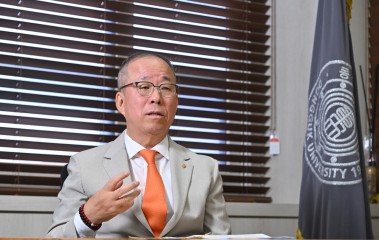
"This is not an accident but a structural tragedy," Um Gil-yong, head of the Korean Public Service and Transport Workers' Union, said during a Tuesday press briefing.
"The revised labor law provisions were written with the blood of countless cargo workers, yet another worker has now lost his life," Um said, accusing both the company and public authorities of responsibility.
"This is not just a problem of an individual company, but one that reflects the current administration's approach."
Structure behind the dispute
The case reflects a broader dispute over employer responsibility in a multilayered subcontracting system.
The logistics center where the incident occurred is operated by BGF Logis, the logistics subsidiary of BGF Retail. BGF Logis supplies goods through contracts with regional transport firms, while drivers are classified as "special employment" workers — effectively freelancers — who sign individual contracts and are paid per delivery.
The union argues that despite this structure, BGF Retail exercises effective control over operations and should therefore be treated as the negotiating party. BGF Retail, however, maintains that it does not qualify for employer status under the current contractual arrangement.
Following the implementation of the revised labor law, the union called on the company to enter direct negotiations. Workers have staged daily protests outside the logistics center since April 5, but the company has not entered talks, according to union officials.
Limits of the law
The incident has drawn renewed attention to the Yellow Envelope law, a revised set of labor regulations intended to expand workers' rights to collective bargaining.
The amendments to the Trade Union and Labor Relations Adjustment Act aim to clarify employer responsibility in complex subcontracting arrangements and limit companies' ability to pursue excessive damages against striking workers.
In practice, the changes were meant to allow subcontracted and "special employment" workers, such as delivery drivers, to negotiate directly with companies that exert real control over their working conditions.
However, the Jinju case is being cited by labor groups as evidence of a gap between legal intent and enforcement.
Despite the revisions, the union has been unable to secure direct negotiations with BGF Retail, underscoring what critics describe as the law's limited impact on entrenched contracting structures.
Government response
The government has drawn a clear line between the incident and the revised law.
The Ministry of Employment and Labor said the case "goes beyond issues related to employer recognition under the revised law."
Officials also noted that cargo truckers are often classified as independent contractors, complicating the application of traditional labor protections.
"The fundamental issue lies in the lack of a structured system for dialogue among stakeholders," the ministry said.
The incident comes just days after efforts to reopen communication channels between labor and management, raising concerns that tensions could escalate further.
Labor groups have called for accountability and preventive measures, framing the case as a test of the government's commitment to worker safety and labor rights.
jychoi@heraldcorp.com