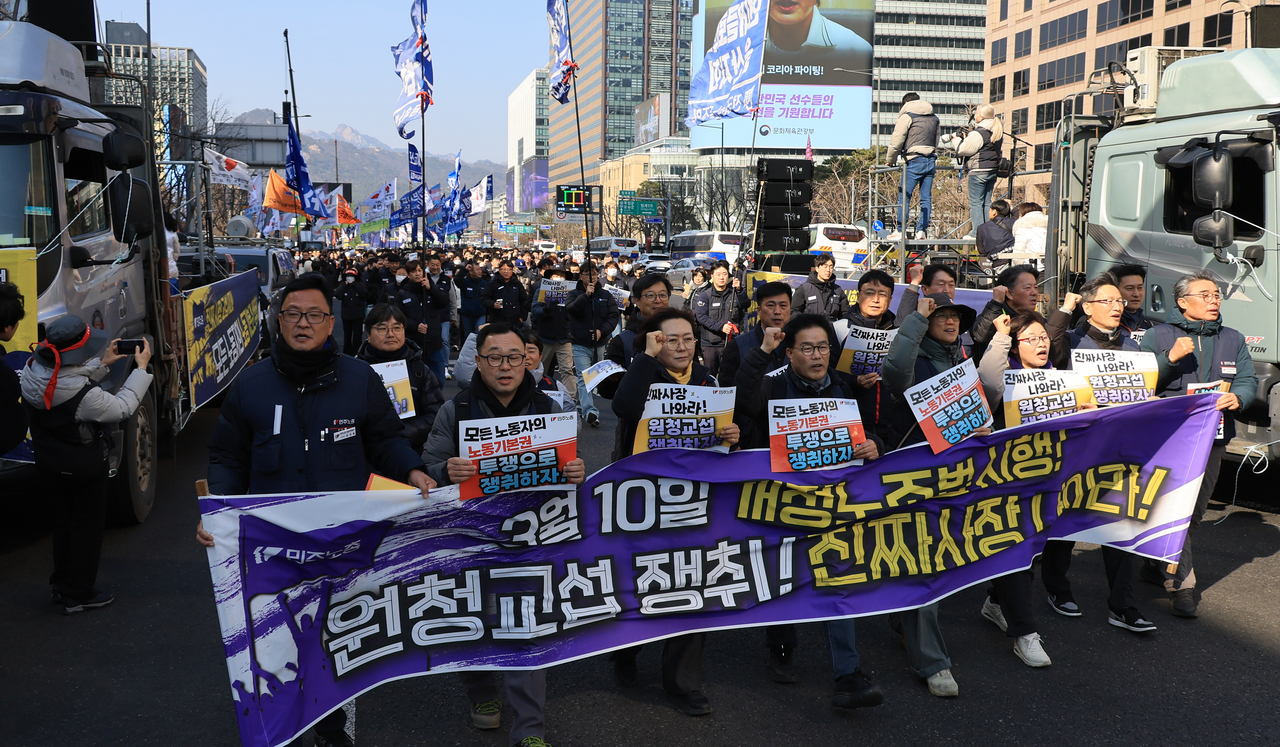
Labor groups on Friday welcomed the first ruling by a regional labor relations commission recognizing contractors’ obligation to negotiate with subcontracted workers, saying the decision could accelerate similar demands across industries.
The response followed a decision a day earlier by the Chungnam Regional Labor Relations Commission, which found that four public institutions had de facto employer relationships with subcontracted workers in areas such as safety management and workforce deployment.
The institutions include the Korea Institute of Nuclear Safety, the Korea Atomic Energy Research Institute, the Korea Asset Management Corporation and the Korea Research Institute of Standards and Science.
The ruling -- the first since amendments to the Trade Union and Labor Relations Adjustment Act, known as the “Yellow Envelope Act,” took effect on March 10 -- requires the institutions to respond to collective bargaining demands from subcontracted workers.
“Despite their status as public institutions, they attempted to revise contract language and adjust supervisory practices in ways that could undermine union bargaining demands and avoid employer responsibility,” an official from the Korea Confederation of Trade Unions said.
“With this decision, we will step up efforts to expand negotiations between contractors and subcontracted workers across workplaces.”
Given the institutions’ public-sector nature, where working conditions are largely shaped by government policy, negotiations are expected to remain limited to areas such as safety conditions.
Still, bargaining demands from subcontracted workers are likely to increase across public institutions, where maintenance and support functions are widely outsourced under similar arrangements.
The decision, which cited contractors’ control over safety conditions, has also raised concerns among private companies about potential labor disputes involving subcontracted workers. Firms are already responsible for subcontractor safety under laws such as the Occupational Safety and Health Act and the Serious Accidents Punishment Act.
When the government was drafting detailed guidelines for the law in January, the Korea Enterprises Federation argued that fulfilling legal obligations to prevent workplace accidents should not be interpreted as exercising control over workers.
As bargaining demands rise, related cases are also increasing. A total of 267 cases had been filed with the National Labor Relations Commission as of Monday, according to Rep. Cho Ji-yeon of the main opposition People Power Party.
forestjs@heraldcorp.com