After months of warnings about AI-assisted cheating, the Education Ministry’s last-minute scramble exposed failures in preparation and leadership
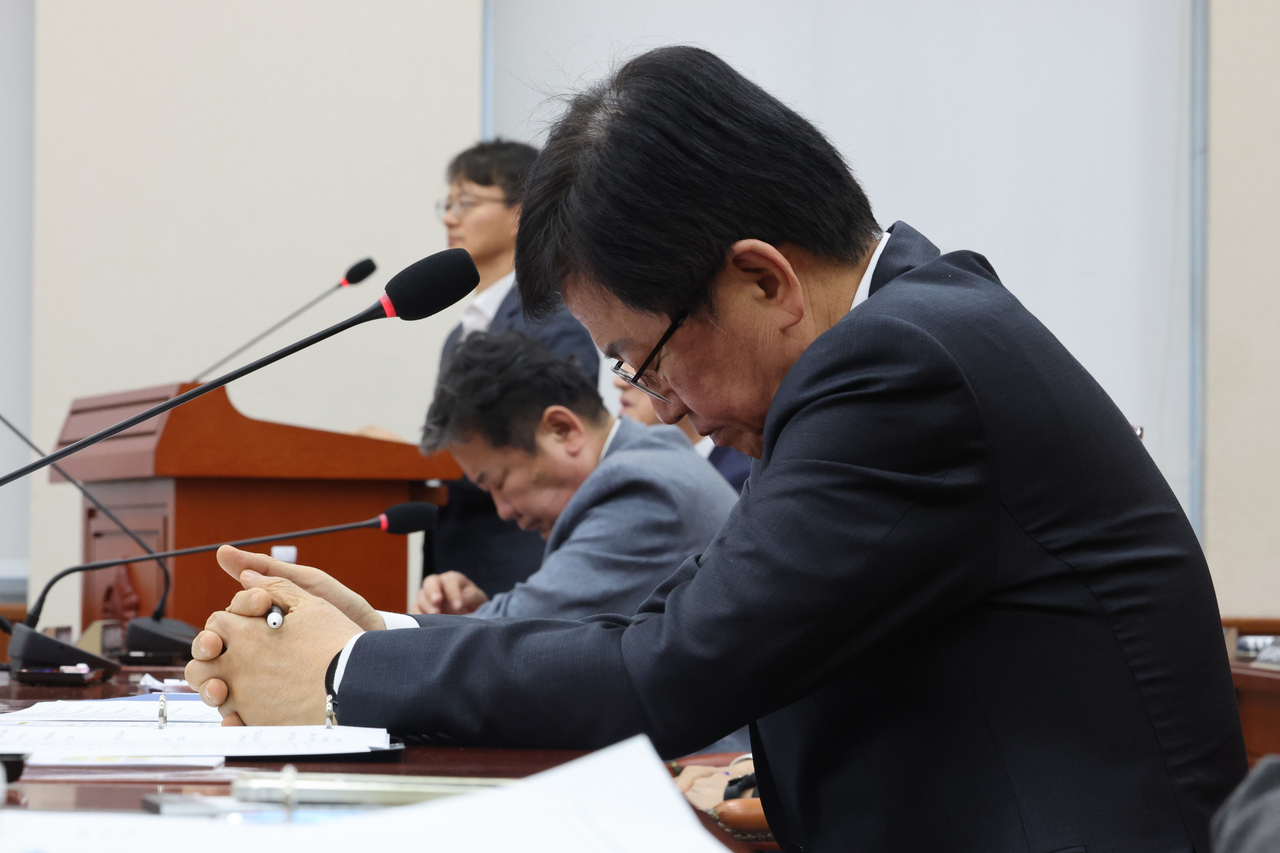
"I don't think I can because of my age."
That was Education Minister Choi Kyo-jin's response at the National Assembly on Monday when asked whether he was confident he could detect every instance of suspicious behavior involving increasingly sophisticated artificial intelligence-powered devices during the national college entrance exam.
Just one day later, on Tuesday, Choi was supposed to announce the government's plan for countering cheating attempts.
But when Prime Minister Han Seong-sook took over to deliver a nationally televised announcement of emergency anti-cheating measures that day, Choi was nowhere to be seen. Instead, Vice Education Minister Choi Eun-ok accompanied Han and answered journalists' questions.
Local broadcaster MBN reported that a message visible on Choi's phone during a Cabinet meeting earlier in the day indicated that the presidential office had expressed concerns and that the prime minister's office had decided to proceed with the briefing with the vice minister, rather than Choi.
Choi's absence from the public continued through Thursday's College Scholastic Ability Test, or Suneung.
His planned visit to encourage students at a testing center was abruptly canceled, while Vice Minister Choi Eun-ok again took the podium, appearing at two briefings Thursday to explain the government's preparations and announce the number of students caught cheating.
"The figures are very specific statistical data, so we thought it would be best for working-level officials to respond," a senior Education Ministry official told reporters when asked why the minister was absent from the briefings.
"The minister has been monitoring the situation since this morning and making decisions on matters that require his attention," the official added.
Choi's disappearance was particularly conspicuous given his pledge at Monday's parliamentary hearing to stake the ministry's fate on ensuring that the Suneung proceeded without incident.
His absence from the public eye, however, was merely the most visible symptom of a much larger problem.
What unfolded in the days leading up to Thursday's exam was a striking display of administrative incompetence by a ministry that had ample warning of an emerging threat but failed to adequately prepare until the last moment.
A crisis hiding in plain sight
The threat was neither new nor unpredictable.
As early as April 2025, smart glasses had been used to cheat on the Test of Proficiency in Korean. Similar incidents subsequently emerged in national technical qualification examinations, with five cases identified by the Human Resources Development Service of Korea.
In April this year, The Korea Herald reported that miniature earpieces were being marketed online to help test-takers cheat on the TOPIK.
By October, smart-glasses cheating allegations had surfaced at universities, further highlighting how easily such devices could undermine exam integrity.
The Education Ministry was not entirely oblivious. It had explicitly prohibited smart glasses at this year's Suneung and instructed proctors to inspect suspicious eyewear.
But much of its response still rested on the assumption that human supervisors could identify devices deliberately designed to escape human detection.
When lawmakers challenged that approach on Monday, Choi defended experienced exam proctors' ability to identify suspicious behavior.
Such confidence in individual teachers was difficult to justify when miniature cameras, wireless earphones and increasingly sophisticated smart glasses were already available to potential cheaters. That was especially so when the country's top education official — a former teacher — said even he did not think he could detect every instance of cheating.
The ministry's shortcomings became even more apparent as the exam approached.
On Monday, just three days before the Suneung, Choi told lawmakers that he would consult the Science Ministry about whether wireless signals could be blocked at testing centers.
At the same time, an Education Ministry official was telling reporters that signal jamming was not being considered due to legal and technical limitations. The ministry later clarified that Choi had been referring to the shutdown of public Wi-Fi networks.
That the country's top education official was still discussing the feasibility of such a fundamental security measure three days before the exam raises an obvious question: What exactly had the ministry been doing during the preceding months?
Last minute measures, long-standing problems
As concerns mounted over miniature cameras and wireless earphones, the government convened emergency meetings, announced the deployment of 8,400 additional proctors and ordered closer inspections of students' belongings and clothing.
Prime Minister Han announced additional measures on Tuesday, two days before the exam, including stronger Wi-Fi monitoring and checks of students' glasses, collars, sleeves and buttons.
Even on the eve of the exam, the government was announcing additional restrictions on stationery and arrangements to supply permitted writing instruments.
The barrage of rushed announcements risked creating precisely the uncertainty the ministry was supposed to prevent.
More troubling was the government's failure to establish the legal and technical foundations for stronger screenings in advance.
Officials acknowledged that comprehensive searches of students' belongings and bodies faced legal obstacles, while specialized radio-frequency detection equipment remained under consideration for future examinations.
There are legitimate reasons why such measures cannot be introduced overnight. Intrusive searches raise privacy concerns, while radio-frequency screening requires technical validation and consideration of possible interference.
But those constraints were hardly unforeseeable.
Other examination authorities had already begun responding. The Human Resources Development Service of Korea conducted a simulated cheating exercise involving radio-frequency detectors in September, while authorities overseeing driver's license examinations moved to introduce similar equipment.
The National Institute of International Education had also begun rolling out electronic device-screening at TOPIK sites.
If additional legal authorization, technical assessments or funding were necessary, why had the ministry not addressed those requirements months earlier?
Instead, teachers were left to shoulder much of the responsibility.
They were expected to distinguish ordinary eyewear from smart glasses, identify devices concealed in clothing and monitor suspicious behavior, all while supervising an exam involving more than half a million students.
Teachers' groups repeatedly warned that the measures placed an excessive burden on individual proctors and exposed them to potential legal disputes.
Yet the government's most immediate solution was essentially to ask teachers to look harder.
A test of accountability
According to the ministry's figures Friday, 111 electronic-device-related violations were detected during the exam, including five cases involving smart-device use.
One test-taker was caught using smart glasses, while another was found with a miniature camera and wireless earphones.
The figures do not establish that AI was successfully used to obtain answers, nor do they prove that the ministry's policies were entirely ineffective. Indeed, the detection of prohibited devices suggests that some safeguards worked.
But catching individual offenders is only one part of the government's responsibility.
It has a greater obligation to anticipate emerging threats, establish clear procedures and ensure that both students and supervisors can approach the exam with confidence.
No government can reasonably be expected to anticipate every technological innovation or eliminate every possibility of cheating.
But there is a fundamental difference between confronting an unforeseen threat and failing to prepare for one that has been repeatedly demonstrated in other state examinations.
As the ministry prepares for next year's Suneung, it owes students, parents and teachers more than promises of tougher penalties and better visual inspections.
It needs to demonstrate that it still has the capacity to prepare for and prevent predictable crises. Why were key decisions on exam security still being made days before the Suneung despite repeated warnings from other exams?
The education minister owes the nation an answer.
seungku99@heraldcorp.com