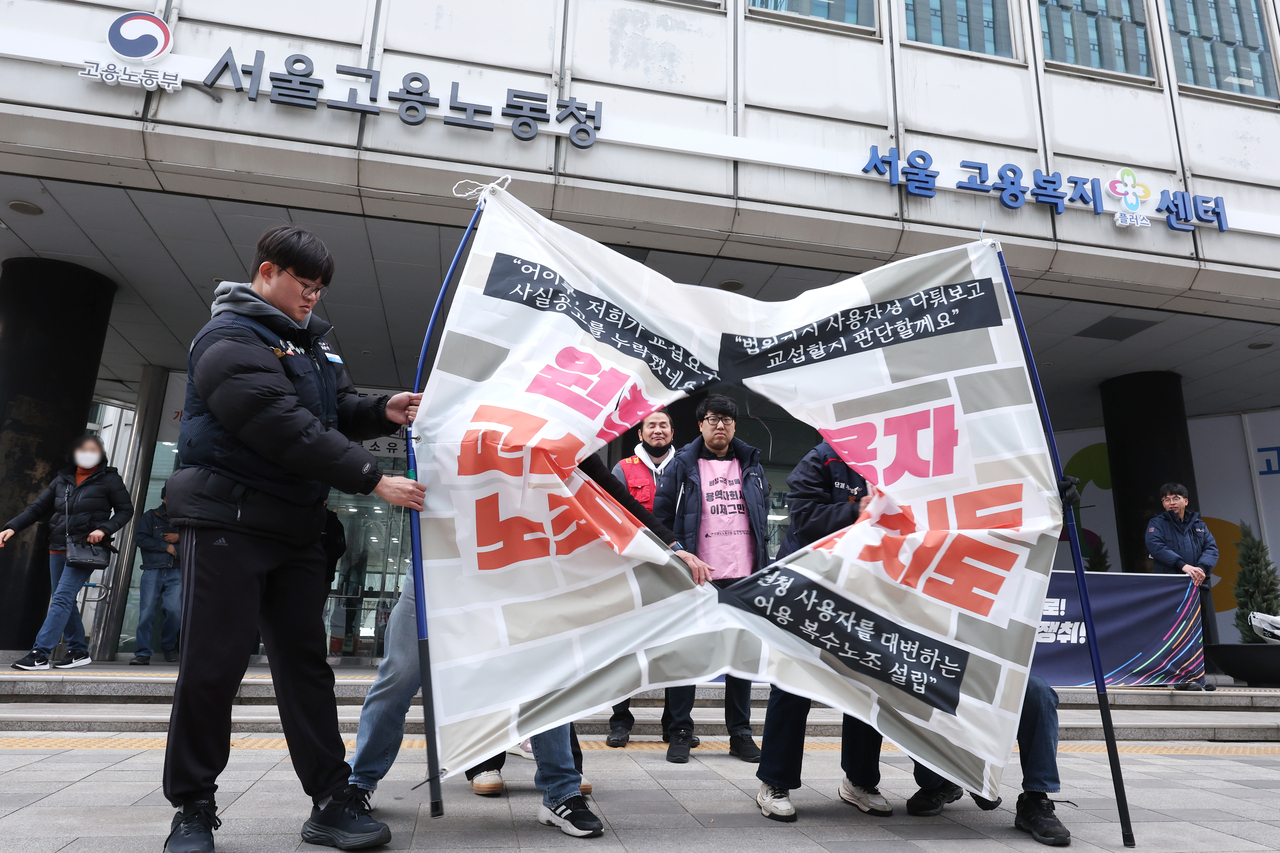
The government’s major revision to labor law took effect Tuesday, allowing subcontractors to negotiate directly with contractors and expanding the scope of permissible labor disputes. But mixed views persist over potential disruptions to business operations.
The government promulgated the revision to the Trade Union and Labor Relations Adjustment Act, commonly called the "Yellow Envelope" bill, on Sept. 9. 2025. Since then, authorities have continued to clarify ambiguous provisions in the law, easing some of the initial opposition from businesses, including domestic companies and foreign firms operating in Korea.
Labor groups say the initial impact of the law is unlikely to be significant, citing the relatively low unionization rate among subcontractors and a provision requiring a unified bargaining window among subcontractor unions.
Businesses, however, continue to raise concerns over unclear provisions and the risk that expanded labor disputes could hamper operations, noting that tensions between companies and labor unions are already posing a significant challenge to business activities.
According to the Ministry of Employment and Labor, the key change in the revision is the recognition of the contractor’s systematic control over subcontractors’ working conditions in labor disputes, allowing subcontractor workers to negotiate directly with the contractor.
Such control may be recognized in cases where the contractor effectively determines working conditions, such as setting working and rest hours, specifying the workforce needed for certain procedures or exerting influence over work processes despite the absence of a direct employment contract.
The provision particularly targets industrial workplaces common in Korea, where employees of contractors and subcontractors work side by side. In such cases, subcontractor workers often face difficulty requesting improvements in facilities or equipment from the contractor, increasing the risk of industrial accidents.
The revision also expands the scope of legitimate labor disputes by including issues related to business restructuring or management decisions that may affect working conditions, as well as disagreements over the interpretation of labor agreements.
At the same time, it limits civil liability claims against labor disputes, which had served as a deterrent to labor actions in Korea.
Businesses have strongly opposed the law, arguing it creates uncertainty for corporate operations amid already intense labor-management conflicts.
They say the expanded concept of employer responsibility could increase the administrative burden on companies by requiring them to negotiate with multiple entities, whereas previously they only dealt with unions representing their own employees.
Labor groups, however, argue that the requirement could create obstacles for subcontractor workers and delay negotiations.
They also claim businesses are exaggerating the potential impact of the law, pointing to the low unionization rate among subcontractor workers. The second-largest umbrella union, the Korea Confederation of Trade Unions, estimated that about 137,000 of its 1.08 million members could participate in negotiations with contractors under the revised law in the initial stage.
Businesses remain concerned, citing a lack of legal precedents and what they describe as the KCTU’s strong determination to push for negotiations, including its plan to stage a general strike on July 15.
"Some labor groups have vowed to demand negotiations regardless of whether employer status can be recognized or whether the bargaining agenda is related to such recognition," the Korea Enterprises Federation said in a statement.
"To maintain at least a minimum level of stability in labor-management relations, excessive demands beyond the scope of recognized employer responsibility and illegal actions to enforce them should be refrained from."
Concerns have also been raised by international companies operating in Korea.
While the European Chamber of Commerce in Korea and the American Chamber of Commerce in Korea warned last year that the Yellow Envelope bill could affect investment in Korea, the chairperson of the French Korean Chamber of Commerce and Industry also expressed concern about confusion during the early stages of enforcement.
Responding to such concerns, the government said the law aims to create a platform for dialogue in disputes that previously led to street protests or illegal actions, as subcontractor workers had little in the way of formal channels to negotiate their working conditions.
forestjs@heraldcorp.com