Kim Jung-kwan rejects claims of one-sided $350b pact, stresses win-win goal in negotiations
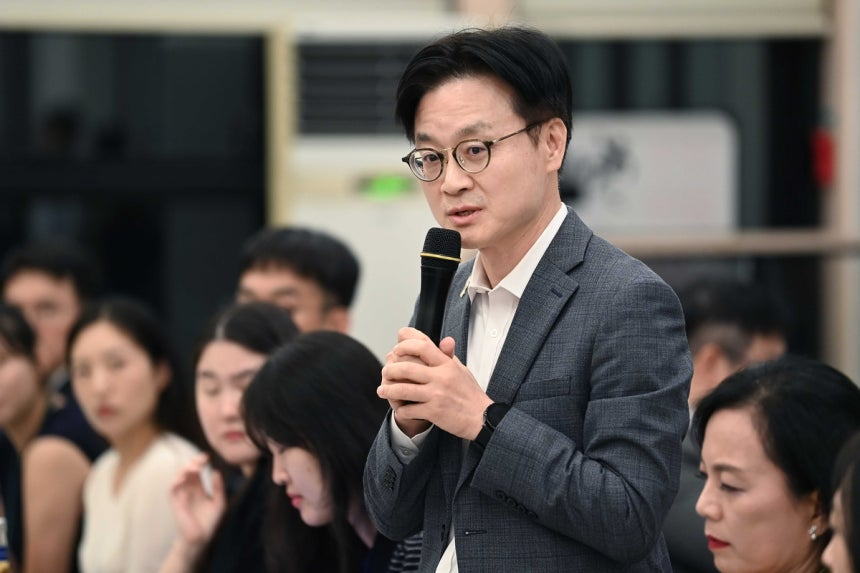
SEJONG — Industry Minister Kim Jung-kwan said Tuesday that South Korea was pushing to secure a win-win deal as negotiations with the United States over a $350 billion tariff pact remain in flux.
At a press briefing, Kim rejected the view that Seoul’s pledge to invest $350 billion in the US — in return for Washington lowering “reciprocal” tariffs from 25 percent to 15 percent — amounts to a one-sided deal.
“Some people think the US will take all of the $350 billion, but that is not the structure,” Kim said, noting that the package includes $150 billion earmarked for the “Make American Shipbuilding Great Again” initiative, which will also benefit Korean firms building facilities in the US.
“The negotiations have been in a push-and-pull process. Both sides are exchanging terms they see as unreasonable or unfair, but the talks are continuing in search of a win-win deal,” he said.
Kim met US Commerce Secretary Howard Lutnick in New York on Sept. 12 to discuss the pact. While the two sides announced the broad outlines of the deal on July 30, differences remain over how to structure Korea’s pledged investment and how returns will be shared.
On speculation that Seoul should redirect the money into subsidies for domestic companies to offset tariff losses, Kim stressed the talks are about more than cash.
He acknowledged the negotiations have been tough but stressed they were critical to shaping Korea’s future, pointing out that Washington under the Trump administration is taking a far more hard-nosed approach than in the past.
He contrasted Seoul’s situation with Japan, which signed a nonbinding memorandum with Washington earlier this month. Tokyo’s deal, Kim suggested, was aimed at securing favorable terms for its auto industry.
The minister also addressed the recent US immigration raid at Hyundai Motor and LG Energy Solution’s joint battery plant in Georgia, where 317 Korean workers were detained. Kim said the issue was raised first in his latest meeting with Lutnick.
“Lutnick said he will ‘fix’ it. It was an embarrassing issue for him personally, and even for President Trump, who is trying to attract foreign investors,” Kim said, noting that the US side expressed regret.
Kim, a former CEO of Doosan Enerbility, also outlined the government’s energy plans. He called for building two large nuclear reactors and one small modular reactor under the 11th Basic Power Plan, reflecting the administration’s pledge for a balanced energy mix.
While the Democratic Party of Korea to which he belongs has often opposed nuclear power, the Lee administration has said nuclear, renewables and climate policy must be pursued together. But Kim voiced regret over the transfer of the Industry Ministry’s energy division to the new Ministry of Climate, Energy and Environment.
“Industry and energy should move organically together, and I believe the energy portfolio should lead environmental policy,” he said. “There will be side effects, but it is our mission to handle them wisely.”
Kim underlined that despite hurdles, Seoul remains committed to both advancing tariff talks with Washington and ensuring Korea’s energy competitiveness.
herim@heraldcorp.com