US President Donald Trump's administration said Monday it will start implementing a lowered tariff of 15 percent on Japanese automobiles this week in line with a bilateral trade deal.
In a notice posted on the Federal Register, the International Trade Administration under the Commerce Department said that the reduced tariff rate will go into effect Tuesday -- an enactment after Trump's signing of an executive order earlier this month to officially implement the deal with Japan.
Under the deal, the United States has agreed to lower tariffs on Japanese automobiles and parts to 15 percent from the current 27.5 percent -- the rate that comprises the existing 2.5 percent tariff and the global sector-specific duty of 25 percent.
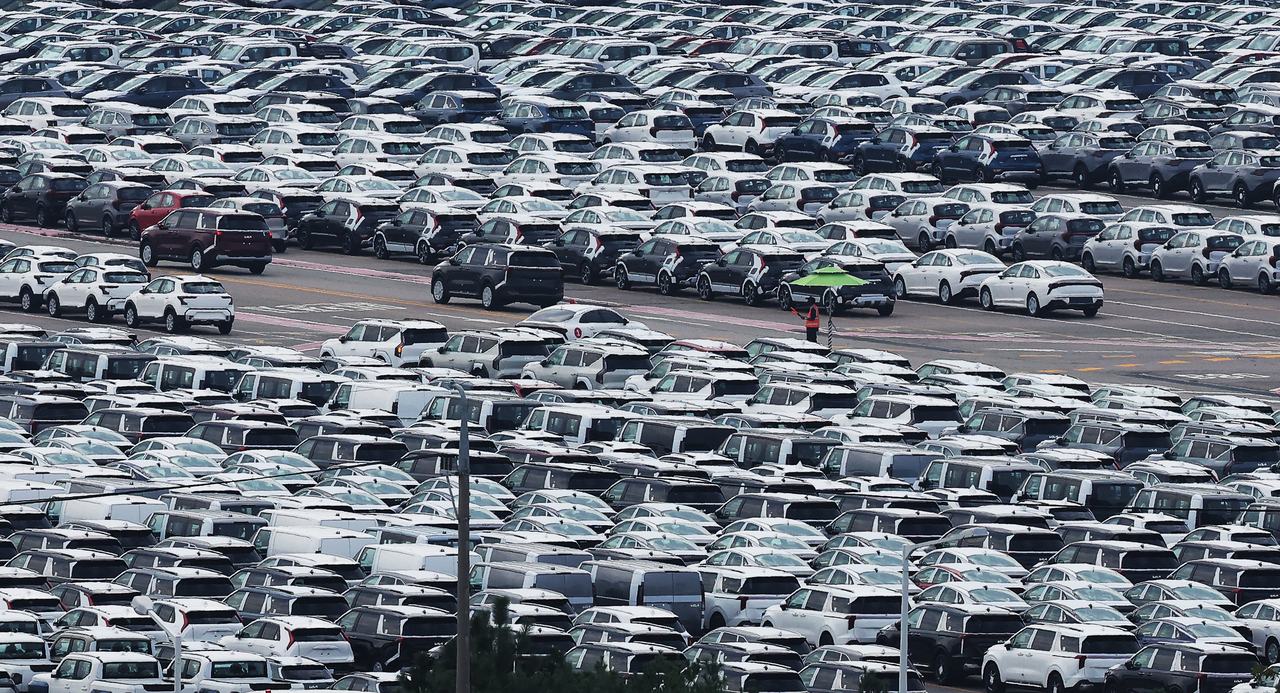
Currently, South Korean autos are subject to the sectoral tariff of 25 percent that the Trump administration has put in place under Section 232 of the Trade Expansion Act of 1962 -- a law that gives the president authority to adjust imports when he determines they threaten to impair national security.
The US has also agreed to lower the tariff on South Korean autos to 15 percent as part of a bilateral trade deal struck in July, but it remains uncertain when the deal will go into force amid negotiations over its specifics.
Upon arrival in the US on Monday, Korea's Trade Minister Yeo Han-koo underscored Seoul's ongoing efforts to ensure that the auto tariff reduction can also be implemented for Korean cars "as quickly as possible."
"As we are in the negotiation process, we will stay level-headed," he told reporters as he plans to meet US Trade Representative Jamieson Greer and other US officials to engage in follow-up negotiations on the July trade deal.
The U.S. is a top auto export market for South Korea.
Of South Korea's total car exports last year, exports to the US were tallied at $34.7 billion, or 49.1 percent. Hyundai Motor Group and GM Korea exported around 970,000 and 410,000 units to the US, respectively, last year. (Yonhap)










