Seoul emphasizes national interest amid stalled talks, while Georgia raid adds strain on alliance
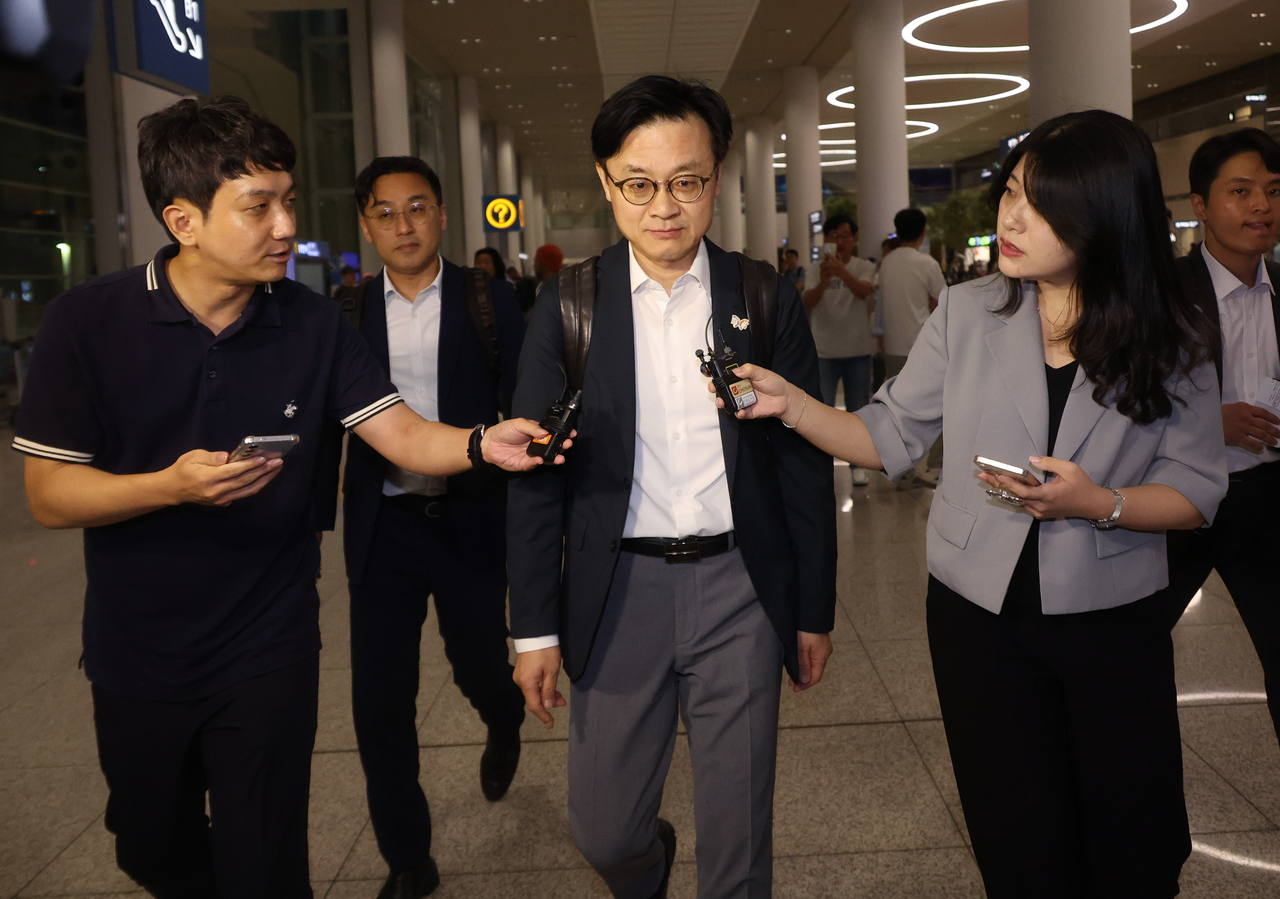
South Korea’s industry minister returned from the US on Sunday with no apparent progress on follow-up negotiations for a multibillion-dollar investment deal meant to ease tariff tensions, suggesting the high-profile agreement remains stalled and raising concerns that the prolonged deadlock could complicate tariff relief for Korean exporters.
Industry Minister Kim Jung-kwan arrived at Incheon Airport early Sunday morning after meeting with US Commerce Secretary Howard Lutnick in New York. Kim had been in the US since Thursday to hash out the details of Seoul’s pledged $350 billion investment there in exchange for Washington reducing its “reciprocal” tariffs from 25 percent to 15 percent.
Kim remained silent when reporters at the airport asked about progress in the talks. He met with Lutnick twice in New York, but neither side disclosed any progress, fueling speculation that key disagreements remain unresolved.
The trade deal, initially struck in July, was broadly reaffirmed when President Lee Jae Myung and US President Donald Trump held their summit in Washington last month.
However, in the absence of a written contract, specific details of the agreement -- including how the fund will be structured and how profits will be shared -- remain unsettled.
South Korea’s presidential chief of staff for policy, Kim Yong-bum, admitted last week that the two sides are at an “impasse” over details of the deal, during a forum organized by the Korea Broadcasting Journalists Club.
The presidential office took a cautious stance Sunday, stressing that negotiations must prioritize Seoul’s national interest.
“The officials have called the process ‘total package’ tariff negotiations because it is not the kind of talks that pursue a fixed goal, rather both sides are continually putting forward new conditions and trying to strike an optimal balance,” presidential spokesperson Kang Yu-jung told reporters during a press briefing, describing the approach as finding a “zero point” or “equilibrium.”
She added that only when Korea’s “national interest is best preserved and upheld” will there be something meaningful to share with the public.”
“All I can say is that the negotiation involve many variables.”
The two governments are said to be split over the investment structure.
Seoul wants to reduce upfront equity commitments by using loans and guarantees from state-run financial institutions such as the Export-Import Bank of Korea and the Korea Trade Insurance Corp., while Washington is pushing for a higher proportion of direct investment and also demanding control over which projects are selected. But Seoul is against this, arguing that Korean firms should decide based on business feasibility.
Escalating the pressure, Lutnick said in a CNBC interview on Thursday that “there is no flexibility” when it comes to the deal and that Seoul should either accept the deal or see tariffs rise back to 25 percent.
"The Koreans didn't sign when the president was in. ... You remember that he came to the White House. Notice how we didn't talk about trade because he didn't sign the piece of paper," Lutnick said, referring to Lee’s Aug. 25 visit to Washington for his summit with Trump.
"I mean, the devil is in the details. I think they saw the Japanese now, so there's no flexibility. The Japanese signed the contract," he added. "The Koreans either accept that deal or pay the tariffs. Black and white. Pay the tariffs or accept the deal."
Kim, however, has stressed that Seoul cannot agree to terms similar to Japan’s $550 billion investment deal signed last week, pointing to the economic differences between Korea and Japan as well as adverse effects on Seoul’s foreign exchange market.
“The economic scale of Korea and Japan, and more fundamentally, their foreign exchange markets, are very different,” Kim said at the forum. “The Japanese (yen) is a reserve currency, and its foreign exchange reserves are three times those of Korea. The circumstances are different.”
Kim added that if Seoul were to follow Washington’s terms, it would need to raise $350 billion in the foreign exchange market, but realistically Korea can only raise $20 billion to $30 billion.
The $350 billion also equals 84 percent of South Korea’s foreign reserves of $416.3 billion as of the end of August, a level experts say is practically impossible to raise without risking a dollar shortage and potential financial instability.
The talks have been also been overshadowed by tensions following a massive immigration raid on Sept. 4 at a Hyundai Motor-LG Energy Solution battery plant in Georgia, where more than 300 Korean workers were detained.
The workers, after a week in custody at an immigration detention center, were released and returned home Friday, but the incident rattled public sentiment in South Korea toward the US while heightening uncertainties for businesses in their US activities.
President Lee suggested that South Korean businesses would hesitate to build new factories in the US if Washington does not ease its visa requirements.
Sources say Industry Minister Kim raised concerns over the immigration raid to Lutnick, and stressed that visa rules need to be improved for Korean companies to invest in the US with confidence.
sahn@heraldcorp.com