Kim Jong-un's surprise visit to China fuels speculation over renewed US-North Korea diplomacy, but analysts differ on Beijing's willingness to mediate
South Korean and US watchers are diverging on the possibility of Beijing playing a role in reviving US-North Korea talks, as speculation rises following North Korean leader Kim Jong-un's surprise visit to China.
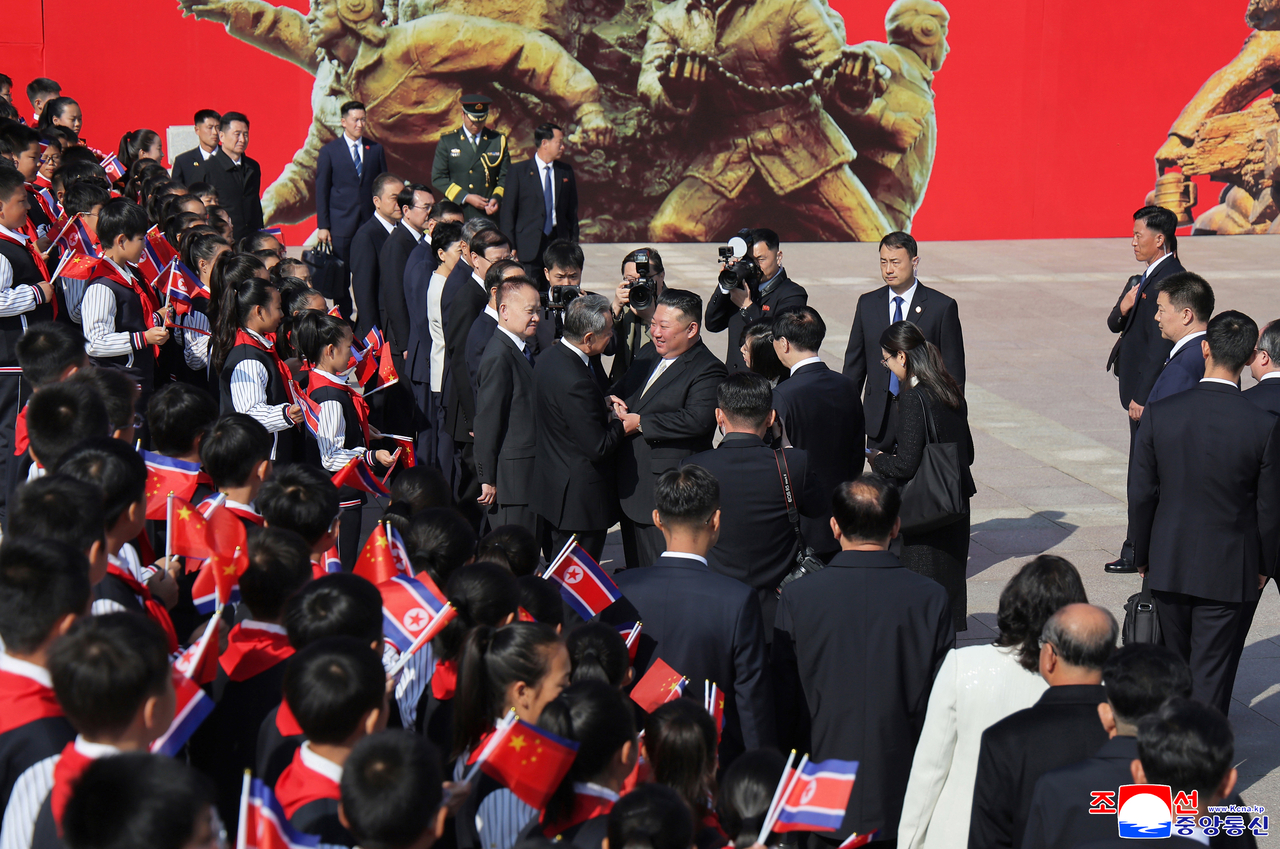
Kim made an unannounced, one-day visit to the Chinese border city of Dandong on Saturday, meeting Wang Huning, chairman of the Chinese People's Political Consultative Conference, and touring the New Yalu River Bridge and a local automobile factory.
Although Kim did not meet Xi, the unusually high-level diplomatic delegations accompanying the visit have prompted speculation that the two countries may have discussed potential US-North Korea negotiations behind the scenes.
The possibility of Chinese mediation was raised in a report released Monday by the state-run Korea Institute for National Unification.
Joung Eun-lee, head of the institute's North Korea Research Division, suggested that Kim's Dandong visit may have involved preliminary coordination for a potential summit with US President Donald Trump who is expected to attend the Asia-Pacific Economic Cooperation summit in Shenzhen next month.
Joung pointed to the participation of North Korean Foreign Minister Choe Son-hui and North Korean leader's sister Kim Yo-jong, alongside senior Chinese officials, including Wang Huning, Wang Yi and Liu Haixing, head of the Communist Party's International Department.
Although neither country publicly mentioned the US or South Korea in connection with the visit, Joung wrote in the report that the composition of the delegations "draws attention to the possibility of President Xi Jinping mediating dialogue between North Korea and the United States."
She also suggested that Xi could have a political incentive to facilitate renewed diplomacy, particularly as he prepares to seek a fourth term as China's leader at the Communist Party's 21st National Congress next fall.
Successfully brokering US-North Korea talks could allow Xi to claim a diplomatic achievement in stabilizing the Korean Peninsula while strengthening his domestic political standing, according to the report.
Similar assessments have emerged within the South Korean government, with senior officials acknowledging that potential US-North Korea dialogue may have been discussed during Kim's visit.
During a parliamentary audit Tuesday, Foreign Minister Cho Hyun acknowledged the possibility that Pyongyang and Beijing had discussed renewed US-North Korea dialogue, citing the presence of senior Chinese diplomats, including Foreign Minister Wang Yi and Executive Vice Foreign Minister Ma Zhaoxu, a former Chinese envoy to the United Nations with extensive experience in US affairs.
Unification Minister Chung Dong-young also described Kim's visit as an unusual diplomatic engagement, noting that the participation of senior foreign policy officials from both sides, despite the absence of a formal summit between Kim and Xi, suggested the trip was more than a purely economic event.
Cho, however, cautioned against drawing firm conclusions, noting that previous rounds of US-North Korea summit diplomacy had generally been preceded by meetings between the North Korean and Chinese leaders. He also confirmed that Beijing had not notified Seoul of Kim's visit in advance.
However, US-based experts offered a more skeptical assessment, questioning both the prospects for an imminent diplomatic breakthrough and Beijing's willingness to play an active mediating role.
Sydney Seiler, a senior adviser at the Center for Strategic and International Studies and a former US national intelligence officer on North Korea, said during a CSIS podcast Tuesday that neither Pyongyang nor other major players are "feeling a sense of urgency, to include obviously Kim Jong-un, that the US and DPRK need to talk right now, referring to North Korea by the abbreviation of its official name.
"In fact, there's much to be accomplished by refusing to talk," he added, suggesting that Pyongyang could strengthen its negotiating leverage by keeping Washington waiting.
Seiler was particularly skeptical of the prospect of Xi personally orchestrating a diplomatic breakthrough.
"I just don't see Xi Jinping taking a lot of political risk, like Moon Jae-in style," he said, referring to the former South Korean president's efforts to facilitate the previous rounds of Trump-Kim summit diplomacy. "I don't think China is looking to do that."
Victor Cha, Korea Chair at CSIS, echoed that assessment, suggesting that Beijing might be willing to host a potential summit but would be reluctant to undertake the diplomatic groundwork needed to make one happen.
"They're really not interested in doing any of the heavy lifting," Cha said.
Seiler warned that even if Trump and Kim were to meet, their relationship could deteriorate again within six to 12 months without substantive agreements to sustain the diplomatic momentum.
Still, he did not rule out the possibility of meaningful progress, particularly if Pyongyang returned to negotiations prepared to discuss issues such as arms control.
Under the right conditions, he suggested, negotiations could reduce tensions and make the Korean Peninsula safer even without achieving North Korea's denuclearization.
Seiler also offered an alternative interpretation of Kim's Dandong visit, suggesting that the North Korean leader was seeking to demonstrate his ability to maintain close relationships with both Beijing and Moscow rather than signaling an imminent diplomatic opening with Washington.
Kim may have been seeking to remind Russia that North Korea retains other strategic partnerships and should not be taken for granted, he said.
Even Joung, who raised the possibility of Xi's mediation, acknowledged significant obstacles to a potential summit.
She noted that North Korea might be reluctant to rely on Beijing to facilitate negotiations with Washington out of concern that doing so could disproportionately expand China's influence over Pyongyang.
The lack of a visible response from North Korea to Trump's overtures, along with unresolved questions over a potential summit's venue, format and agenda, also complicated the outlook, she said.
For Seoul, the competing scenarios have raised concerns about the possibility of South Korea being sidelined.
"Both direct negotiations between the US and North Korea and Chinese-led mediation risk narrowing South Korea's diplomatic and security maneuvering room," Joung warned, urging Seoul to take steps to prevent being left out of any renewed diplomatic process.
"Even if President Xi serves as a mediator and President Trump becomes a 'peacemaker,' the South Korean government must maintain a leading role in promoting peaceful coexistence on the Korean Peninsula," she said. "As a 'pacemaker,' Seoul must actively participate in preliminary consultations, negotiations and the implementation of any agreements, while maintaining communication with both Washington and Beijing."
Cho, meanwhile, reiterated Seoul's intention to facilitate renewed dialogue by serving as a "pacemaker" in support of Trump's role as a "peacemaker."
The two analysts used the metaphor coined by President Lee in describing relations between the two countries.
Cho described a potential Trump-Kim summit as a possible catalyst for breaking the current diplomatic deadlock, saying Seoul was consulting with Washington, Beijing and other relevant countries, including Russia, to encourage Pyongyang's return to negotiations.
mkjung@heraldcorp.com