The International Atomic Energy Agency has "positively assessed" South Korea's cooperation on nuclear safeguards and nonproliferation obligations related to its nuclear-powered submarine project, marking what Seoul's Foreign Ministry described Thursday as "a good first step" toward advancing the program.
"The report positively assessed South Korea's cooperation with the IAEA regarding its nuclear-powered submarine program," a Foreign Ministry official responsible for international organizations and nuclear affairs told reporters Thursday.
"The IAEA also confirmed that South Korea had fulfilled its reporting obligations under the Comprehensive Safeguards Agreement and the Additional Protocol," the official, who requested anonymity, added.
The assessment came as the UN nuclear watchdog released its first report on South Korea's plan to develop nuclear-powered, conventionally armed attack submarines, following consultations between Seoul and the agency over safeguards and other nonproliferation requirements.
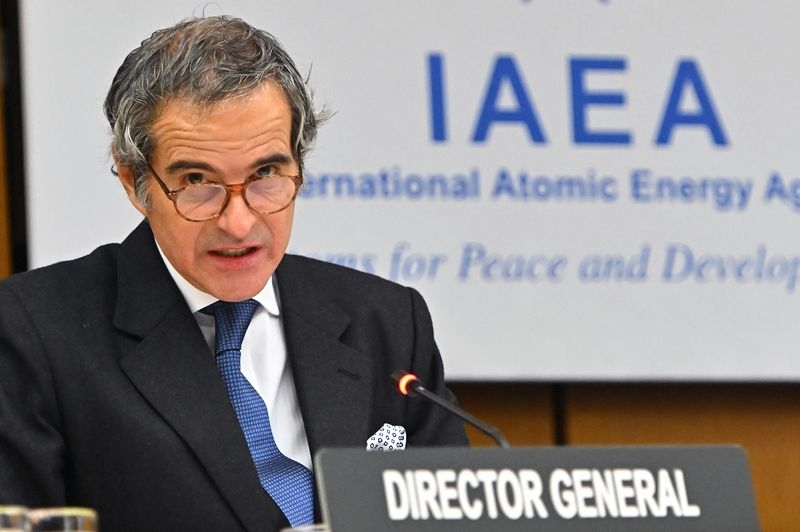
The report, titled "Naval Nuclear Propulsion: Republic of Korea," was issued under the name of IAEA Director General Rafael Grossi on Nov. 9 and circulated among member states, according to the Foreign Ministry. It was subsequently discussed during the agency's regular November Board of Governors meeting in Vienna before being made public Thursday.
The IAEA has published annual reports on Australia and Brazil since 2022 and 2023, respectively, as both countries have pursued consultations with the agency over their nuclear-powered submarine programs. This marks the first such report on South Korea, with similar reports expected to be issued annually to document the progress of consultations.
The report outlines South Korea's communications with the IAEA, its compliance with safeguards reporting obligations and the technical consultations held between the two sides.
"Based on the technical consultations and exchanges of views conducted so far, the IAEA expressed satisfaction with South Korea's cooperation," the Seoul ministry official said.
The official added that Grossi welcomed Seoul's cooperation with the agency and expressed hope for continued engagement to ensure that South Korea fulfills its nuclear nonproliferation and safeguards commitments.
South Korea's nuclear-powered submarine initiative was first announced following a summit between President Lee Jae Myung and US President Donald Trump in Gyeongju in October 2025. Washington subsequently agreed in a joint document to cooperate in meeting the requirements for the project, including arrangements for sourcing nuclear fuel.
Seoul and the IAEA held their first high-level policy consultations in December 2025, followed by South Korea's advance notification to the agency of its basic development plan for nuclear-powered submarines, announced by the Defense Ministry in May.
During preliminary technical consultations in June, South Korea explained the need for a special arrangement under the IAEA safeguards framework to protect classified military information associated with the construction and operation of nuclear-powered submarines.
The two sides held their first formal technical consultations last month, reviewing issues requiring further discussion and decisions, and agreed to continue engagement next year.
"We plan to continue consultations with the IAEA to ensure the faithful implementation of nuclear nonproliferation and safeguards obligations while also ensuring that relevant military secrets are adequately protected," a Foreign Ministry official said.
The IAEA also reaffirmed that South Korea has maintained its "broader conclusion" since 2007, meaning the agency has concluded that all nuclear material in the country remained in peaceful activities.
Under the Nuclear Non-Proliferation Treaty, the CSA requires non-nuclear-weapon states to accept IAEA safeguards to verify that nuclear material is not diverted to nuclear weapons or other nuclear explosive devices. The Additional Protocol, which entered into force for South Korea in 2004, strengthens the agency's verification capabilities by expanding access to information and facilities.
"The government will continue technical consultations with the IAEA under the principle of faithfully fulfilling nuclear nonproliferation and IAEA safeguards obligations throughout the development and operation of nuclear-powered submarines, while maintaining transparent and close communication with the agency," the ministry said.
While the report represents a positive development in Seoul's engagement with the nuclear watchdog, it does not constitute formal approval of the submarine program. Further consultations will be necessary to establish safeguards arrangements that accommodate the use of nuclear material for naval propulsion while protecting sensitive military information.
Moreover, substantive progress on the project will ultimately depend on further negotiations between Seoul and Washington, particularly over nuclear fuel supply and related security arrangements.
Despite the agreement outlined in the South Korea-US Joint Fact Sheet released in November 2025, follow-up bilateral consultations have made little visible progress since the two sides held their first meeting in June, leaving key implementation details unresolved.
mkjung@heraldcorp.com