South Korea on Wednesday reiterated its support for renewed dialogue between US President Donald Trump and North Korean leader Kim Jong-un, saying it stands ready to assist such efforts as speculation mounts over a possible meeting on the sidelines of the Asia-Pacific Economic Cooperation summit in Shenzhen, China.
"South Korea and the United States have consistently maintained that they are open to dialogue with North Korea," a Foreign Ministry official said in response to a question about the possibility of a Trump-Kim meeting during APEC.
"Our government supports US-North Korea dialogue and stands ready to actively assist such efforts if necessary," the official added.
The remarks came as US Secretary of State Marco Rubio said Wednesday that Trump remained willing to meet Kim, although no summit had been scheduled during the US president's visit to China.
Speaking to reporters in Manila, the Philippines, before departing for Shenzhen, Rubio said Trump's willingness to engage directly with Kim remained unchanged from his first administration.
Rubio stressed that he was not suggesting a US-North Korea summit would take place Thursday, but emphasized that Trump was serious about pursuing dialogue with the North Korean leader.
"If we have a problem with North Korea, the only way we're ever going to solve it is if we engage with them," Rubio said.
For South Korea, the possibility of a Trump-Kim summit presents both an opportunity to restart stalled diplomacy and a risk of being excluded from negotiations directly affecting its security, observers say.
The presidential office said Wednesday that it considered the likelihood of a meeting during APEC relatively low, but it was preparing for multiple scenarios while maintaining close communication with Washington.
"We believe the actual likelihood is not high, but we are preparing for it and communicating extensively with the United States," a senior presidential official said, requesting anonymity.
The official suggested that a meeting outside the APEC period might be more likely than one during the gathering itself.
The Lee Jae Myung administration has sought to encourage Washington to reopen communication with Pyongyang while emphasizing that South Korea must not be excluded from discussions concerning the peninsula's future.
Speculation over a possible diplomatic breakthrough has intensified following the Kremlin's suggestion that Kim could meet Russian President Vladimir Putin during APEC, potentially creating an opportunity for an encounter with Trump.
Kremlin spokesperson Dmitry Peskov said Monday that Russian President Vladimir Putin could meet North Korean leader Kim Jong-un if Kim attended the APEC summit in Shenzhen.
"Of course, if he is at the APEC summit," Peskov answered about a potential meeting, according to Russia's Interfax news agency, as quoted by Reuters.
The remark followed Putin's meeting in Moscow with Jo Yong-won, a senior secretary of North Korea's ruling Workers' Party and one of Kim's closest aides.
Jo, who arrived in Russia on Nov. 14 leading a party and government delegation, also met senior Russian officials, including Dmitry Medvedev, deputy chairman of Russia's Security Council, and Vyacheslav Volodin, chairman of the State Duma.
South Korea's Unification Ministry said Tuesday that it was closely monitoring Jo's visit, particularly given its timing immediately ahead of the planned trilateral summit among Trump, Chinese President Xi Jinping and Putin on Thursday.
"We are closely watching the visit, particularly because it represents high-level communication between North Korea and Russia just before the US-China-Russia summit," a ministry official told reporters.
The official said the visit appeared to reaffirm the close relationship between Pyongyang and Moscow following their signing of a comprehensive strategic partnership treaty in 2024.
The possibility of Kim traveling to China has divided analysts over whether a surprise encounter with Trump could materialize.
Sydney Seiler, a senior adviser at the Center for Strategic and International Studies and former US national intelligence officer for North Korea, told Reuters that the Kremlin's remarks suggested a possible meeting was being arranged.
"I'm pretty confident something's underway," Seiler said.
John Delury, a professor at the Johns Hopkins University-Nanjing University Center for Chinese and American Studies, similarly cited recent diplomatic exchanges among Pyongyang, Beijing and Moscow as signaling possible summit preparations.
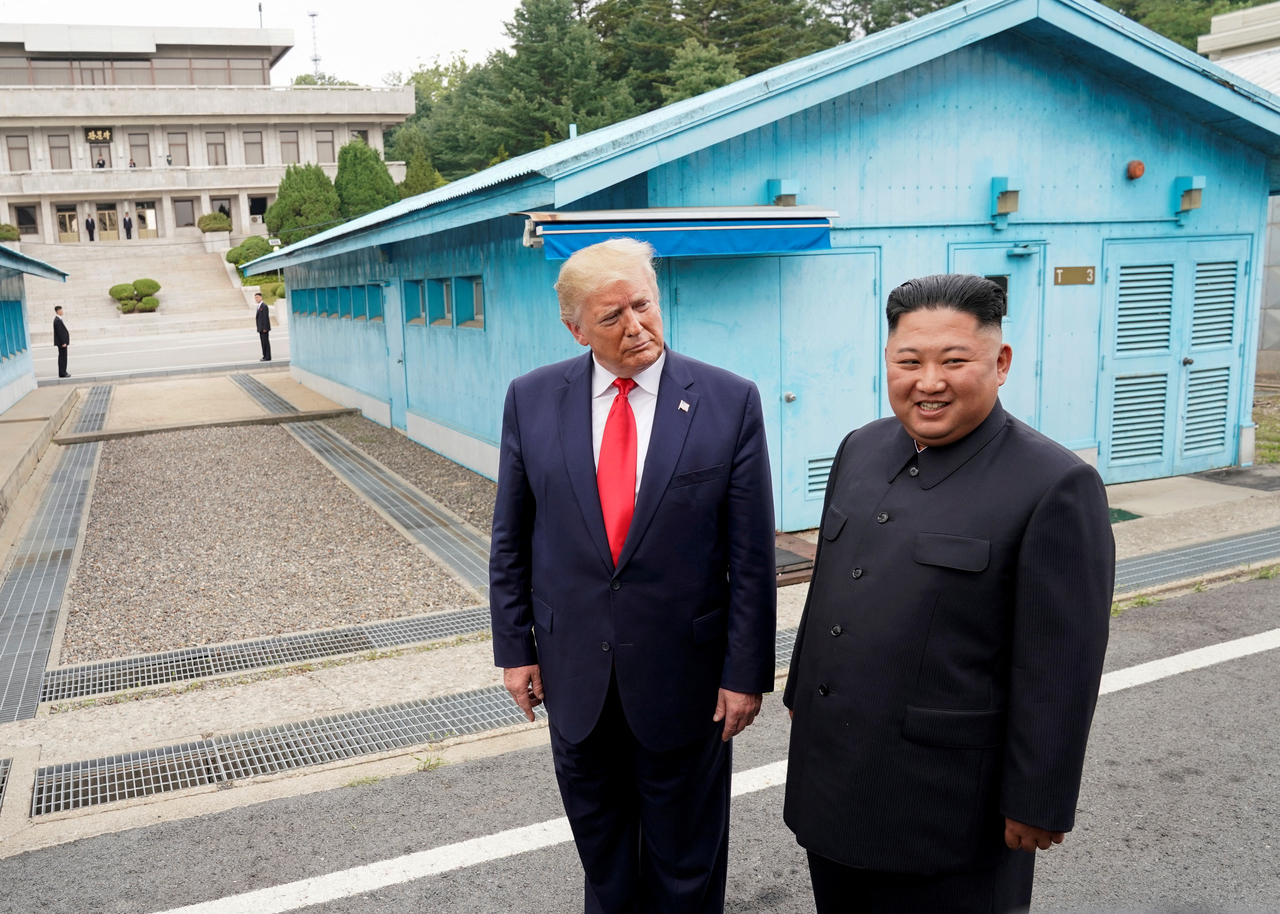
"If Kim goes to Shenzhen, he's going to talk to Donald Trump," Delury told Reuters, suggesting Kim could travel aboard an Air China aircraft, as he did for his 2018 summit with Trump in Singapore.
Trump himself has fueled speculation about a possible encounter.
Asked Monday whether North Korea's nuclear program would be discussed during the planned US-China-Russia summit, Trump suggested Kim might join the discussions.
"He may come; I don't know. That's up to President Xi," Trump told reporters before departing the White House for his Asia trip.
The following day, asked in Manila, the Philippines, whether Kim would attend APEC, Trump replied, "He would like to, yeah. We'll see what happens."
However, neither Beijing nor APEC organizers have confirmed if Kim has been invited to the summit, and there have been no clear indications that a meeting is being arranged.
China's Foreign Ministry, meanwhile, said it had no information to share regarding a possible invitation, while the APEC Secretariat likewise said it had no relevant information.
Some experts remain skeptical that Kim would see sufficient benefits in attending.
Experts, however, remain divided over the prospects and potential significance of a Trump-Kim summit, with some questioning Pyongyang's incentives to engage while others suggest even a largely symbolic meeting could serve both leaders' political interests.
For Trump, renewed engagement with Kim could help revive a signature diplomatic initiative from his first presidency
For Seoul, the immediate challenge is balancing its hopes for renewed engagement with Pyongyang against concerns that a diplomatic breakthrough among major powers could unfold without South Korea having a meaningful role in shaping the outcome.
President Lee Jae Myung held talks with Chinese President Xi Jinping in Shenzhen on Wednesday, calling for closer cooperation to ensure peace and stability on the Korean Peninsula amid growing speculation over a possible Trump-Kim summit.
mkjung@heraldcorp.com