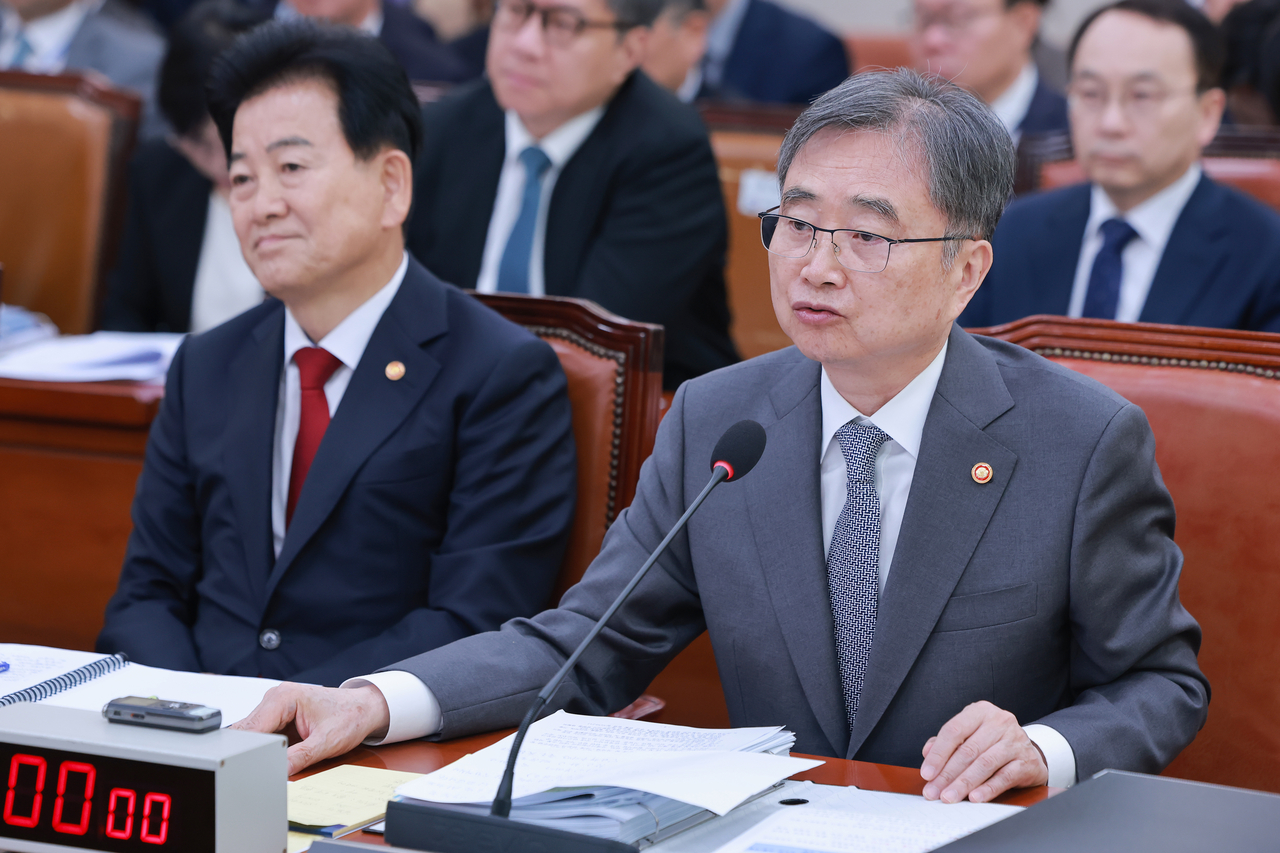
South Korean Foreign Minister Cho Hyun said Tuesday that North Korea and China may have discussed the possibility of US-North Korea dialogue during the North Korean leader's visit to the Chinese border city of Dandong last week.
Speaking at a parliamentary audit of the National Assembly's Foreign Affairs and Unification Committee, Cho acknowledged the possibility that the two countries had exchanged views on the potential talks, particularly given the presence of a senior Chinese diplomat responsible for relations with Washington.
"I believe there is a possibility," Cho said when asked by Rep. Kwon Young-se of the main opposition People Power Party whether discussions on US-North Korea dialogue could have taken place during North Korean leader Kim Jong-un's visit to Dandong on Saturday.
Kwon pointed to the presence of Ma Zhaoxu, China's executive vice foreign minister and its highest-ranking vice foreign minister, who has played a key role in Beijing's diplomatic engagement with Washington.
But Cho stressed that Seoul had not received advance notification from Beijing about Kim's visit and that there was insufficient information to determine whether discussions on potential US-North Korea talks had actually taken place.
"It is still difficult to say definitively," Cho said, adding that multiple factors would need to be considered before reaching any conclusion.
The remarks come amid renewed attention to the possibility of diplomatic engagement between Washington and Pyongyang, even as North Korea continues to reinforce its border with South Korea and characterize inter-Korean relations as those between two hostile states.
Cho suggested that a summit between the leaders of North Korea and the United States could provide an opening to break the current diplomatic deadlock.
Asked by Rep. Maeng Sung-kyu of the ruling Democratic Party of Korea about Seoul's strategy for bringing North Korea back to negotiations, Cho said a US-North Korea summit could serve as a catalyst for overcoming the impasse.
Cho said Seoul would seek to coordinate closely with relevant countries, including China and Russia, to encourage North Korea to return to the negotiating table.
The foreign minister also addressed concerns that expanding economic ties between Beijing and Pyongyang could further undermine international sanctions against North Korea.
Asked whether the opening of the New Yalu River Bridge linking Dandong with North Korea's Sinuiju could weaken sanctions enforcement, Cho acknowledged long-standing concerns that existing restrictions had not been effectively implemented.
He said China had generally sought to preserve the broader principles of sanctions against North Korea, but suggested that Pyongyang's increasingly close relationship with Moscow was complicating Beijing's calculations.
"As North Korea and Russia have grown closer, China also appears to be under pressure and seems inclined to provide additional support to North Korea in one form or another," Cho said.
The prospect of renewed diplomacy comes against a backdrop of escalating tensions along the inter-Korean border, where North Korea has been reinforcing military barriers and issuing increasingly hostile statements toward Seoul.
In a later exchange during the hearing, Cho said South Korea and the US appeared to be moving toward a consensus on the timing and details of the transfer of wartime operational control, or OPCON, from Washington to Seoul.
"I have heard that discussions are converging on the timing and substance of the transfer through ongoing communication," Cho said in response to a question from Rep. Song Seog-jun of the People Power Party.
Cho said he had discussed the issue with US Secretary of State Marco Rubio during a previous meeting and with Undersecretary of War Elbridge Colby during a visit to Washington.
Asked whether the conditions for the transfer had been met, Cho said South Korean military authorities believed they had and were seeking to expedite the process.
The transfer of wartime operational control remains a key alliance issue, with Seoul seeking greater command authority over its forces in the event of war while maintaining the combined South Korea-US defense posture.
Cho is scheduled to visit Atlanta from Thursday through Nov. 2 for a meeting of Group of 20 foreign ministers, with another meeting with Rubio under discussion.
At the same parliamentary hearing, Unification Minister Chung Dong-young assessed that recent series of threats by senior North Korean officials, including Kim Yo-jong, the North Korean leader's sister, were primarily intended to ensure that Pyongyang completes its border fortification project on schedule.
"Judging from what we have seen so far, the main intention appears to be to complete the border fortification project as planned and within the designated timeframe," Chung said.
He added that the project also reflected North Korea's intention to cement its characterization of inter-Korean relations as those between two hostile states.
Chung nevertheless defended the government's emphasis on dialogue, rejecting opposition criticism that its approach was overly conciliatory.
He argued that restoring conditions in the Demilitarized Zone to those that existed before the suspension of the 2018 inter-Korean military agreement would help reduce the risk of accidental military clashes.
Chung pointed out that no comparable land mine incidents had occurred in the DMZ during the five years following the Sept. 19 military agreement, which had established measures aimed at reducing military tensions along the border.
His remarks came amid continued political controversy over the Sept. 21 land mine explosions inside the DMZ that injured three South Korean military personnel.
Chung reiterated that while the government had attributed responsibility to North Korea and was seeking accountability for a violation of the Korean War Armistice Agreement, further investigation was needed to determine whether the explosions constituted a deliberate attack.
The incident also sparked a fresh dispute between the ruling and opposition parties on Tuesday over whether the Foreign Affairs and Unification Committee should adopt a resolution condemning North Korea.
Rep. Kim Dae-sik of the People Power Party urged lawmakers to jointly condemn the recent land mine incident and Pyongyang's continued threats, while calling for an apology, measures to prevent recurrence and stronger international cooperation to curb North Korea's illicit foreign currency earnings.
However, Rep. Hong Kee-won of the Democratic Party questioned the need for another resolution, noting that the National Assembly's National Defense Committee had already adopted a resolution on Oct. 14 condemning North Korea over the September land mine explosion.
The resolution demanded an apology, accountability and measures to prevent a recurrence. It passed without opposition lawmakers, who walked out over the exclusion of their demand for a parliamentary investigation into the military's handling of the incident.
Hong argued that the Foreign Affairs and Unification Committee, which oversees diplomacy and inter-Korean cooperation, should avoid adopting a more confrontational resolution than the one already approved by the defense panel.
The two sides agreed to continue consultations over the proposed resolution, but no agreement was reached during the hearing.
mkjung@heraldcorp.com