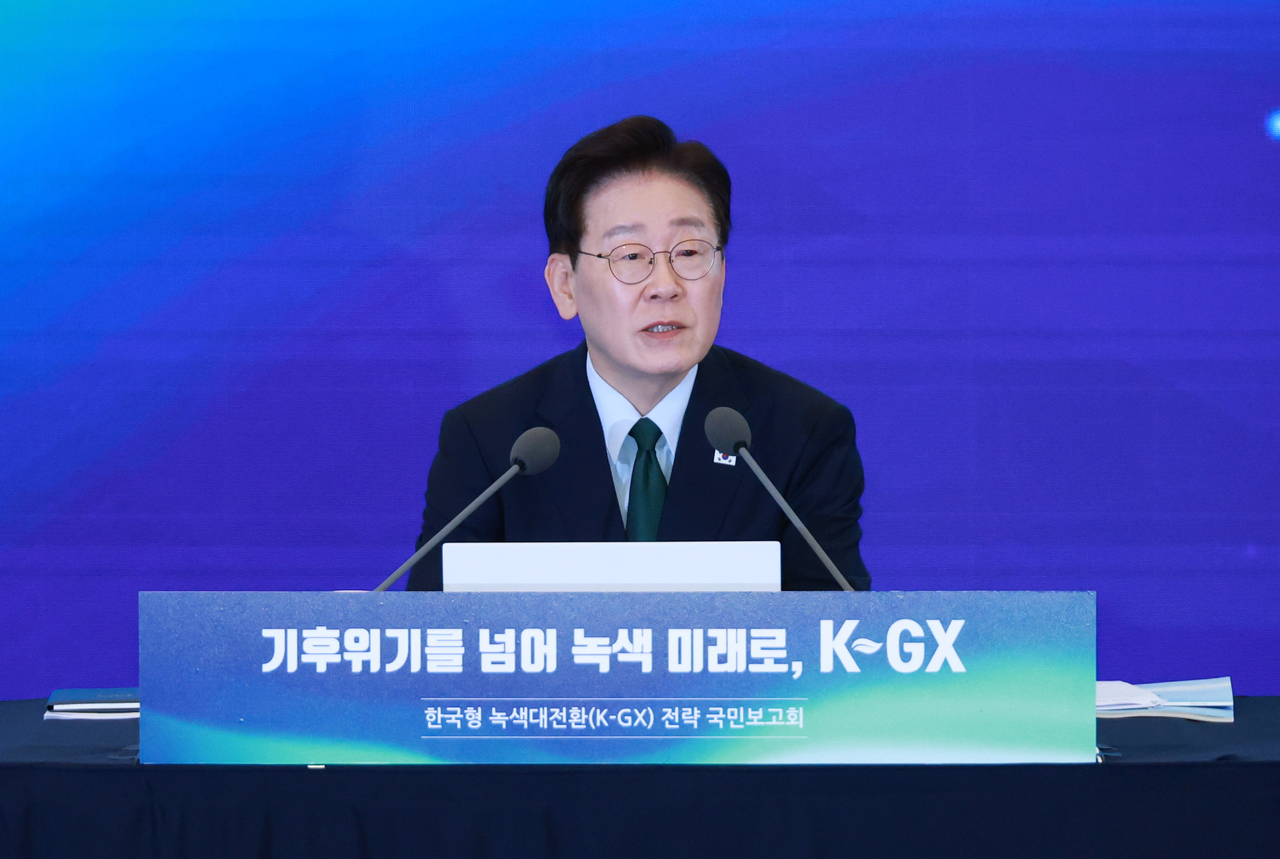
President Lee Jae Myung called Wednesday for a sweeping green transition that would make climate action a driver of industrial growth and national competitiveness, rather than a trade-off between the environment and the economy.
Lee presided over a public briefing in Seoul to unveil the government’s Korean Green Transformation, or K-GX, strategy, outlining its policy framework alongside corporate investment plans for flagship projects under the initiative.
Lee underscored the urgency of the transition as “extreme weather increasingly disrupts daily life.”
“Responding to the climate crisis should no longer mean sacrificing either the environment or economic growth,” Lee said in his opening remarks. “We need a sweeping transformation that provides a practical way to strengthen both industry and national competitiveness.”
The strategy unveiled Wednesday also marked the first major follow-through on a pledge Lee made at the United Nations General Assembly in New York last month, where he presented a “green transformation” as one of three pillars of his K-Initiative for tackling shared global challenges.
At the UN, Lee noted that countries would be unlikely to rally behind climate action if it required them to sacrifice economic growth. South Korea, he said, would instead seek to create a “virtuous cycle” in which carbon neutrality generates new engines of growth and high-quality jobs.
Wednesday’s event was intended to put substance behind that promise.
The strategy reflects a particular challenge for South Korea, an export powerhouse whose economy remains heavily dependent on energy-intensive manufacturing industries including steel, petrochemicals, semiconductors, automobiles and electronics.
“Carbon-related trade barriers, including Europe’s carbon border levy, are rising by the day, while foreign companies are increasingly demanding emissions cuts from the products they source,” Lee said.
“Moving proactively on the green transition is a clear strategy for the future — one that will both secure our global competitiveness and protect people’s lives and livelihoods from the climate crisis.”
Lee said South Korea should capitalize on its research and development capabilities to secure key green technologies early and gain a foothold in emerging markets, arguing that the transition would also be essential to maintaining the country’s technological edge in advanced industries.
Lee also called for greater use of renewable energy and industrial complexes to make the green transition a source of regional growth, while cautioning that older industrial complexes, vulnerable industries and low-income households should not be left behind in the process.
“If you can’t avoid it, enjoy it, as the saying goes,” Lee said. “We need to break away from the practice of following others and become the architects and leaders who shape the green market ourselves.”
At the briefing, Finance and Economy Minister Lee Hyoung-il and Climate, Energy and Environment Minister Kim Sung-whan presented the government’s strategy outlining financing and fiscal support plans.
According to Minister Lee, the government plans to provide 200 trillion won ($149.3 billion) in fiscal support and more than 790 trillion won in financing over the next decade, amounting to roughly 1,000 trillion won in total government support for the green transition.
The strategy targets the decarbonization of carbon-intensive industries such as steel and petrochemicals, while seeking to build new growth engines in batteries, next-generation solar power and small modular reactors.
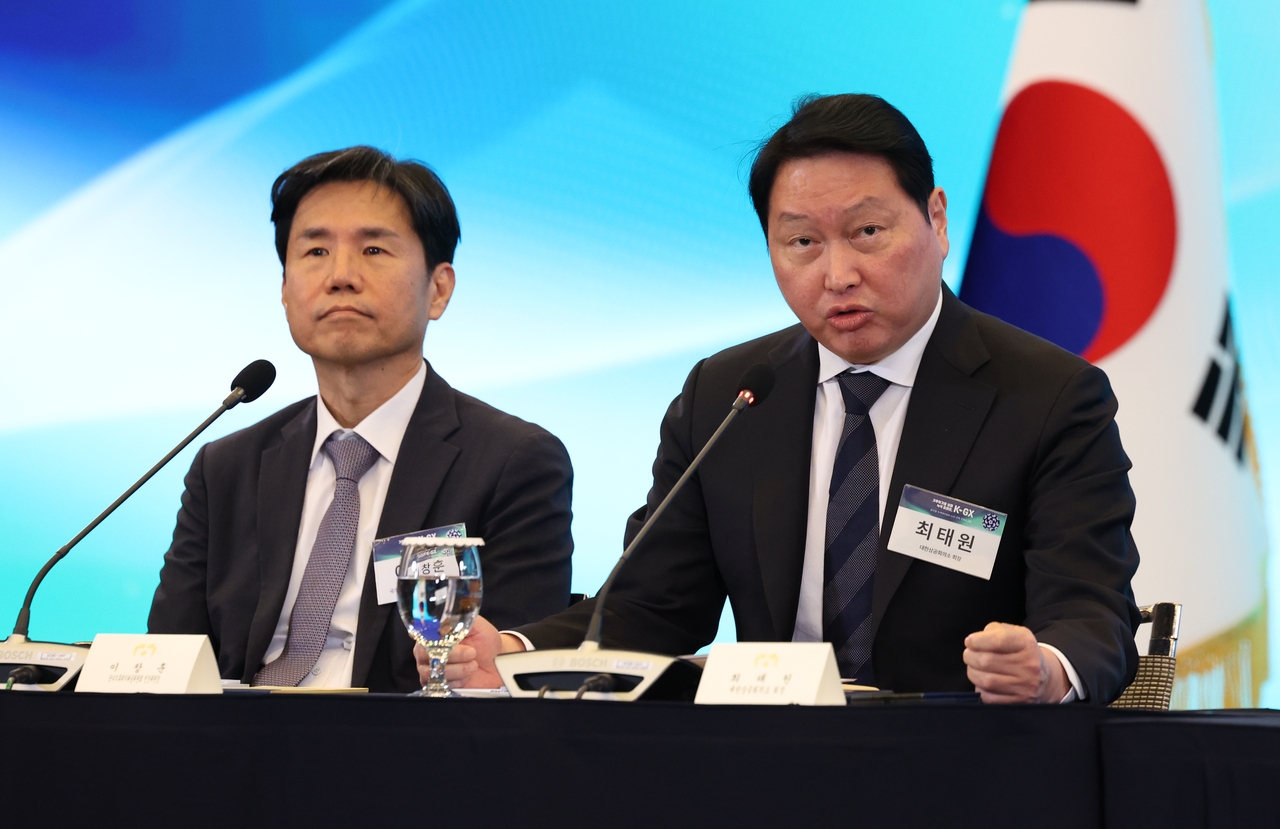
SK Group Chairman Chey Tae-won, who leads the private-sector arm of the joint K-GX task force as chairman of the Korea Chamber of Commerce and Industry, said the strategy was significant because it had been designed jointly by government and business from the outset.
The task force brings together 13 government ministries and 17 business and industry organizations, reflecting an effort to make the green transition an economy-wide project rather than one confined to environmental policy.
Chey said companies had hesitated to make long-term investments in carbon neutrality not because they lacked commitment, but because they had been expected to shoulder the risks of uncertain technologies, markets and policies on their own.
“Regulation can bring companies up to the baseline, but the power to go beyond that comes from incentives,” he said, describing the government’s package of investment, infrastructure support and regulatory changes as a commitment to share those risks with businesses.
Chey also called artificial intelligence and the green transition “twin national strategies” that should be designed and pursued together, saying AI could accelerate the green transition while greener energy and industry could support the sustainable growth of AI.
Chey emphasized that the business sector now had to follow through on 220 trillion won in planned investment and show results on the ground, with the aim of turning carbon neutrality “from a burden into a new opportunity for growth.”
dagyumji@heraldcorp.com