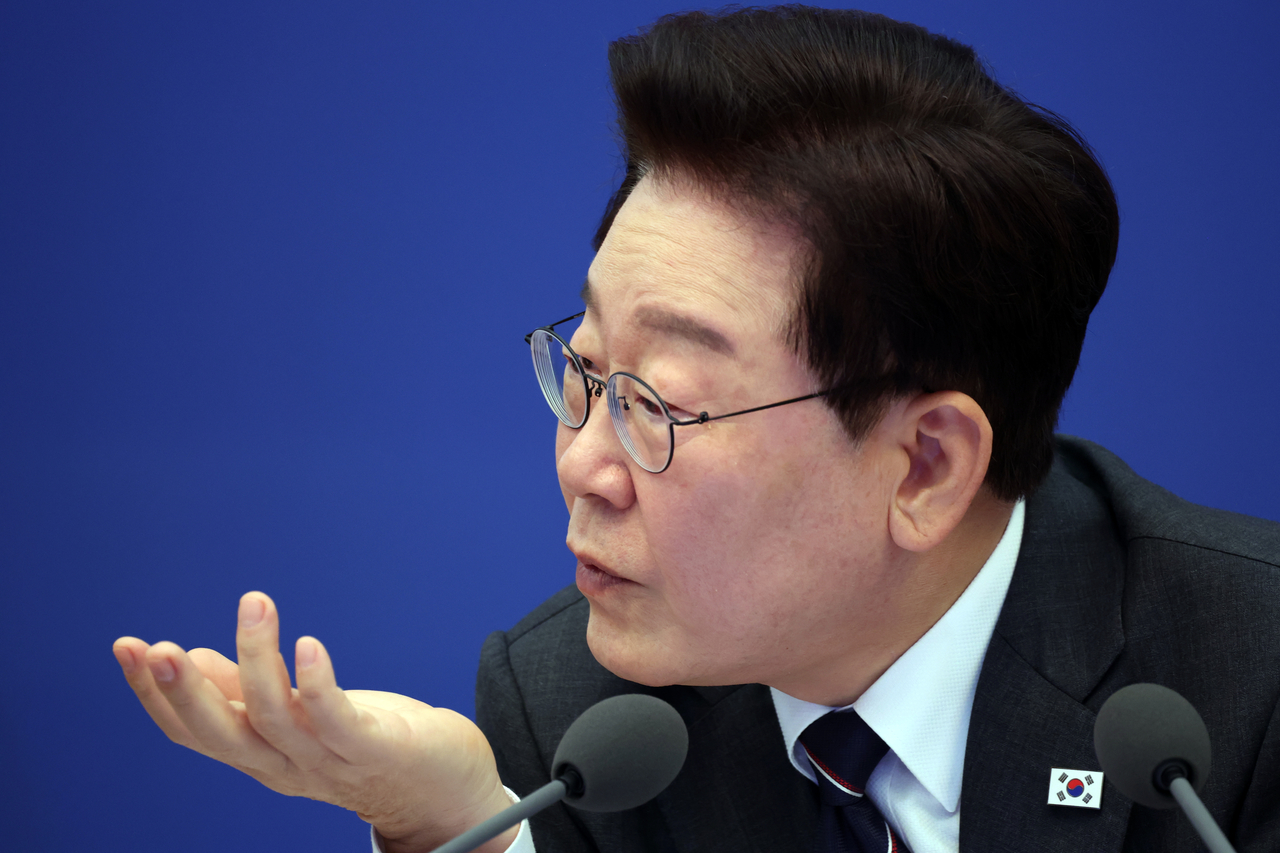
President Lee Jae Myung on Tuesday ordered a fresh review of South Korea’s possible entry into a major trade pact from scratch, noting strong concerns from the agricultural and fisheries sectors.
Lee gave the instruction on South Korea’s possible entry into the Comprehensive and Progressive Agreement for Trans-Pacific Partnership, or CPTPP, during a closed-door session of a Cabinet meeting, senior presidential spokesperson Kang Yu-jung said at a press briefing.
“President Lee noted that some have stressed the strategic value of the CPTPP amid upheaval in the global trade order, while concerns remain very high among the agricultural and fisheries sectors,” Kang said.
“(Lee) emphasized that any policy decision should weigh the national interest on the basis of trust and consensus among farmers and fishers.”
Lee instructed officials “not to rush the process with a predetermined conclusion, but to restart dialogue from square one,” she added.
Kang said the administration would reopen discussions with stakeholders, without assuming that South Korea would ultimately join the 12-member pact.
“We plan to start talking with stakeholders again from square one, without setting a conclusion in advance,” she said.
The directive followed Lee’s public intervention in the debate last week, when he ordered officials to thoroughly gather views on CPTPP membership.
In a Sept. 29 post on X, Lee said farmers and other industries that could suffer from South Korea’s entry into the CPTPP were strongly opposed to the move. He compared the resistance to the backlash over free trade agreements during the Roh Moo-hyun administration.
Lee pledged to meet representatives of affected sectors in person and hear their concerns. He said he was fully aware of the importance of agriculture, fisheries, livestock and forestry as “strategic security industries.”
His remarks came a day after the Korean government released a preliminary joint assessment of related ministries highlighting the sharply different effects CPTPP membership could have across industries.
The assessment projected that South Korea’s real gross domestic product would be 0.38 percentage point higher 10 years after the pact takes effect than it would be without membership.
Manufacturing output was projected to increase by an annual average of 6.3 trillion won ($4.7 billion) to 6.7 trillion won over 15 years.
But agricultural, forestry and fisheries production was projected to fall by about 850 billion won annually over the same period. Agriculture accounted for the largest decline, at 710 billion won a year, followed by fisheries at 81.7 billion won.
The assessment came after the Lee administration revived the prospect of CPTPP membership in August after years of little movement.
Minister of Trade, Industry and Resources Kim Jung-kwan told Lee during an Aug. 4 policy briefing that the government would review joining the pact as part of efforts to secure new export markets, including in Southeast Asia and Mexico, and boost exports of Korean content and consumer goods.
Kim said the government would consult farmers, fishers, lawmakers and other stakeholders as it considered the move.
South Korea had taken similar steps under the Moon Jae-in administration.
In 2021, Seoul began domestic consultations and formally signaled its intention to pursue CPTPP membership, but never submitted an application.
The push lost momentum amid opposition from the agricultural and fisheries sectors. It was also complicated by South Korea’s restrictions on seafood imports from Fukushima and surrounding areas, which have long been a source of friction with Japan.
Japan has called on South Korea to lift those restrictions as part of the accession process. That gives the issue added weight because Japan is a leading CPTPP member and any new entrant requires the consent of all 12 existing members.
The CPTPP grew out of the Trans-Pacific Partnership after the United States withdrew from the original agreement in 2017. Japan subsequently played a central role in keeping the pact alive.
dagyumji@heraldcorp.com