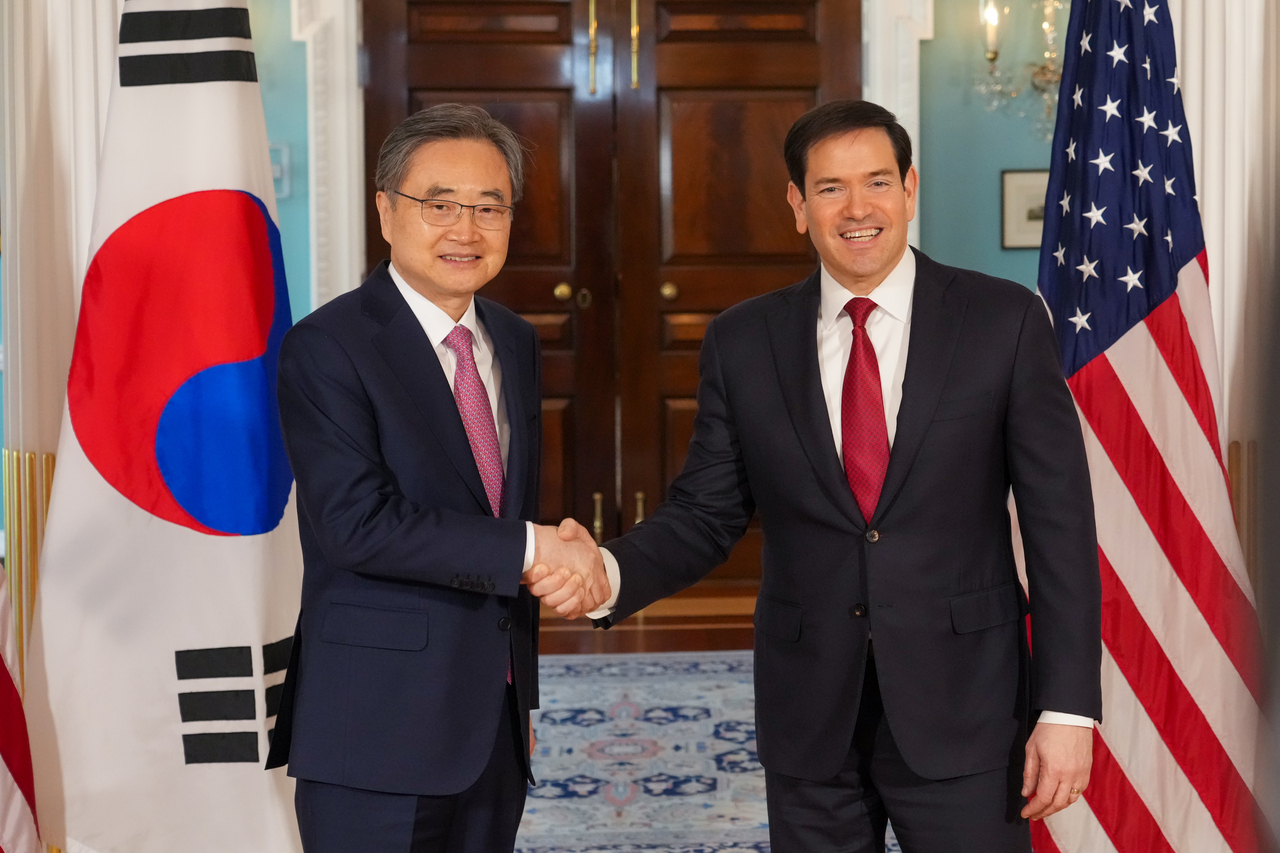
Foreign Minister Cho Hyun will meet with US Secretary of State Marco Rubio in Washington on Friday, as Seoul weighs its response to US calls for contributions to efforts regarding the Strait of Hormuz, while seeking progress on a series of unresolved economic and security issues with Washington.
Cho is scheduled to visit Washington from Thursday through Saturday and hold talks with Rubio on Friday, the Foreign Ministry said Wednesday. The talks will be Cho and Rubio’s first formal bilateral meeting since February, though they briefly spoke in July on the sidelines of Association of Southeast Asian Nations meetings in Manila, Philippines.
“The two sides will discuss a wide range of issues, including South Korea-US relations, the Korean Peninsula and regional and global issues,” the ministry said in a press release.
In a phone call late last month, the two agreed to arrange an in-person meeting and continue coordinating on economic and security issues, including North Korea and the Middle East.
The talks come at a sensitive time for Seoul as it considers how to respond to Washington's calls for South Korea to contribute to efforts to restore freedom of navigation through the Strait of Hormuz.
South Korea's presidential office is expected to convene a meeting of the National Security Council Standing Committee on Thursday, where, according to news reports, possible forms of South Korean contributions to those efforts will be discussed.
The discussions are expected to draw on a report by a Defense Ministry fact-finding team recently dispatched to the United Arab Emirates to assess conditions in the region.
The team, which returned to South Korea last week, included working-level officials from the Defense and Foreign ministries and visited sites including Al Dhafra Air Base, a major US military installation in the Middle East.
The Ministry of National Defense previously said the team was sent to assess the regional situation and security conditions, stressing that the mission was “not conducted on the premise of an actual troop deployment.”
The presidential office, however, declined to comment on the issue, saying it was difficult to comment on specific matters involving the council, adding, "Unfounded speculation regarding the agenda or discussions of the NSC does not serve the national interest.”
The government has repeatedly stressed that no decision has been made on a potential deployment. Resistance has also emerged at home, with lawmakers from both the ruling Democratic Party of Korea and main opposition People Power Party voicing concerns and civic groups staging protests.
The issue complicates Seoul's relations with Tehran, with Iran warning of "serious consequences" for military participation.
On Sept. 11, Cho spoke with Iranian Foreign Minister Seyed Abbas Araghchi by phone to convey that Seoul had made no decision on a deployment, while stressing the need to restore freedom of navigation through the Strait of Hormuz and expressing hope for peace and stability in the region, according to Seoul's Foreign Ministry.
The Hormuz issue is expected to form part of a broader economic and security agenda when Cho sits down with Rubio.
Among the issues are follow-up negotiations on South Korea's push to develop nuclear-powered submarines and discussions on revising the bilateral civil nuclear cooperation agreement, known as the 123 Agreement, to allow Seoul to enrich uranium and reprocess spent nuclear fuel.
The meeting could also coincide with an announcement on the first project under South Korea's $350 billion investment commitment to the United States, which came about as part of the joint fact sheet adopted following the summit between President Lee Jae Myung and US President Donald Trump last year.
mkjung@heraldcorp.com