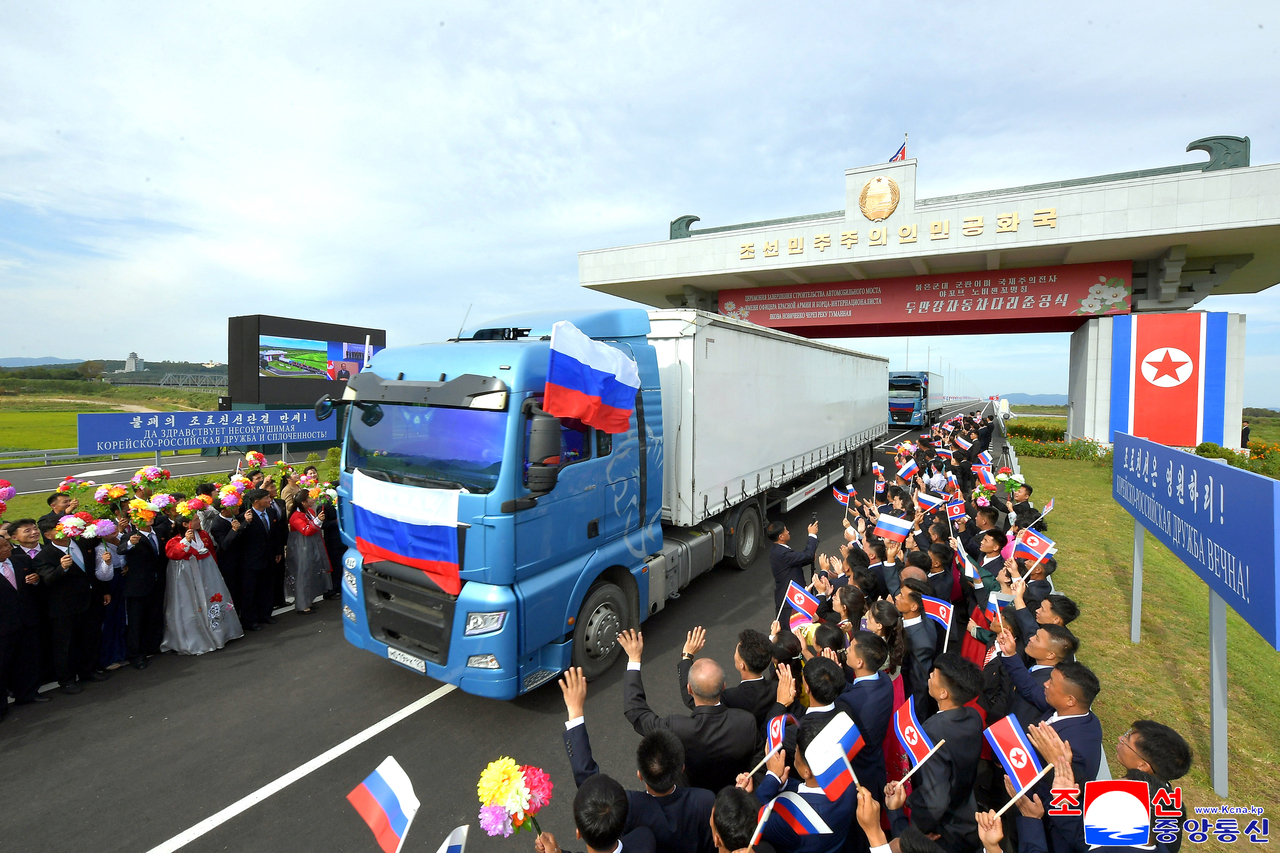
North Korea and Russia have opened the first road bridge across the border, Pyongyang's state media reported Tuesday.
The bridge is the latest development in deepening ties between the two countries, and signs that international sanctions against Pyongyang are losing efficacy.
The Tuman River Motor Bridge spans the Tumen River to connect North Korea's northeastern border city of Rason with Khasan in Russia's Far East. It was formally inaugurated Monday, North Korea's state-run Korean Central News Agency said. The bridge was named after Yakov Novichenko, a Soviet Red Army officer known for having saved North Korean founder Kim Il-sung from an assassination attempt in 1946.
Describing Pyongyang-Moscow relations as developing on the foundations of comprehensive strategic partnership and an "invincible alliance," the KCNA said the bridge will provide a "guarantee for building up and reinforcing an important infrastructure for economic cooperation between the two countries and revitalizing multi-faceted cooperation."

The inauguration ceremony was held Monday simultaneously in North Korea's border city of Rason and the Russian border town of Khasan. North Korean Premier Pak Thae-song and Russian Prime Minister Mikhail Mishustin joined via video link from Pyongyang and Moscow, respectively, and senior officials from both countries attended ceremonies on either side of the border.
The opening adds a major new piece of cross-border infrastructure to a relationship that has expanded rapidly since North Korean leader Kim Jong-un and Russian President Vladimir Putin elevated bilateral ties to a "comprehensive strategic partnership" in 2024.
KCNA said the two countries completed the project in 495 days.
A Seoul-based expert said the development illustrates the weakening practical effect of international sanctions on North Korea as its cooperation with Russia expands.
"The bridge's opening goes beyond the expansion of physical infrastructure," Lim Eul-chul, a professor at Kyungnam University's Institute for Far Eastern Studies, said. Lim described the milestone as a political and geopolitical signal of an emerging "North Korea-China-Russia continental triangular bloc" and a reflection of North Korea's changing diplomatic position.
He contrasted Pyongyang's current circumstances with those surrounding the collapse of the second US-North Korea summit between Kim and US President Donald Trump in Hanoi in February 2019.
At the time, sanctions relief was one of North Korea's central objectives in negotiations with Washington. The Hanoi summit ended without an agreement after the two sides failed to bridge differences over the scope of North Korean denuclearization measures and sanctions relief.
North Korea now finds itself in a markedly different strategic environment, Lim said; China and Russia provide large economic and logistical hinterlands that could reduce Pyongyang's incentive to seek sanctions relief from Washington through concessions on its nuclear program.
The development could therefore also carry a message for the United States that Pyongyang sees less need than it did in 2019 to make denuclearization concessions in return for economic benefits, according to Lim.
The bridge is expected to substantially increase overland trade and logistics between the two countries, according to Lim.
"Considering the road networks, customs facilities and surrounding logistics complexes on both sides, trade and logistics between North Korea and Russia are expected to gradually expand in both scale and sophistication," Lim said.
While the pace of expansion could fluctuate, Lim said the growth of road-based cargo transportation is likely to result in a significant increase in overall freight volume.
The new route could have implications beyond ordinary commercial exchanges.
Lim said that for Russia, amid the prolonged war in Ukraine, the bridge provides a direct road network that could facilitate the movement of military supplies, ammunition and personnel from North Korea, including workers and deployed troops. It could also allow businesses to expand truck-based logistics, boosting bilateral trade while reducing transportation costs.
North Korea has supplied Russia with large quantities of weapons and ammunition for its war against Ukraine and has also deployed troops to support Russian forces, dramatically expanding military cooperation between Pyongyang and Moscow.
The bridge also gives North Korea another major overland economic corridor at a time when its economic links with both Russia and China are expanding.
Lim pointed to the Tuman River bridge with Russia and the New Yalu River Bridge connecting North Korea and China as two potentially important land routes that could allow Pyongyang to deepen economic ties with both of its neighbors.
From North Korea's perspective, having major overland corridors with both countries could also enable Pyongyang to capitalize on competition between Beijing and Moscow and maximize its economic gains, he said.
The bridge itself was among the projects agreed upon by Kim and Putin during their summit in Pyongyang in June 2024.
Construction began near the existing railway bridge across the Tuman River in April 2025.
mkjung@heraldcorp.com