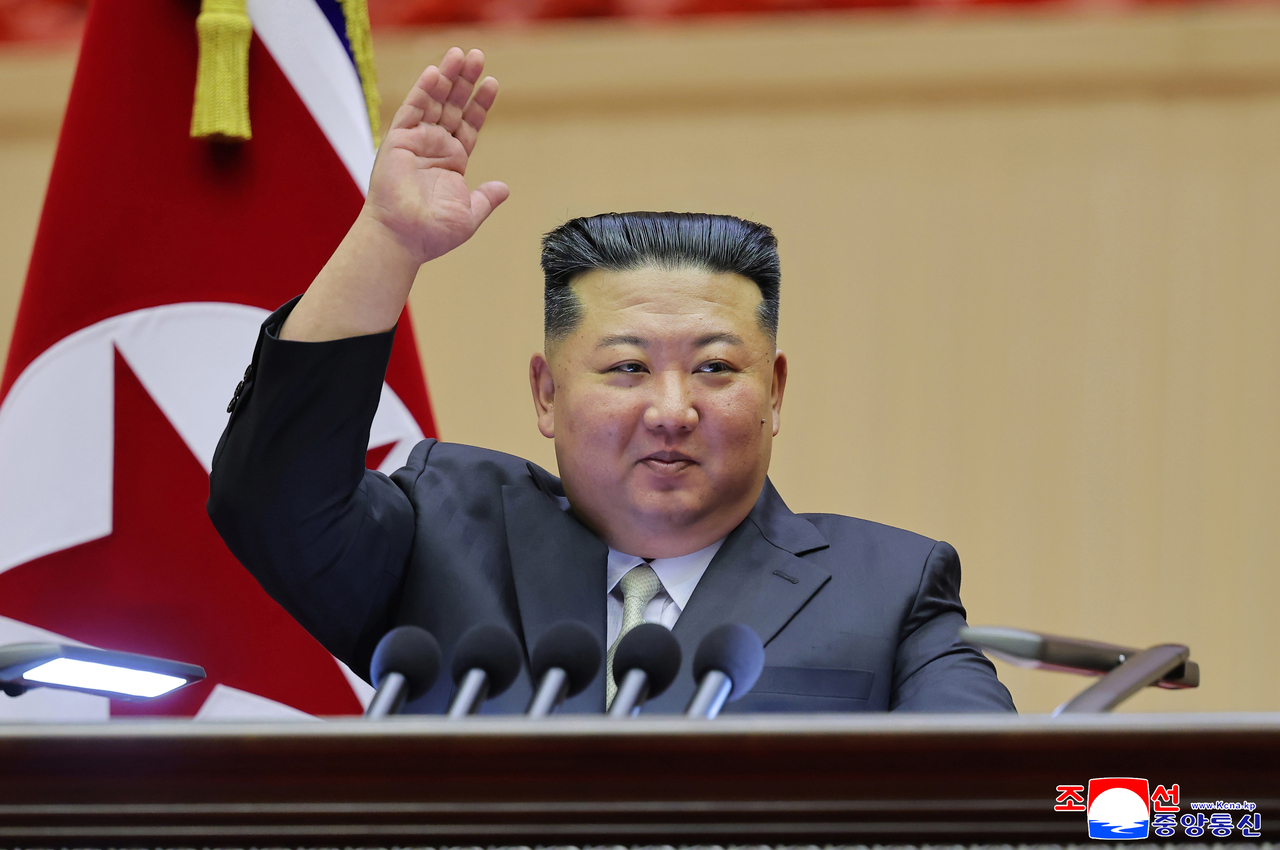
North Korea has formally removed its goal of reunification with South Korea from the charter of its ruling Workers’ Party of Korea, while expanding leader Kim Jong-un’s authority and further stripping away references to the legacy of his predecessors, the document showed Thursday.
The revisions provide the clearest documentary evidence yet of how Pyongyang has institutionalized its “two hostile states” policy toward Seoul while simultaneously reshaping the ruling party around Kim’s leadership.
The Institute for National Security Strategy, a think tank affiliated with South Korea’s National Intelligence Service, on Thursday released the full text of the revised WPK charter in a report analyzing changes adopted at the party’s ninth congress in February.
The shift in the party charter did not happen all at once. North Korea had already revised the document in June 2024 as part of Kim’s push to abandon the decades-old principle that the two Koreas belong to a single nation ultimately destined for reunification and instead treat them as two separate states.
South Korean intelligence authorities had previously confirmed that such changes had been made, but the revised charter itself remained largely out of public view. The document released Thursday provides the first full look at those changes, together with a further round of amendments adopted at the WPK’s ninth congress in February.
Among the most significant changes is the removal of language associated with inter-Korean unification and Koreans on both sides of the border belonging to a single nation.
Terms including “peaceful reunification of the country,” “united front,” “South Korea,” “great national unity” and references to pursuing political goals “on a nationwide scale” have been removed from the charter’s preamble.
Also deleted were passages calling for the withdrawal of US forces from South Korea and the rejection of foreign interference in the South, language that had formed part of Pyongyang’s previous strategy of pursuing reunification under a single Korean nation.
The revisions put into writing the fundamental shift in inter-Korean policy Kim announced in late 2023, when he declared relations with Seoul to be those between “two hostile states” rather than two parts of a single nation ultimately destined for reunification.
Kim subsequently called for constitutional provisions concerning peaceful reunification to be removed during a Supreme People’s Assembly meeting in January 2024, arguing that reunification with South Korea was no longer possible. Pyongyang announced in October that year that it had amended the constitution, although it did not publicly release the revised text.
Alongside the overhaul of its policy toward Seoul, the revised charter further strengthens Kim’s position at the center of North Korea’s political system.
The preamble has removed the two remaining paragraphs describing the achievements and legacy of state founder Kim Il-sung and his successor Kim Jong-il in connection with so-called “Kim Il-sung-ism" and "Kim-Jong-il-ism.”
Much of the language highlighting the achievements and symbolism of Kim’s grandfather and father had already been removed when the charter was revised at the eighth party congress in 2021. With the remaining passages gone, the INSS assessed that the party’s identity has been more explicitly reorganized around Kim Jong-un, its current general secretary.
This comes amid a broader push by Kim in recent years to establish a political identity increasingly distinct from those of his father and grandfather, as his own leadership enters its second decade.
Pyongyang has gradually scaled back some of the language, symbols and commemorative practices traditionally associated with Kim Il-sung and Kim Jong-il, while placing greater emphasis on Kim Jong-un’s own leadership and achievements.
The trend has become particularly visible in the treatment of major anniversaries associated with his predecessors. North Korean state media has reduced the use of traditional honorific names for Kim Il-sung’s April 15 birthday and Kim Jong-il’s Feb. 16 birthday, while Kim Jong-un has on several occasions skipped customary visits to the Kumsusan Palace of the Sun, where their bodies lie in state.
The North has also increasingly elevated Kim Jong-un’s own ideological and political concepts, including his “people-first principle,” while strengthening language surrounding his unitary leadership system.
The revised party charter appears to take that process a step further by removing the remaining passages devoted to the achievements of his predecessors and more explicitly codifying Kim’s own authority.
Kim’s authority as WPK general secretary has also been defined in significantly greater detail.
While the previous charter broadly described the general secretary as the head of the party, the revised rules explicitly enumerate powers including the authority to convene party meetings, appoint and dismiss officials, expel party members and dissolve party departments.
The INSS views the changes as part of Pyongyang’s broader effort to reinforce Kim’s “unitary leadership system” as he approaches 15 years in power and enters what the institute describes as the “Kim Jong-un Era 2.0.”
The revised charter also introduces wartime provisions. Under the new rules, the party can bypass internal election procedures during wartime.
Another notable change raises the minimum age for joining the WPK from 18 to 20.
The membership threshold was initially set at 20 when the party was founded in 1945 but was lowered to 18 at its third congress in 1956, following the 1950-53 Korean War, as Pyongyang sought to expand party membership. The latest revision restores the threshold to 20 for the first time in about seven decades, according to the INSS.
The charter also incorporates five areas of party building promoted under Kim — political, organizational, ideological, disciplinary and work-style development.
Questions remain over the position of WPK first secretary, a post created at the eighth party congress in 2021 to act on behalf of the general secretary.
North Korea has never publicly identified who holds the position. The INSS assessed that Jo Yong-won, a secretary of the WPK Central Committee and one of Kim’s senior aides, is likely serving in the role.
mkjung@heraldcorp.com