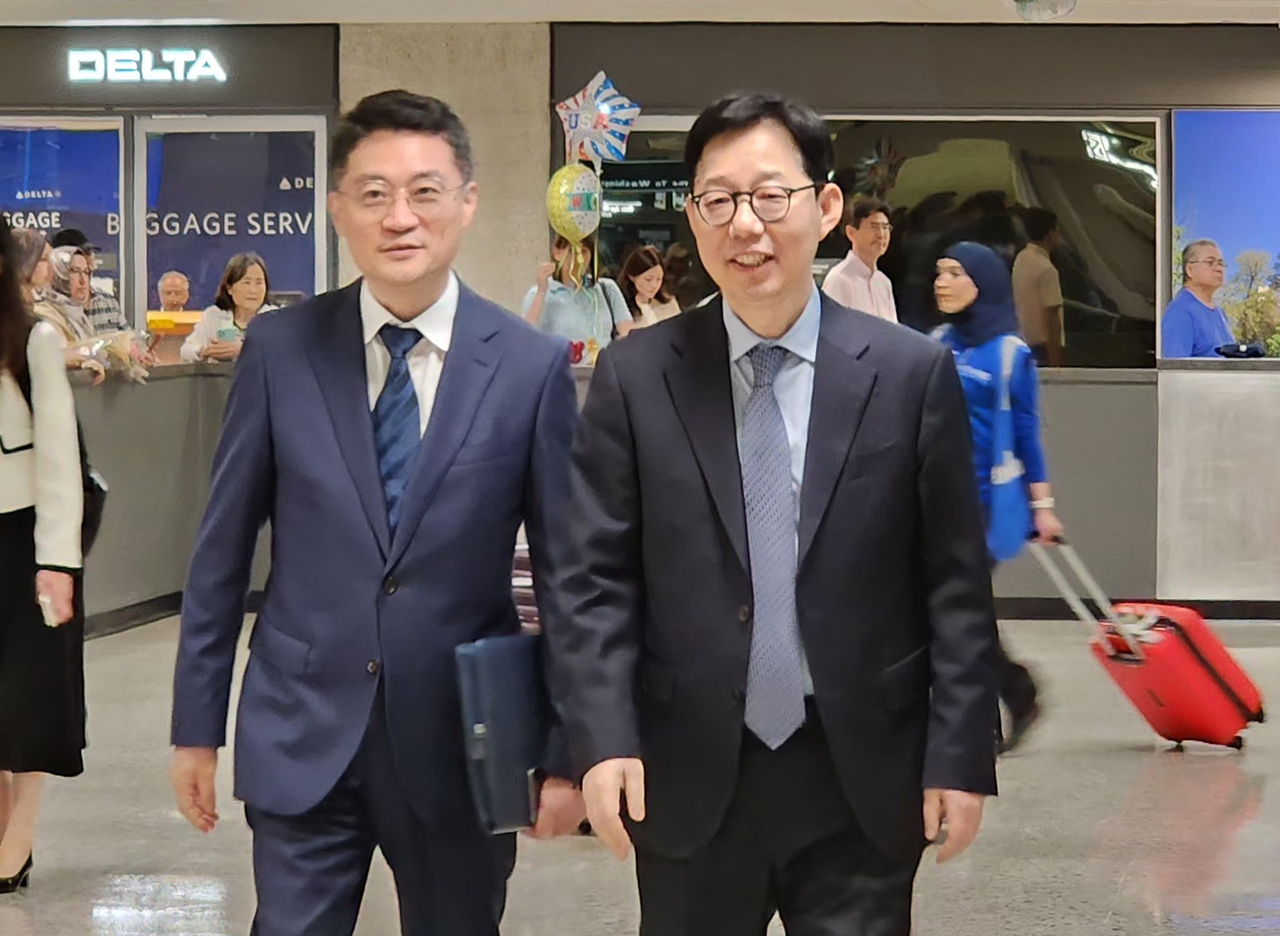
South Korea’s First Vice Foreign Minister Park Yoon-joo visited Washington on Tuesday for high-level talks with US officials amid mounting concerns in Seoul over delays in implementing key bilateral security agreements, including cooperation on nuclear-powered submarines.
Park began his US schedule after arriving at Dulles International Airport near Washington. During the visit, he is set to meet Under Secretary of State for Political Affairs Allison Hooker and Deputy Secretary of State Christopher Landau.
Park told reporters upon arrival that he was visiting Washington "to hold broad consultations on pending issues" between Seoul and Washington, adding that the two sides would also discuss "regional and global developments amid rapidly changing geopolitical circumstances."
The trip came after US President Donald Trump held summit talks with Chinese President Xi Jinping in Beijing from May 13-15, during which the two leaders reaffirmed their shared goal of North Korea’s denuclearization, according to a White House fact sheet released afterwards.
The White House said the two leaders discussed a range of issues during the summit, including Korean Peninsula security, Iran and bilateral trade, while Seoul has been closely watching whether renewed US-China coordination could help create diplomatic momentum on North Korea.
Trump reportedly briefed President Lee Jae Myung on the outcome of the Beijing summit and discussions related to Korean Peninsula affairs during a phone call between the leaders on Monday.
Addressing cooperation on nuclear-powered submarines and Seoul’s push for broader uranium enrichment and spent fuel reprocessing rights, Park told reporters that the agreements reached by the two leaders last year marked a “historic” step forward for the alliance.
He said the two countries had already established multiple consultative mechanisms to advance implementation and were now moving into more substantive follow-up discussions, adding that Seoul and Washington had maintained close coordination on the issues and would continue consultations.
Park explained his meetings with senior State Department officials would cover the joint fact sheet agreed upon by the two presidents, as well as broader political, military and Korean Peninsula issues.
Regarding the Trump-Xi agreement on maintaining the goal of North Korean denuclearization, Park said “constructive” consultations between Washington and Beijing appeared to have created “a good momentum.”
“From our perspective, that is an outcome, and I will seek to ensure that it has a positive effect as we deal with Korean Peninsula issues and the South Korea-US relationship,” he said.
Park said the two sides also plan to discuss a broad range of pending bilateral issues during the visit, including South Korean investment projects in the United States, Washington’s ongoing Section 301 trade investigation that could lead to additional tariffs on Korean products and the recent attack on the South Korean-operated vessel HMM Namu near the Strait of Hormuz.
The talks are expected to touch on recent strains surrounding intelligence sharing between the allies after Washington reportedly curtailed part of its intelligence cooperation with Seoul over concerns about the disclosure of sensitive information related to North Korea’s nuclear program.
The controversy emerged after Unification Minister Chung Dong-young publicly referred to Kusong as a possible third North Korean uranium enrichment site beyond Yongbyon and Kangson, remarks that reportedly triggered concerns in Washington over the handling of intelligence-related information. Chung has maintained that his comments were based on open-source materials and previously published reports rather than classified intelligence shared by the United States.
Attention is now focused on whether Park’s visit could help find a breakthrough on several unresolved bilateral issues that have remained deadlocked in recent months.
Park is also expected to hold a meeting with Korean correspondents in Washington on Wednesday.
mkjung@heraldcorp.com