Analysts believe North Korean leader Kim Jong-un’s continued absence from Kumsusan Palace of the Sun on April 15 — the birthday of state founder Kim Il-sung — is a calculated move to distance himself from his predecessors and solidify his own leadership identity.
Kim Jong-un has now skipped the mausoleum visit for four consecutive years, breaking with a long-standing tradition of paying tribute to the embalmed bodies of Kim Il-sung and Kim Jong-il on major national holidays.
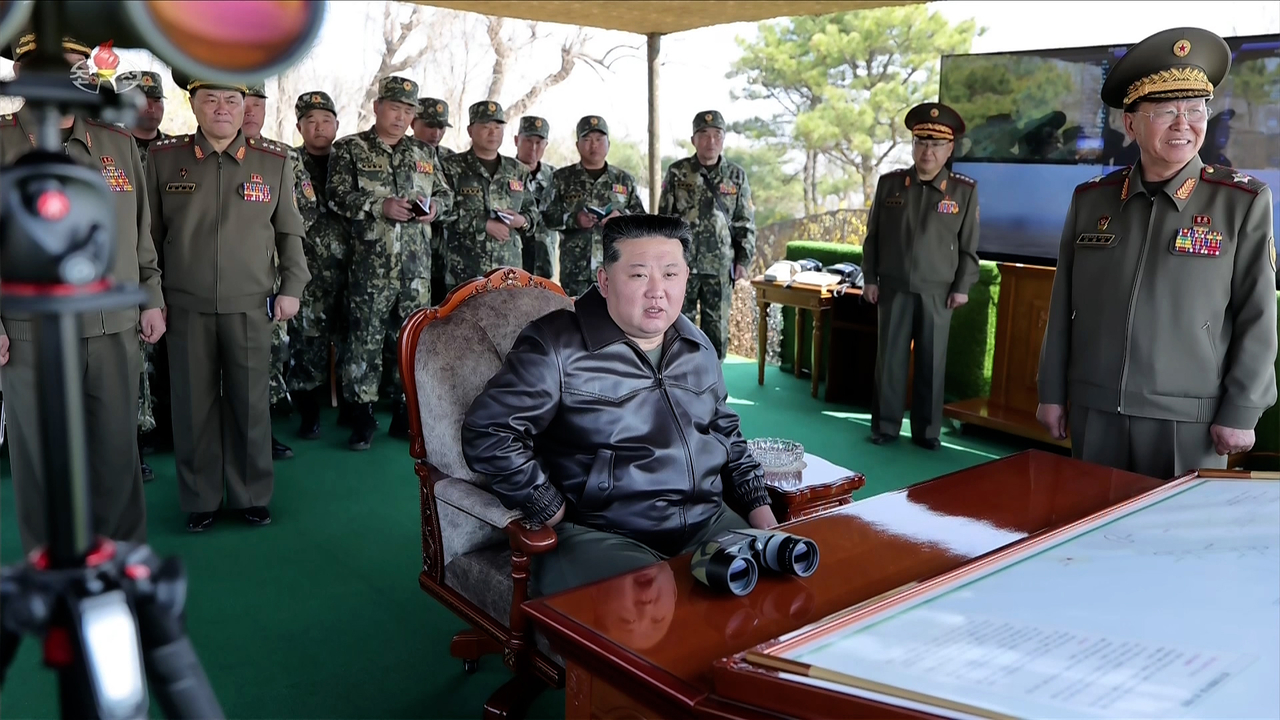
Instead of attending the ceremony this year, Kim oversaw an artillery firing contest in the western region, according to the Korean Central News Agency.
“Comrade Kim Jong-un ... oversaw an artillery firing contest of artillery subunits under the large combined units of the Korean People’s Army on April 15, the Day of the Sun,” KCNA said.
Photos released by KCNA and Rodong Sinmun, the North’s ruling party newspaper, on Thursday, did not show Kim Jong-un visiting the mausoleum.
The shift from symbolic tribute toward military activity highlights what experts describe as Kim’s effort to portray himself as a hands-on leader focused on defense capabilities and state performance.
Yang Moo-jin, a distinguished professor at the University of North Korean Studies, said the move underscores Pyongyang’s emphasis on modernizing conventional forces under its five-year defense development plan. The plan, unveiled at a recent party congress, focuses on advancing both nuclear and conventional capabilities, including the development of tactical nuclear weapons, hypersonic missiles, and the modernization of artillery and other frontline systems.
“Kim’s attendance at the artillery firing contest reflects efforts to upgrade artillery units and complete war preparations through modernization,” Yang said, noting that artillery remains a decisive factor in warfare alongside missiles.
Yang added that the inclusion of frontline units, particularly those in the western region, signals a dual purpose: reinforcing defensive readiness while simultaneously exerting pressure on South Korea.
The absence from the Kumsusan Palace, he said, should also be understood as part of Kim’s broader strategy to establish an independent leadership image, according to Yang.
“It appears to be part of a ‘standing on his own’ approach, aimed at projecting the image of a working military leader focused on the field rather than ritual observance,” Yang said.
State media reported that senior officials, including Premier Pak Thae-song and Supreme People’s Assembly Chairman Jo Yong-won, visited the mausoleum in Kim’s place, while Kim sent a flower basket.
Analysts say this pattern of delegating ceremonial duties while personally overseeing military or economic activities has become increasingly consistent in recent years.
Kim has repeatedly chosen to mark key political anniversaries by highlighting major state projects or weapons developments, including housing construction in Pyongyang’s Hwasong district and the test launch of the Hwasong-18 intercontinental ballistic missile.
Experts say such moves are part of a broader effort to reshape North Korea’s political narrative around Kim himself.
Kim Sang-bum, a professor at Kyungnam University’s Institute for Far Eastern Studies, said the shift reflects attempts to promote a “new era” centered on Kim’s leadership, while also presenting a more normalized state image externally.
“Since the 8th Party Congress in 2021, North Korea has begun using the term ‘normal state’ and shown signs of reorganizing its state system, which is one of the notable characteristics of its recent political direction,” said Kim at Kyungnam University.
“From an external perspective, the continued practice of three generations of hereditary leaders repeatedly paying tribute at the mausoleum does not appear ‘normal,’ and this may have been taken into consideration,” he said.
“It also reflects a strong intention to lead North Korea based on what could be described as ‘Kim Jong-un’s revolutionary ideology,’ going beyond the existing ‘Kim Il-sung/Kim Jong-il-ism,’” he added.
This evolving approach is also reflected in changes to state messaging. While the Day of the Sun remains one of North Korea’s most important holidays, state media has at times referred to it as the “April holiday” or a “spring holiday in April,” suggesting a subtle shift in tone, observers say.
mkjung@heraldcorp.com