Lee warns current crisis is no ‘passing shower’ but ‘massive storm whose duration is unpredictable’
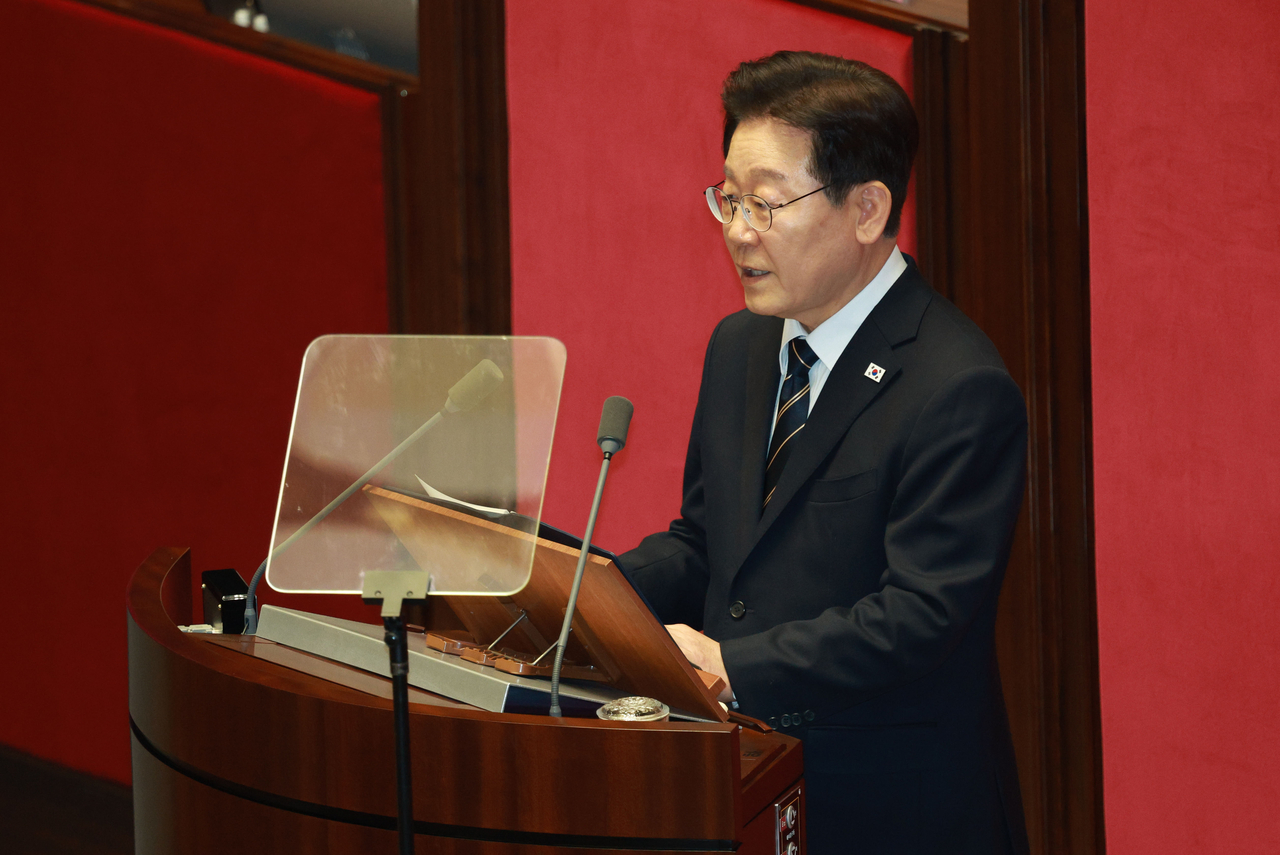
President Lee Jae Myung urged the National Assembly to swiftly pass a supplementary budget, underscoring that speed will determine whether South Korea can protect its economy and people’s livelihoods from the unpredictable fallout of the Middle East war.
“I stand before you today with a desperate sense of responsibility to protect our people’s lives and the economy in the face of the grave crisis caused by the Middle East war,” Lee said in his budget speech to the National Assembly on Thursday.
“With a grave recognition that the people’s livelihoods and economy are in a wartime-like state of emergency, the government is devoting all its efforts to overcoming the immediate crisis,” Lee added.
Lee called for bipartisan support for approval of a 26.2 trillion won ($17.1 billion) supplementary budget as the war in the Middle East entered its 34th day with no clear end in sight.
“This supplementary budget will act as a breakwater shielding people’s livelihoods from the waves of crisis, and as a springboard for South Korea’s post-crisis takeoff,” Lee told lawmakers. “The success or failure of overcoming this crisis depends on speed. I ask for bipartisan cooperation so that this budget proposal can be passed swiftly.”
Lee explained that the supplementary budget was "guided by the principle that the more severe the crisis, the more strongly we must protect the socially vulnerable, and with a determination not to miss the golden window for economic recovery."
“While making bold investments where they are most needed amid the Middle East war-driven crisis, we have designed the budget so that the burden is not passed on to our people or the broader economy,” Lee said. “In particular, I want to make it clear that this supplementary budget is a ‘debt-free’ budget that does not involve issuing government bonds.”
The supplementary budget bill, submitted to the National Assembly on Tuesday, is structured around five key pillars: 10.1 trillion won to ease the burden of high oil prices, 2.8 trillion won for livelihood stabilization, 2.6 trillion won to minimize industrial damage and stabilize supply chains, 9.7 trillion won to bolster local government finances, and additional allocations for government debt repayment.
The government plans to finance the package largely through 25.2 trillion won in excess tax revenues driven by a strong stock market and semiconductor sector, along with 1 trillion won from public funds.
Lee calls for steady resolve despite uncertainty
In a message to the public, Lee repeatedly underscored the far-reaching implications of the ongoing Middle East war, using the word “crisis” 28 times in his 15-minute budget speech.
“The crisis we are facing is not a passing shower that comes and goes. It is more like a massive storm whose duration we cannot predict. That is precisely why the situation is so grave,” Lee said.
“Even if the war were to end tomorrow, it would inevitably take a considerable amount of time to restore the Middle East’s damaged energy infrastructure and return supply to normal levels,” he added.
Lee reiterated that "We must overcome the current crisis with a long-term perspective and steady resolve, while preparing for the future, given that we cannot know when this crisis will end."
Lee explained that South Korea’s economy “has faced an unexpected, multifaceted crisis due to the Middle East war,” expressing his concern that the “hard-won momentum of our economic recovery could lose steam” amid the global economic downturn.
Lee repeatedly emphasized the exceptional nature of the crisis, saying “extraordinary times call for extraordinary measures.”
“Disruptions in oil supply have caused sharp increases in gasoline and diesel prices, while shortages of raw materials such as naphtha and urea are threatening a wide range of livelihoods, including the production of plastic products and fertilizers,” Lee said.
“Above all, given that this situation may not come to an end in the short term, we must prepare more thorough and robust responses."
The speech came after the ruling Democratic Party of Korea and the main opposition People Power Party agreed to put the budget bill to a plenary vote on April 10, despite remaining disagreements over its contents.
The proposal, which was submitted to the Assembly on Tuesday, must first clear the National Assembly’s Budget and Accounts Committee. However, People Power Party’s lawmakers led by Rep. Park Hyeung-soo, the committee’s executive secretary, blasted it as “vote-winning spending” during a joint news conference held Thursday morning.
The People Power Party members demanded cuts to around 20 items, including oil price subsidies, renewable energy financing, the petroleum reserve program, the government’s “Startup for All” initiative, and tourism policy loans.
dagyumji@heraldcorp.com

![[Surive&Thrive] Tips for getting around Seoul by subway (2)](https://wimg.heraldcorp.com/news/cms/2026/10/08/news-p.v1.20261006.1e7dee51d7f64cdba1a20b897d88cee6_T1.jpg?type=h&h=800)