President to deliver budget speech on 26.2 trillion won supplementary budget Thursday

President Lee Jae Myung said he could invoke emergency fiscal orders if needed to stabilize energy and other critical supplies hit by the Middle East war.
During a Cabinet meeting Tuesday, Lee called for "more rigorous oversight and finely calibrated contingency measures," citing South Korea's dependence on energy imports and heavy reliance on the Middle East for supplies of oil and gas.
Lee also ordered each ministry to "closely monitor, on a daily basis, the trends in the items under its responsibility, and take preemptive and bold action in response to any concerns over supply and demand instability."
Lee repeatedly urged his Cabinet to break the inertia of relying on established practices or standard procedures in addressing the current energy and supply shocks.
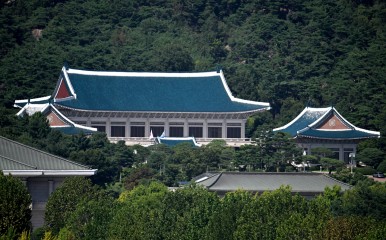
"What is needed now is a more proactive and forward-leaning response. If necessary, we must pursue legislative measures and make every effort to exercise the full extent of the authority and capabilities at our disposal," Lee said during the meeting at Cheong Wa Dae in Seoul.
"There is no need to be bound by existing practices. In urgent circumstances, the emergency financial and economic orders provided for under the Constitution may also be utilized," Lee added, without further details on what measures he was considering through the use of emergency orders.
Article 76 of the Constitution provides that the president may take the minimum necessary financial and economic measures, or issue orders having the effect of an act, only when urgent measures are required to maintain national security or public peace and order in times of internal turmoil, external threat, natural disaster or a grave financial or economic crisis.
There has been only one instance in which the provision was actually invoked since South Korea’s democratization in 1987: the introduction of the real-name financial transaction system under the Kim Young-sam administration in 1993.
Later in the meeting, Lee returned to the need to invoke presidential emergency powers, calling on the Cabinet to identify any institutional or legal hurdles to addressing on-the-ground challenges stemming from the Middle East war and report them either to the Cabinet or the presidential office.
"The Constitution provides for the emergency financial and economic order, a mechanism that can even substitute for legislation," Lee said.
At another point, Lee reiterated, "In urgent cases, procedures can be significantly shortened, and if necessary, action can be taken in the form of an emergency order.
"Even if it requires changing the system or enacting emergency legislation, we will resolve them."
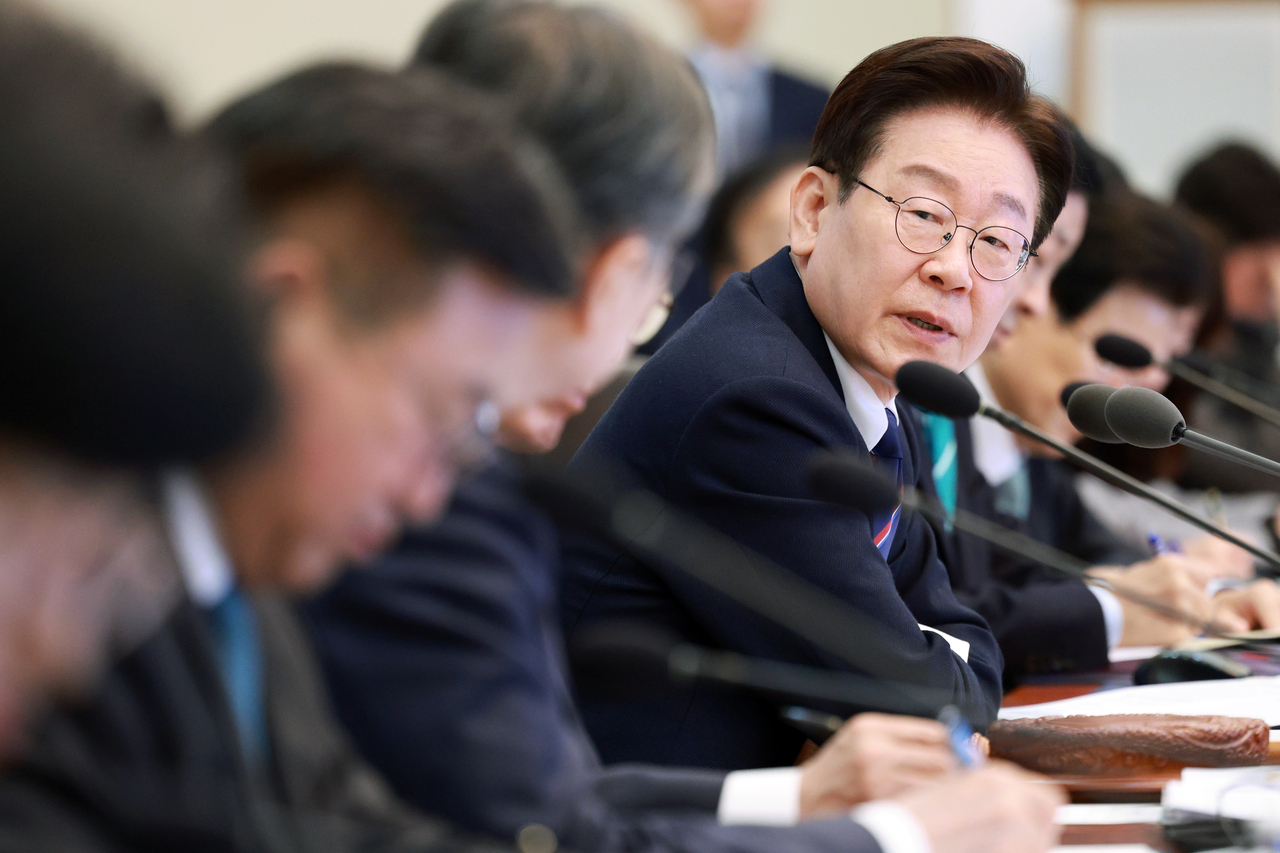
All-out crisis response
During the meeting, Lee further instructed that "key raw materials — including urea solution, helium and aluminum — be strictly managed at a level equivalent to wartime materials," in addition to emergency measures on naphtha supply and export controls, which took effect Friday.
"The same applies to various essential consumer goods and medical supplies directly linked to people’s everyday lives," Lee said.
Concurrently, Lee reiterated, "This Middle East war has made it clear that the major shift to renewable energy is no longer a task that can be postponed, but a national and era-defining imperative."
"If we leave the current economic and industrial structure, which depends on fossil fuels, as it is, we will inevitably remain exposed to such geopolitical risks going forward," Lee said. "We must now hasten fundamental measures. The direction has already been set. What remains is how quickly we execute it."
During the Cabinet meeting, a 26.2 trillion won ($17.1 billion) supplementary budget proposal aimed at cushioning the economic fallout from the Middle East war was reviewed and approved. The budget also includes measures to expand household renewable energy deployment to reduce reliance on fossil fuels. Lee is set to deliver a budget address to the National Assembly on the supplementary budget Thursday.
Fake news crackdown
Speaking at the Cabinet meeting, Lee reiterated his call for law enforcement to identify those who spread false information about the government’s response to disruptions in energy and industrial feedstock supplies and to "deal with them swiftly and sternly."
Lee rebutted rumors that the price of government-issued garbage bags would rise as "fake news," explaining that local ordinances set prices for such bags to cover administrative costs, effectively functioning as a form of tax.
Lee also pushed back against another rumor that 900,000 barrels of oil stored in Ulsan had been diverted to North Korea via a third country, pointing out that the crude was actually sold to Vietnam after the state-run Korea National Oil Corp. did not immediately exercise its priority purchase option.
Lee underscored that "spreading bizarre fake news to inflict harm or cause disruption is something that should never be tolerated," particularly at a time of national emergency.
"Such acts amount to serious crimes, because they disrupt public order and obstruct the country’s efforts to overcome a national crisis."
dagyumji@heraldcorp.com