Subway passengers may come across various hurdles: you might miss your stop, you're carrying a lot of luggage and require an elevator, or you need priority seating. In many cases, the subway system has you covered. Here are some tips for taking advantage of services that could be helpful when using Korea's expansive subway network.
Free re-entry within 15 minutes
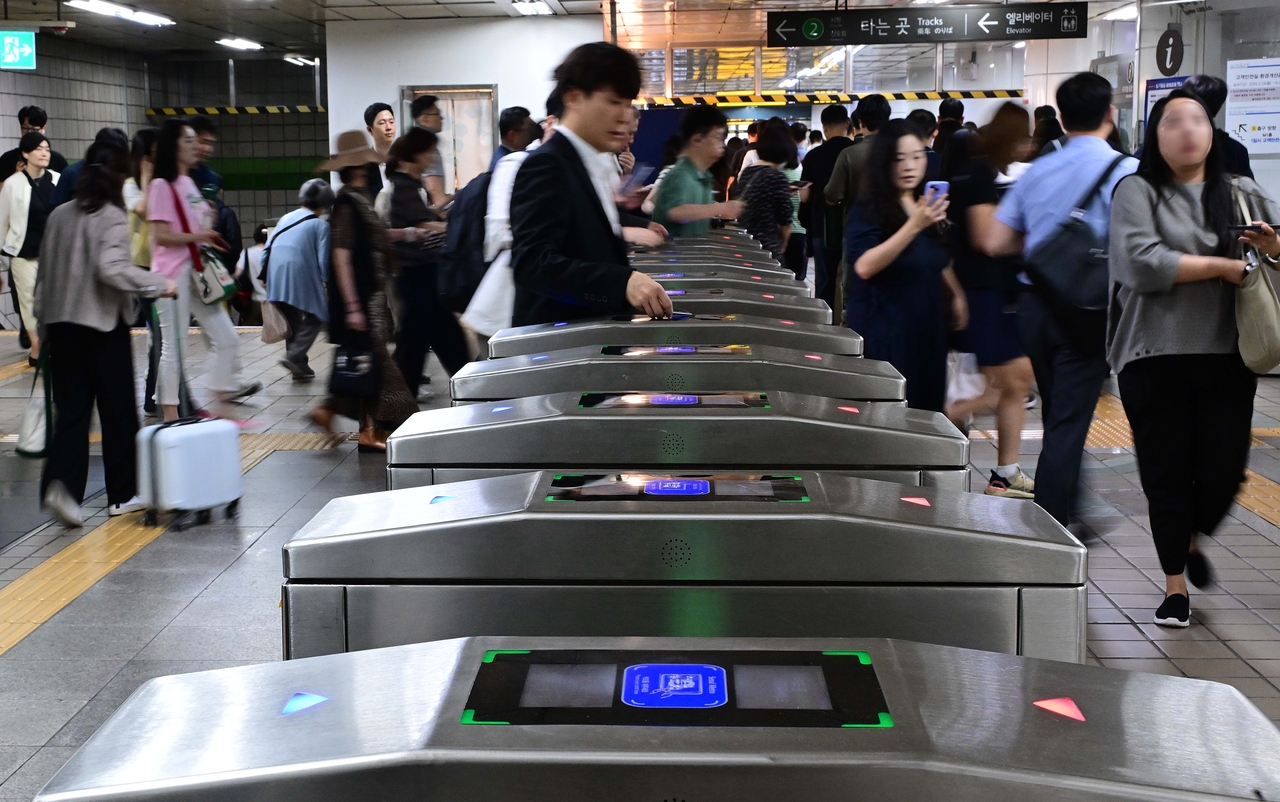
Major cities across the country have free transfer systems, as mentioned in a previous edition of this series, but many subway stations in the Seoul metropolitan area also allow passengers to get off at one station and reenter the same station within 15 minutes without paying an extra fare.
This had previously been offered at sections operated by Seoul Metro, but was expanded to sections operated by Korail in June. It does not apply to lines operated by private capital, such as the Airport Railroad (AREX), Shinbundang Line, Yongin EverLine, Uijeongbu Light Rail Transit and those run by the Incheon Transit Corporation, which includes all three major lines in the city and the Incheon section of Line No. 7. Some sections of the Seoul subway system are excluded as well.
Free reentry is possible only once during a single subway trip, and using it subtracts one of the five rides allowed by the free transfer system. You must enter the same line at the same station where you exited to get this benefit, and holders of one-time passes and prepaid passes are not eligible.
This is useful when you have to make a quick exit to use the bathroom, check the lost and found, or if you have missed your stop and have to go in the opposite direction, especially since some subway stations do not allow you to cross over to the other side without exiting the gate first.
The Busan Metro allows exit and free reentry within five minutes. The biggest difference from Seoul is that it applies only at the initial station of entry.
For example, if you enter at Seomyeon Station, you must exit and reenter there within five minutes. If you travel to even one station away, you have to pay the fare again to enter.
This does not count as a transfer, and holders of one-time passes and prepaid passes can use it. Free reentry is possible only once during a single subway trip.
The system applies to Lines No. 1 to No. 4, which are operated by the Busan Transportation Corporation.
Korail's Donghae Line, which is separate from the Busan Metro, has a similar five-minute reentry system for the initial station.
Stations without elevators
Seven stations in the Greater Seoul area under Korail's management reportedly do not yet have full elevator systems, referring to those that allow wheelchair users to reach the platforms in both directions without help.
Some stations have elevators that take passengers from outside to the concourse but not to the platforms, or only have elevators reaching the platform on one side. They are Seoksu Station, Gwanak Station, Guro Station, Namyeong Station, Hankuk Univ. of Foreign Studies Station and Kwangwoon Univ. Station on Line No. 1, and Hannam Station on the Gyeongui-Jungang Line.
Korail said it plans to set up a full elevator system at Seoksu Station, which was built in 1982, in Anyang, Gyeonggi Province, by 2029. Elevators at Guro and Hannam are currently under construction.
Seats, badges for pregnant women
Korean subways nationwide have seats exclusively reserved for pregnant women, although it is also acceptable for them to use the priority seats reserved for the elderly, disabled or others with mobility issues. The pregnant-priority seats are marked in pink and are located at the end of a row.
Women can signal their condition with pregnancy badges, which are issued at public health centers (bogeonso) or at customer centers at large subway stations.
You will need to show an ID — a resident card or a passport if you do not have it — and hospital documents to prove your pregnancy. If you register your pregnancy at a public health center, you could also receive related benefits, such as a free parking sticker for use at a public parking lot.
In addition to the priority seats for pregnant women, the Busan Metro has the country's first women-only cars, introduced in 2016.
While the cars still exist, the policy has been subject to criticism for being ineffective. There are no penalties for men who use the cars and most citizens treat it like any other car.
![[Surive&Thrive] Tips for getting around Seoul by subway (2)](https://wimg.heraldcorp.com/news/cms/2026/10/08/news-p.v1.20261006.1e7dee51d7f64cdba1a20b897d88cee6_T1.jpg?type=h&h=800)