[Key Points] North Korea's ‘third enrichment site’
Debate is intensifying over facilities in Kusong, North Korea, after Unification Minister Chung Dong-young identified the city as a potential third uranium enrichment site, a claim experts say remains unproven.
Chung made the remarks during a National Assembly Foreign Affairs and Unification Committee session on March 6, stating that North Korea operates uranium enrichment facilities in Yongbyon, Kusong and Kangson. It marked the first time a senior South Korean official had publicly named Kusong alongside the North’s known enrichment sites.
Chung said North Korea is estimated to have extracted about 16 kilograms of plutonium last year by removing spent fuel rods from the 5-megawatt reactor at Yongbyon, indicating that its nuclear weapons buildup is ongoing.
“In a report delivered to the Board of Governors on March 2, International Atomic Energy Agency Director General Rafael Grossi said that uranium enrichment facilities currently exist in Yongbyon, Kusong and Kangson, and that while Iran enriches uranium to about 60 percent, North Korea produces weapons-grade uranium enriched to around 90 percent,” He added.
“The director general also reported that an additional enrichment facility is being constructed at Yongbyon.”
Yongbyon is widely regarded as North Korea’s main nuclear complex, serving as the core of its plutonium production and uranium enrichment activities.
Contrary to Chung's claim, IAEA Director General Rafael Grossi did not mention Kusong in his latest report to the agency’s Board of Governors in Vienna, despite Chung citing the briefing. The IAEA has publicly focused on facilities at Yongbyon, while references to other sites remain limited.
Regarding Chung's remarks, a Unification Ministry official speaking on condition of anonymity said that the government cannot officially confirm it as a nuclear facility, only acknowledging that Kusong has appeared in past open-source analyses, including US think tank reports.
Limited evidence, cautious assessments
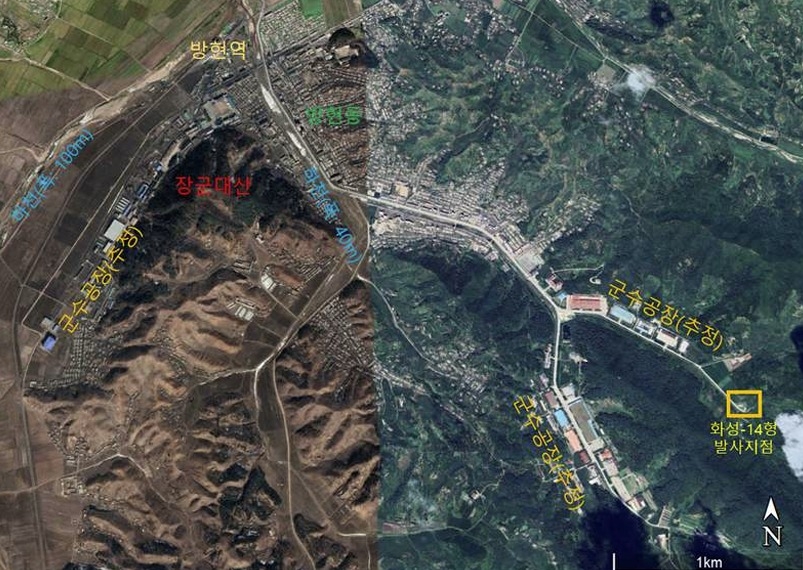
Much of the speculation surrounding Kusong traces back to a 2016 report by the US-based Institute for Science and International Security, which identified a suspected underground aircraft parts facility near the Panghyon area as a possible enrichment site.
However, even that report noted there was no evidence that the site was still operating as a centrifuge facility, and experts say not much new evidence has emerged since.
“The first analysis suggesting the possibility of a uranium enrichment facility in Kusong was the ISIS report in 2016, and additional corroborating evidence since then has been limited,” Hwang Jin-tae, a professor of North Korean studies at Dongguk University, said in a report released earlier this month.
To Hwang, the renewed attention to Kusong by a senior official could reflect shifting interpretations of North Korea’s military strategy.
“The fact that a site previously assessed as inactive is being revisited as a potential enrichment facility may indicate changes in North Korea’s nuclear strategy or military environment,” he said.
At the same time, he urged caution in drawing definitive conclusions.
“Given that Kusong is a well-known munitions hub and has already been exposed in past reports, it is questionable whether North Korea would strategically operate such a facility in a highly visible location,” Hwang said.
“Satellite imagery shows limited structural change or security enhancements in the area, raising the possibility that the site may not be actively in use.”
While evidence of uranium enrichment remains inconclusive, there is broader agreement among analysts that Kusong — particularly the Panghyon area — plays a significant role in North Korea’s military-industrial complex.
The region has long been considered a munitions production center; ballistic missile launches, including the Hwasong-14 intercontinental ballistic missile, were conducted nearby in 2017 under North Korean leader Kim Jong-un’s observation.
Satellite imagery analysis by NK Pro released in September last year further suggests that facilities in the area have undergone extensive renovations and expansion over the past two years.
The nearby Panghyon Airfield has also emerged as a focal point for North Korea’s growing drone program. According to NK Pro, frequent testing activity and signs of explosions at the airbase indicate ongoing development of uncrewed aerial vehicles, alongside accelerated construction of what appears to be a new drone production facility.
The expansion comes as Pyongyang seeks to modernize its drone capabilities and potentially mass-produce loitering munitions, following reported combat experience gained by North Korean personnel in drone warfare during Russia’s war in Ukraine.
Kim himself recently visited a construction site in Kusong near Panghyon, raising speculation that he may have also inspected drone-related facilities in the area.
Facilities in the Panghyon area were previously described by North Korean state media as “light aircraft production plants,” but their apparent evolution has fueled speculation about broader military applications.
During on-site inspections in 2014 and 2015, Kim was accompanied by senior officials linked to North Korea’s missile and defense industries, including Ri Pyong-chol, a senior military official overseeing missile development, and Jang Chang-ha, then head of the Academy of National Defense Science. Individuals believed to be associated with the factory have since appeared at events related to cruise missile and long-range weapons development.
Analysts say the site could function as a dual-use complex supporting both aircraft and weapons production — including drones and possibly missile systems.
Hwang also highlighted the structural advantages of Kusong as a potential strategic hub.
“Regions with concentrated munitions industries already possess the technical workforce, logistics infrastructure and security systems necessary for additional strategic weapons facilities,” the Seoul-based expert said. “This makes them more likely candidates for hosting such developments.”
Experts increasingly say the core issue surrounding Kusong is not whether it hosts a uranium enrichment facility, but the role it serves in North Korea’s expanding weapons production network.
“Analysis of Kusong goes beyond a simple regional study and provides an important clue for assessing whether North Korea is expanding its nuclear weapons production capabilities,” Hwang said.
“Satellite-based analysis can play a key role in identifying potential nuclear sites and could serve as a basis for expanding verification targets in future negotiations.”
For now, analysts agree that evidence remains insufficient to definitively classify Kusong as an enrichment site. But its growing role in missile and drone development suggests it is already central to Pyongyang’s strategic weapons ambitions.
mkjung@heraldcorp.com