South Korea maintained a cautious stance as of Friday amid mounting pressure from Washington and its allies over the Strait of Hormuz, even as key partners, including Western nations and Japan, issued a joint statement condemning Iran’s actions, from which Seoul was notably absent.
An official at South Korea's presidential office, speaking on condition of anonymity, underscored the broader stakes, saying, “The situation in the Middle East is a matter of significant importance in the international landscape, and the possibility of a prolonged crisis cannot be ruled out. In particular, any disruption to navigation through the Strait of Hormuz would have a direct impact on our energy supply and overall economy.”
The Cheong Wa Dae official added that Seoul is “in close communication with key allies, including the United States, and engaged in consultations through multiple channels” regarding possible contributions.
“International bodies such as the United Nations Security Council and the International Maritime Organization are viewing the situation with seriousness and have raised the need for a coordinated global response,” the official said. “Various countries are reviewing their own potential contributions to ensure freedom of navigation.”
Reaffirming the government’s position, the official said, “The safety of international sea lanes and freedom of navigation serve the interests of all nations and are protected under international law. Based on this principle, we hope the global maritime logistics network can return to normal as soon as possible.”
“At the same time, we are carefully reviewing response measures, taking into account domestic laws and procedures, as well as the security posture on the Korean Peninsula,” the official added. “We are seeking an optimal combination of policy options that best serve our national interests.”
Separately, a Foreign Ministry official, also speaking on condition of anonymity, said Seoul is closely monitoring developments but declined to elaborate on specific diplomatic exchanges.
“We are fully aware of the situation, but it is difficult to disclose details of communications conducted through diplomatic channels,” the official said. “Taking all relevant factors into account, we plan to review the matter going forward.”
The remarks came after seven countries — Canada, France, Germany, Italy, Japan, the Netherlands and the United Kingdom — issued a joint statement condemning what they described as the “de facto closure of the Strait of Hormuz by Iranian forces.”
The statement strongly condemned attacks on commercial vessels and civilian energy infrastructure and called for the restoration of freedom of navigation and compliance with international law. It also signaled willingness to contribute to efforts ensuring safe passage through the strait, though it stopped short of mentioning direct military support such as naval deployments.
Observers say the move reflects an attempt by US allies to align diplomatically with US President Donald Trump’s hard-line stance on Iran while avoiding the risks associated with direct military involvement.
As Washington intensifies calls for allied participation, South Korea has opted to maintain what observers describe as “strategic ambiguity.”
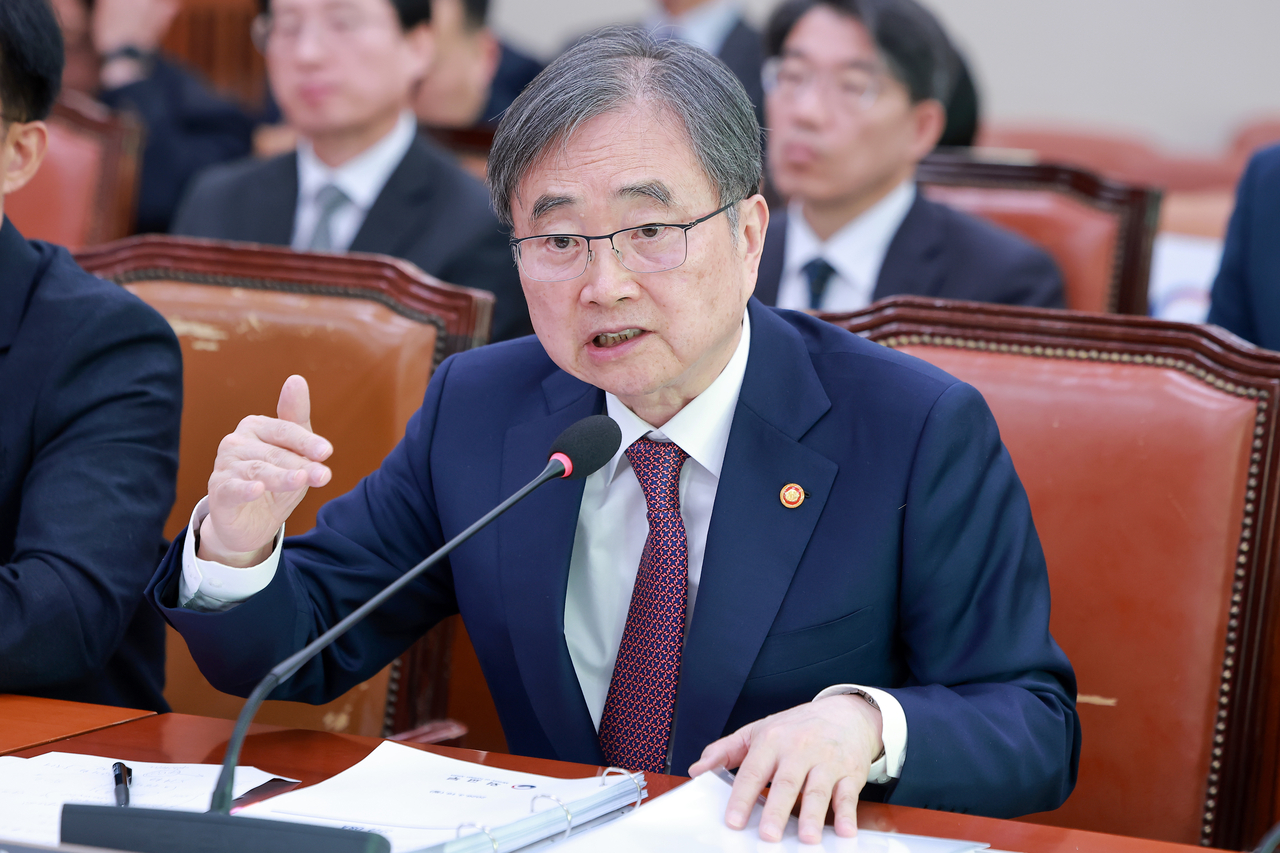
The approach was reflected in remarks by Foreign Minister Cho Hyun during a session of the National Assembly’s Foreign Affairs and Unification Committee on Tuesday, when he was asked whether there had been an official US request for naval deployment.
“It could be seen as a request, or it could not,” Cho said, maintaining an ambiguous stance.
He added that the government would proceed “while maintaining a degree of ambiguity,” emphasizing that decisions would be made in accordance with the Constitution and relevant laws, with national interests and the safety of Korean citizens as the top priority — signaling that avoiding a clear position remains the government’s approach.
Trump has repeatedly urged allies to take on a greater role in securing the Strait of Hormuz, a vital global shipping route that handles roughly one-fifth of the world’s oil supply. During a meeting with Japanese Prime Minister Sanae Takaichi on Thursday in Washington, he called on Tokyo to “step up,” citing Japan’s heavy reliance on energy imports through the strait.
Later, speaking to reporters, Takaichi said both leaders agreed that ensuring the safety of the Strait of Hormuz is “of utmost importance,” but noted that Japan’s response would be constrained by its legal framework. Japan’s pacifist constitution and limits on collective self-defense continue to restrict its ability to engage in overseas military operations, making any deployment politically and legally sensitive.
The remarks were widely interpreted as part of a broader push by Washington for allies — including South Korea — to shoulder more responsibility in maritime security and energy protection. Trump has previously suggested that countries benefiting from the waterway should contribute naval assets, though he later added that the US no longer requires their naval assistance, a move seen as reflecting frustration over allies’ perceived reluctance.
As countries remain hesitant to provide tangible military support, some experts argue that South Korea should at least align with others at the level of rhetorical backing.
“Looking at the joint statement, it is closer to condemnation than to any concrete action,” said Park Won-gon, a professor of international studies at Ewha Womans University. “It would have been preferable for South Korea to express a degree of rhetorical support for the US position.”
Another expert noted that Seoul faces a complex policy choice that goes beyond a simple decision of whether to deploy forces.
“In issues such as Hormuz, rather than viewing it as a binary choice between immediate deployment and nonparticipation, there is a need to design a layered approach to contributions,” said Yu Ji-hoon, a research fellow at the Korea Institute for Defense Analyses and a former Navy commander.
Yu noted that, similar to Japan, South Korea could maintain diplomatic alignment with Washington while approaching any potential military role in stages, taking into account legal constraints, command structures and escalation risks.
Given the complex threat environment in the Strait of Hormuz — including naval mines, drones, coastal missiles and risks to commercial shipping — he suggested Seoul consider a range of options, from information sharing and maritime safety support to energy cooperation and, if necessary, limited naval contributions.
“The key is not simply whether to comply with or reject Washington’s demands, but how to design a calibrated middle ground that balances national interests with alliance commitments,” Yu said.
mkjung@heraldcorp.com