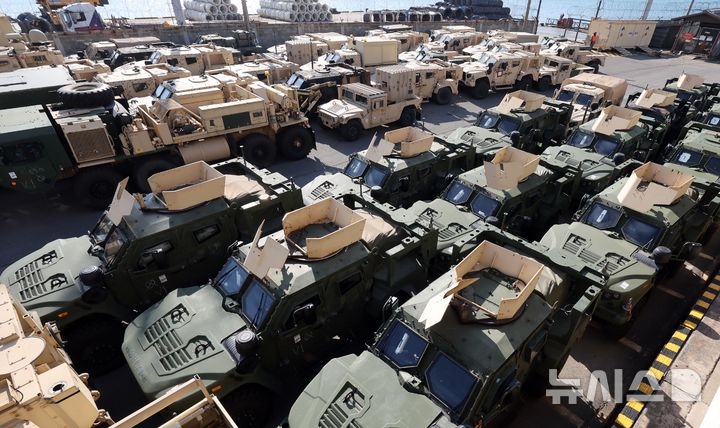
Seoul was cautious Thursday on news reports that South Korea and Washington are discussing the potential redeployment of some United States Forces Korea assets, as tensions escalate in the Middle East.
A Cheong Wa Dae official, declining to be named, said Thursday, "It would not be appropriate for our government to comment on the operational employment of USFK."
The official added, "The mission of USFK is to maintain a strong combined defense posture with South Korean forces and contribute to peace and stability on the Korean Peninsula and in the region. To that end, South Korea and the United States will continue close communication and coordination."
The official addressed earlier reports by local media that Seoul and Washington are holding consultations regarding the operational use of USFK and the possible redeployment of certain capabilities to the Middle East.
The Ministry of National Defense also remained cautious on the matter.
"The goal of USFK is to maintain a strong combined defense posture with South Korean forces and contribute to peace and stability on the Korean Peninsula and in the region," Defense Ministry spokesperson Chung Bin-na said at a regular briefing Thursday, echoing the official in the presidential office. "To that end, Seoul and Washington remain in close communication regarding the operational employment of USFK forces."
The position falls in line with statements from USFK and the US Department of Defense.
Asked about details of a potential redeployment and assets that could be involved, the USFK and the US Department of Defense separately sent the same statement to The Korea Herald.
"For operational security reasons, we do not comment on the movement, relocation, or potential repositioning of specific military capabilities or assets," the statement reads. "United States Forces Korea remains focused on maintaining a strong, ready, and combat-credible force posture on the Korean Peninsula. The United States remains firmly committed to the defense of the Republic of Korea."
Republic of Korea is the formal name of South Korea.
The local media report came as the US' and Israel's conflict with Iran shows signs of becoming prolonged, raising concerns about growing demand for ammunition and air defense capabilities in the Middle East.
The issue of possible redeployment of USFK assets has resurfaced alongside renewed discussion of Washington's concept of "strategic flexibility," under which US forces stationed in South Korea may be used for operations beyond the Korean Peninsula.
US President Donald Trump said early in the week that military operations against Iran were initially expected to last four to five weeks, but could continue longer if necessary.
Meanwhile, military analysts say that the potential redeployment of USFK assets to the Middle East cannot be completely ruled out. Assets that could potentially be redeployed include tactical surface-to-surface missiles, such as the Army Tactical Missile System, or ATACMS, as well as air and missile defense systems including the Patriot PAC-3, according to an expert.
With Iran warning it could launch additional attacks against US bases in the Middle East using advanced weaponry, air defense capabilities are widely viewed as the most likely candidates for redeployment.
Yu Ji-hoon, a research fellow at the state-run Korea Institute for Defense Analyses and a former Navy commander, said air defense systems such as Patriot batteries could be temporarily deployed.
"The Middle East faces persistent threats from ballistic missiles, cruise missiles and drones, meaning the US military urgently requires capabilities to defend bases and critical facilities," Yu said. "In that context, some air defense assets such as Patriot systems could be deployed temporarily on a mission-focused basis."
A similar redeployment occurred last year. Following Israel's strikes on Iran in June, two Patriot batteries operated by USFK were rotationally deployed to the Middle East, where they were reportedly used to defend US bases in Qatar against potential Iranian retaliation.
"Systems such as the Terminal High Altitude Area Defense (antimissile system) carry significant strategic and political implications," Yu said. "As such, rather than relocating the entire system, it may be more realistic to deploy specific operational elements — such as surveillance components, personnel or intelligence analysis support — for a limited period."
Such adjustments could also raise concerns in South Korea about potential air defense gaps, Yu explained.
If that occurs, Washington would likely emphasize that deterrence on the Korean Peninsula remains intact while implementing compensatory measures, such as enhanced combined operations or other reinforcements, Yu said.
However, Yu said that large-scale redeployment of combat aircraft or ground combat units remains unlikely because those assets are closely tied to maintaining immediate readiness on the Korean Peninsula.
mkjung@heraldcorp.com