Lee vows to launch $300 million joint AI venture 'mother fund' in Singapore by 2030
South Korea and Singapore agreed Monday to begin negotiations to upgrade their bilateral free trade agreement and deepen cooperation in nuclear energy, including small modular reactors, as the two countries seek to strengthen economic security amid growing global uncertainty.
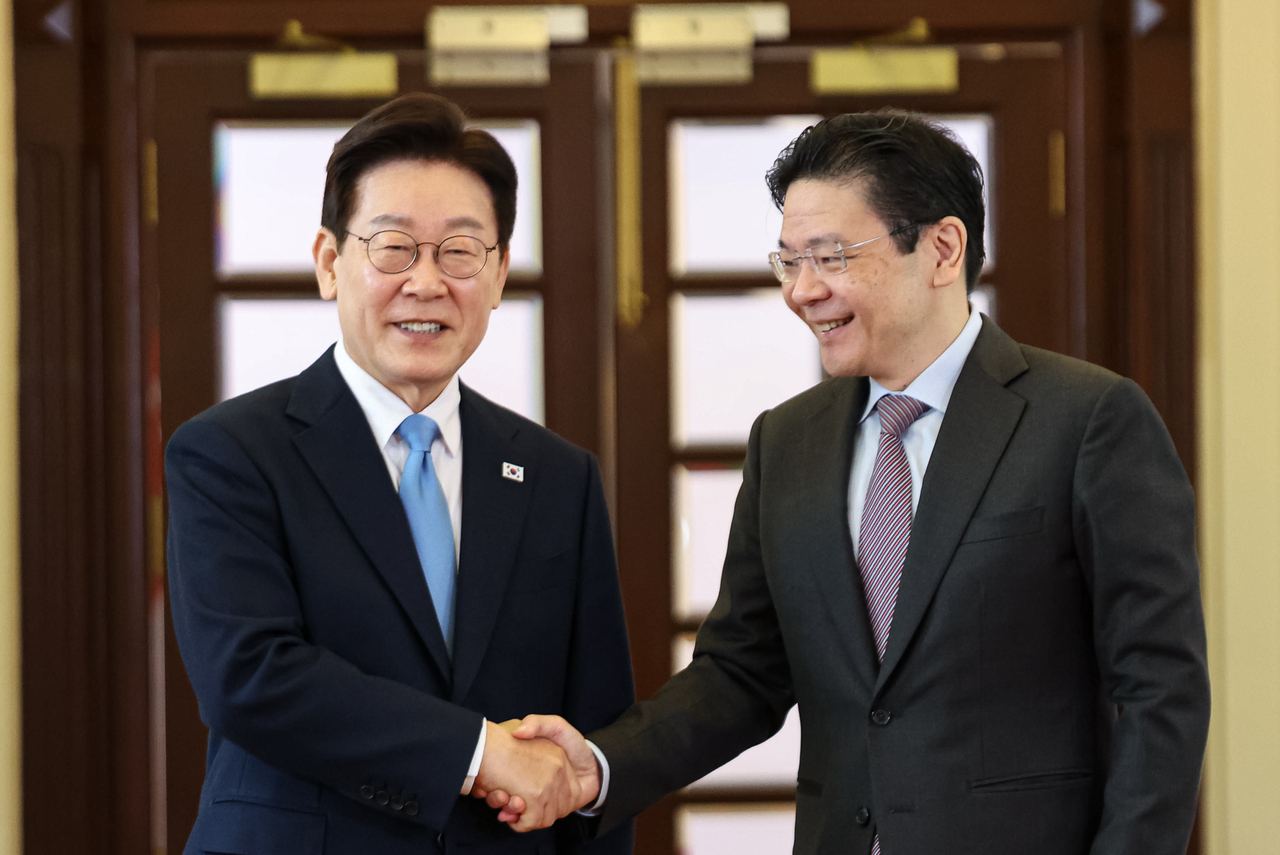
President Lee Jae Myung and Singaporean Prime Minister Lawrence Wong announced the decision following summit talks at Singapore’s Ministry of Foreign Affairs, marking their second meeting in four months since elevating ties to a strategic partnership. The agreements are part of five memorandums of understanding signed on Monday covering areas such as artificial intelligence, small modular reactors, and digital as well as science and technology cooperation.
The two leaders said they would formally launch negotiations to modernize the Korea-Singapore FTA, which entered into force in 2006, to better reflect changes in the global economy, digital trade and emerging strategic industries.
"We concurred on the need to bolster the economic ties that have led the development of our bilateral relations, while accelerating innovation in future-oriented, cutting-edge industries such as artificial intelligence and reinforcing the foundations of our cooperation in defense and security," Lee said during the joint press conference.
"We two leaders agreed to upgrade the bilateral Free Trade Agreement, which took effect twenty years ago, in a manner that fully reflects evolving trade and economic security dynamics, as well as technological advances," he added.
Wong highlighted in his joint statement that the steady expansion of bilateral economic ties, noting that Singapore’s investments in Korea have more than doubled since 2000.
“First, we are strengthening our trade and economic ties,” he said. He said the growth in bilateral trade was built on the 2006 Korea-Singapore FTA but noted that “the global trading landscape has evolved significantly,” underscoring the need to update the pact with greater focus on supply chain resilience and the green transition.
A key pillar of the expanded cooperation is nuclear energy, particularly in the field of small modular reactors — an emerging technology viewed as a next-generation solution for clean, stable power generation.
“Singapore is studying the potential of nuclear energy as part of our longer-term energy mix and we hope to learn from Korea's expertise and experience,” Wong said in his press statement. “We have commenced negotiations on a nuclear cooperation agreement and I look forward to its swift conclusion.”
Beyond nuclear energy, the two countries signed additional MOUs covering artificial intelligence, digital and science and technology cooperation, underscoring their shared interest in strengthening competitiveness in high-tech and future industries.
Lee emphasized that future-oriented sectors such as AI, energy transition, economic security and defense industry cooperation will form the backbone of the upgraded strategic partnership.
To further advance AI collaboration, Lee attended the AI Connect Summit, a bilateral business forum bringing together industry leaders and entrepreneurs from both countries, in the afternoon.
He announced at the summit that Seoul plans to establish a $300 million global “mother fund” in Singapore by 2030 to support joint AI ventures. The fund, he said, will serve as a key driver to accelerate the global expansion of AI companies from both countries and help build an innovation-centered ecosystem for shared growth.
Lee then pledged to support cross-border joint research starting next year, aimed at breaking down national boundaries in technological collaboration.
“We will ensure that researchers from both countries can work closely together and devote themselves to developing AI technologies that address the most pressing challenges facing humanity,” Lee said. “We will also support the global diffusion of the cutting-edge technologies secured through such cooperation.”
AI has emerged as a central pillar of cooperation between the two tech-driven economies. South Korea brings strengths in semiconductors, data center infrastructure and AI manufacturing, while Singapore is known for its advanced AI governance framework and its role as a regional data hub in Southeast Asia.
Lee also reflected on the broader trajectory of bilateral ties, noting that over the past century both Korea and Singapore had overcome geopolitical constraints and a lack of natural resources to emerge as exemplary middle powers through nation-building and modernization. He said he and Wong shared the view that, amid what he described as a new era of “hyper-uncertainty” in the 21st century, the two countries could serve as reliable partners in navigating future challenges together.
"Prime Minister Wong and I shared the view that, as we navigate yet another challenge — the era of hyper-uncertainty in the 21st century —our two countries can become reliable partners," Lee said in his speech.
On top of it, Lee mentioned Singapore’s pivotal diplomatic role in supporting peace efforts on the Korean Peninsula, recalling its hosting of the landmark 2018 US-North Korea Summit.
"Singapore played the important role of serving as the historic location of the 2018 North Korea-United States Summit," Lee said in his joint speech.
"I would like to express my deepest gratitude to the Prime Minister for actively supporting our government’s efforts to achieve peace and stability on the Korean Peninsula and resume inter-Korean dialogue. ... I believe that Singapore will continue to play a constructive role in promoting peace on the Korean Peninsula and in the region."
Prior to Monday's summit, Lee was received by Singaporean President Tharman Shanmugaratnam at an official welcome ceremony. He also took part in an orchid-naming event, where a hybrid orchid — “Vanda Lee Jae Myung Kim Hea Kyung” — was unveiled in honor of the president and first lady’s state visit.
The Korea-Singapore Free Trade Agreement, which entered into force in 2006, was South Korea’s first FTA with an ASEAN member state and laid the foundation for expanded trade in goods and services, as well as investment flows between the two countries.
The pact eliminated most tariffs and established frameworks for cooperation in services, finance and intellectual property, helping to boost bilateral trade and position Singapore as a key gateway for Korean companies seeking to enter Southeast Asia.
Officials from both sides now say the agreement needs to be updated to reflect changes in the global economy, including digital trade, supply chain resilience and the transition toward greener growth.
mkjung@heraldcorp.com