Seoul vows to stay the course on peaceful coexistence, calls for restraint in 'hostile rhetoric'
North Korean leader Kim Jong-un said Pyongyang could build relations with the United States if Washington abandons what it calls a hostile policy, while dismissing Seoul’s dialogue efforts as insincere, the North's state media said Thursday.
"We have no reason not to get along with the United States if it respects our country's current status, as defined in the North Korean constitution, and drops its hostile policy toward North Korea," Kim was quoted as saying during the Party Congress by the Korean Central News Agency.
North Korea’s constitution was revised in 2012 to declare the country a “nuclear-armed state,” a status that has since been reinforced through additional legal and constitutional changes emphasizing permanent nuclear force development. Kim’s remark reflects Pyongyang’s long-standing demand that Washington acknowledge its claim as a precondition for meaningful dialogue, according to a report by the state-affiliated Institute for National Security Strategy, distributed to reporters during a press briefing Thursday.
Kim's message came during a policy review session held from Friday to Saturday at the Ninth Congress of the ruling Workers’ Party of Korea, which wrapped up its weeklong schedule the day before, the KCNA reported.
"Whether it's peaceful coexistence or eternal confrontation, we are prepared for both, and the choice is not ours," he said.
The remarks suggest Pyongyang is keeping the door open for renewed diplomacy with Washington, especially as US President Donald Trump’s planned visit to China in April is viewed as a possible catalyst for restarting high-level talks, which largely stalled after the collapse of US-North Korea summit diplomacy in 2019 during Trump’s first administration.
Kim rebuffs Seoul outreach
At the same time, Kim strongly rebuked the Lee Jae Myung administration’s engagement drive, labeling it deceptive, and warning that South Korea would be permanently removed from what the North calls “the category of the same people.”
Kim has already framed inter-Korean relations as those between hostile states since 2024 and has maintained a hard-line posture toward Seoul despite a recent series of conciliatory efforts by the South. Seoul's attempts at reducing tension have included proposals to reinstate a no-fly zone near the inter-Korean border under the suspended Sept. 19 military agreement, and efforts to secure US backing to resume humanitarian projects in the North.
"We will have no business dealing with South Korea, the most hostile entity," Kim said, adding that this stance will be confirmed in the ruling party's policy.
Kim accused previous South Korean governments of attempting to undermine the North Korean system and dismissed the current administration’s outreach as superficial and misleading.
"The current state of having nullified all conditions connected with South Korea will be perpetuated," Kim said, warning that the only path to safety for South Korea is "abandoning everything (connected with Pyongyang) and not touching us."
Kim also cautioned Seoul against actions he described as destabilizing, saying Pyongyang could resort to preemptive or other enemy-targeted measures and that the "complete collapse" of South Korea could not be ruled out if the North were to take what he called an "arbitrary action."
Kim also reiterated North Korea’s identity as a nuclear-armed state and pledged to accelerate weapons development.
"It is our party's firm and unwavering will to further strengthen state nuclear forces and thoroughly exercise nuclear-armed state status," Kim was quoted by the KCNA as saying.
"Our status as a nuclear-armed country plays an important role in deterring enemies' potential threats and maintaining regional stability," Kim said, calling the country's nuclear weapons "a guarantee and safety device" of its security and interests.
Kim also committed to continuing nuclear weapons production and suggested the pursuit of a sea-based intercontinental ballistic missile capability, saying that within five years the country’s “defense power” would reach a level difficult for adversaries to counter.
"We have a plan each year to strengthen state nuclear forces and will focus on increasing the number of nuclear weapons, expanding nuclear operational capabilities and broadening the space of their utilization," Kim noted as he outlined a new five-year defense buildup plan.
The plan includes land- and submarine-launched ICBMs, artificial intelligence-enabled drones, reconnaissance satellites, and strategic and electronic warfare systems capable of targeting enemy satellites and command infrastructure during wartime.
KCNA said Kim placed significant emphasis on developing nuclear-powered naval forces and enhancing maritime operational capabilities, signaling Pyongyang’s interest in nuclear-powered submarines and stronger naval capacity.
On the economic front, Kim presented trade and tourism as new growth drivers and instructed officials to expand development in aviation and artificial intelligence.
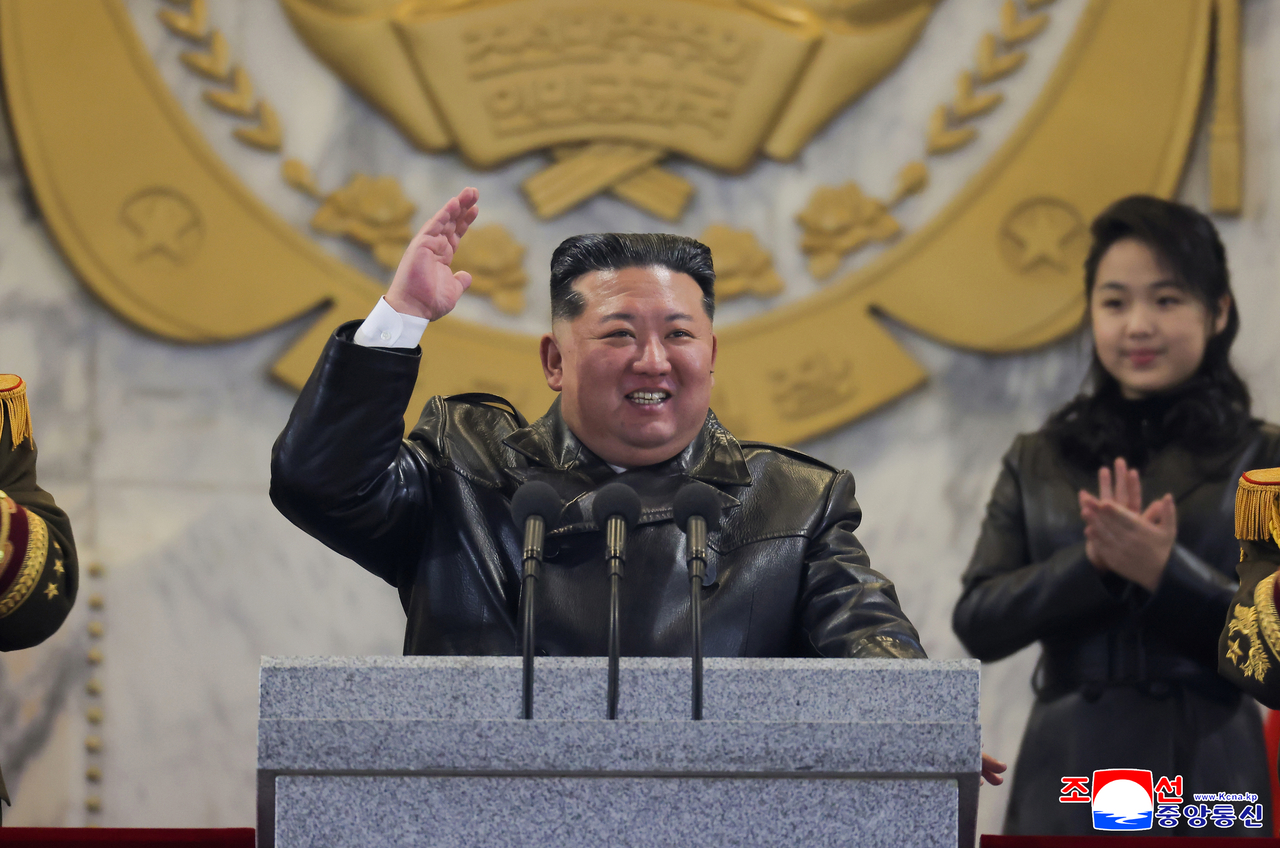
Following the congress, North Korea held a military parade at Kim Il Sung Square in Pyongyang attended by Kim, his wife Ri Sol-ju and their teenage daughter known as Ju-ae, widely viewed as a potential successor.
Seoul stays course on peace
Seoul, meanwhile, said it will not be swayed by Pyongyang's shifting posture and will continue to pursue its policy of peaceful coexistence on the Korean Peninsula with patience and consistency.
An official at South Korea’s presidential office said the government will continue striving to open a future of peaceful coexistence and shared prosperity between the two Koreas, stressing that both sides must refrain from hostile rhetoric and confrontational actions and work to build a foundation of mutual respect and trust.
However, the South's Unification Ministry also expressed regret that North Korea reaffirmed its “two hostile states” stance at the party congress and did not respond to Seoul’s efforts toward peaceful coexistence on the Korean Peninsula.
"Peaceful coexistence on the peninsula is the only path that guarantees the present and future safety of all people in both Koreas," the ministry said, adding that the government would firmly uphold its three principles toward North Korea — respecting the North Korean system, not pursuing unification by absorption and refraining from any hostile acts.
A Unification Ministry official said Kim Jong-un's latest message toward Seoul has not fundamentally changed when asked if Kim’s remarks had become harsher than before.
“The overall substance has not changed,” the official told reporters, adding that while the Lee administration has made efforts to engage the North, more work is needed to ease Pyongyang’s hostile stance.
“Policy direction does not change overnight,” the official said. “We will continue to pursue our approach consistently and with patience.”
Yang Moo-jin, a distinguished professor at the University of North Korean Studies, said, “The ‘two hostile states’ doctrine may have been formally codified in the party charter, and territorial provisions could later be institutionalized through the Supreme People’s Assembly.”
Although revisions to the party charter were included on the congress agenda, specific details were not disclosed.
Hong Min, a senior research fellow at the Korea Institute for National Unification, said, “North Korea has made clear that South Korea should not intervene in US-North Korea summit diplomacy and that it views the South as a hostile state against which nuclear force could be used.”
mkjung@heraldcorp.com