Kim's elevation positions her as the likely operational architect of Pyongyang's hard-line strategy toward Seoul, Washington, expert says
Kim Yo-jong, the influential sister of North Korean leader Kim Jong-un, has consolidated her standing within the ruling Workers' Party of Korea after being promoted to department director and reinstated as an alternate member of the Politburo during the ongoing party congress, observers said Tuesday.
The North's state-run Korean Central News Agency reported Tuesday that Kim Yo-jong had been among 17 department directors of the party's new Central Committee at the first plenary meeting of the Ninth Central Committee held the previous day. She had previously served as a vice department director.
Kim was also reappointed as an alternate member of the Political Bureau — returning to the party's core decision-making structure five years after she was removed from the post at the eighth party congress in 2021. She first entered the politburo as an alternate member in 2017.
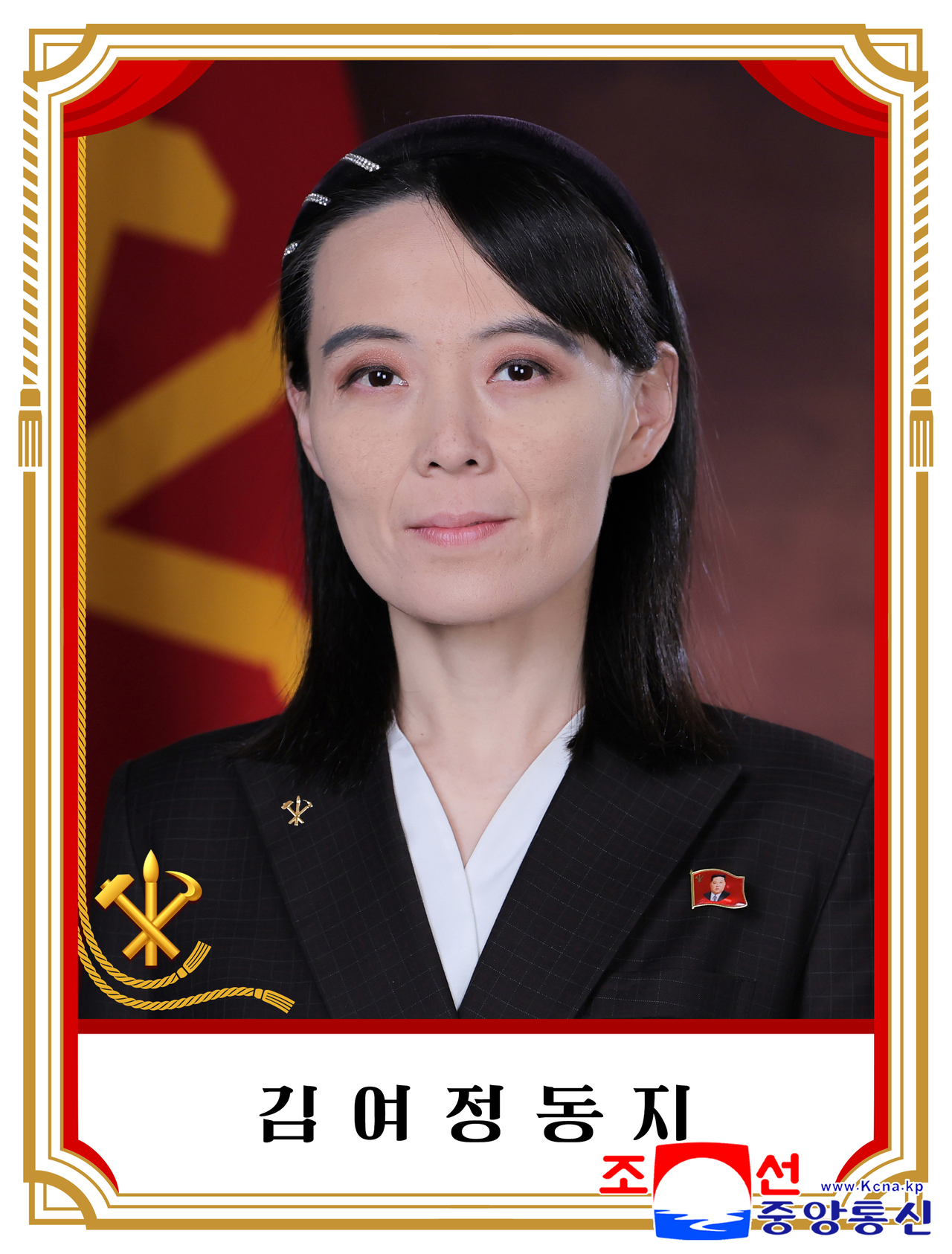
The KCNA did not disclose which department Kim would lead, but given her track record of issuing statements on inter-Korean and US-related issues, analysts say she could also assume a broader role overseeing external strategy.
Lim Eul-chul, a professor at Kyungnam University's Institute for Far Eastern Studies, said the promotion is likely to position Kim Yo-jong as a central operational figure in Pyongyang's external strategy.
"With the official title of Central Committee department head, Kim Yo-jong is expected to play a leading practical role in external affairs," Lim said. "As North Korea has redefined inter-Korean relations as involving a 'hostile state' in recent years and shifted toward a more offensive posture in its policies toward the US and South Korea, she is likely to have been appointed to lead a newly established department dedicated to overseeing those strategies."
Hong Min, a senior researcher at the Korea Institute for National Unification, pointed out, "Kim Yo-jong's scope of activities has already surpassed that of other Presidium of the Politburo members, but she had not been given a higher official post due to her young age."
By formally elevating her now that she is 38 years old, the move appears aimed at strengthening Kim Jong-un's rule and stabilizing the succession framework, Hong added.
A Unification Ministry official, requesting anonymity, told reporters in the morning that Seoul would closely monitor Kim Yo-jong's exact portfolio and whether her elevation signals an expanded role in inter-Korean affairs or broader external strategy.
"The fact that Kim Yo-jong entered the post of party department head for the first time and that Jo Yong-won was excluded from the positions of party secretary and department head suggests there may have been a change in the leadership of the Organization and Guidance Department of the Workers' Party of Korea" a Unification Ministry official said.
Jo Yong-won, the party's organizational secretary and a close confidant of Kim Jong-un, kept his position on the Presidium of the Politburo, but was relieved of his secretary role.
It is possible that Jo will take over as chair of the Standing Committee of North Korea's Supreme People's Assembly, following the removal of Choe Ryong-hae, Kim Jong-un's longtime senior aide, from the post earlier during the congress.
"The number of party secretaries has increased from seven to 11, and it is presumed that the post of international secretary has been restored," the official explained. "It remains unclear which department Kim Yo-jong is heading, but we will closely watch whether she will take on roles related to inter-Korean affairs or external policy."
Asked whether Kim Yo-jong could succeed Ri Son-gwon as head of the party's 10th Bureau — the inter-Korean affairs department formerly known as the United Front Department — an official said, "We need to first determine whether the 10th Bureau still exists, and it is difficult to make any assumptions at this point."
The "10th Bureau" is part of an organizational restructuring the South Korean government believes Pyongyang is making, though North Korean state media sources have never officially referred to it by that name. Ri is a former foreign minister known for his hard-line stance on inter-Korean relations.
The latest reshuffle was made at Monday's plenary session of the party congress, which began last week to assess policy outcomes since 2021 and set goals for the next five years.
South Korean officials view the personnel decisions as designed to reinforce the party's governance capacity through generational change and specialization across sectors such as propaganda, the military, economic management and education.
The reshuffle did not include Kim Jong-un's minor daughter, known as Ju-ae, who is widely viewed by analysts as a potential successor.
"Through generational replacement, Kim Jong-un's state governance functions are expected to be strengthened, and the expansion of party secretaries appears likely to enhance the party's overall leadership capacity," the Unification Ministry official explained.
mkjung@heraldcorp.com