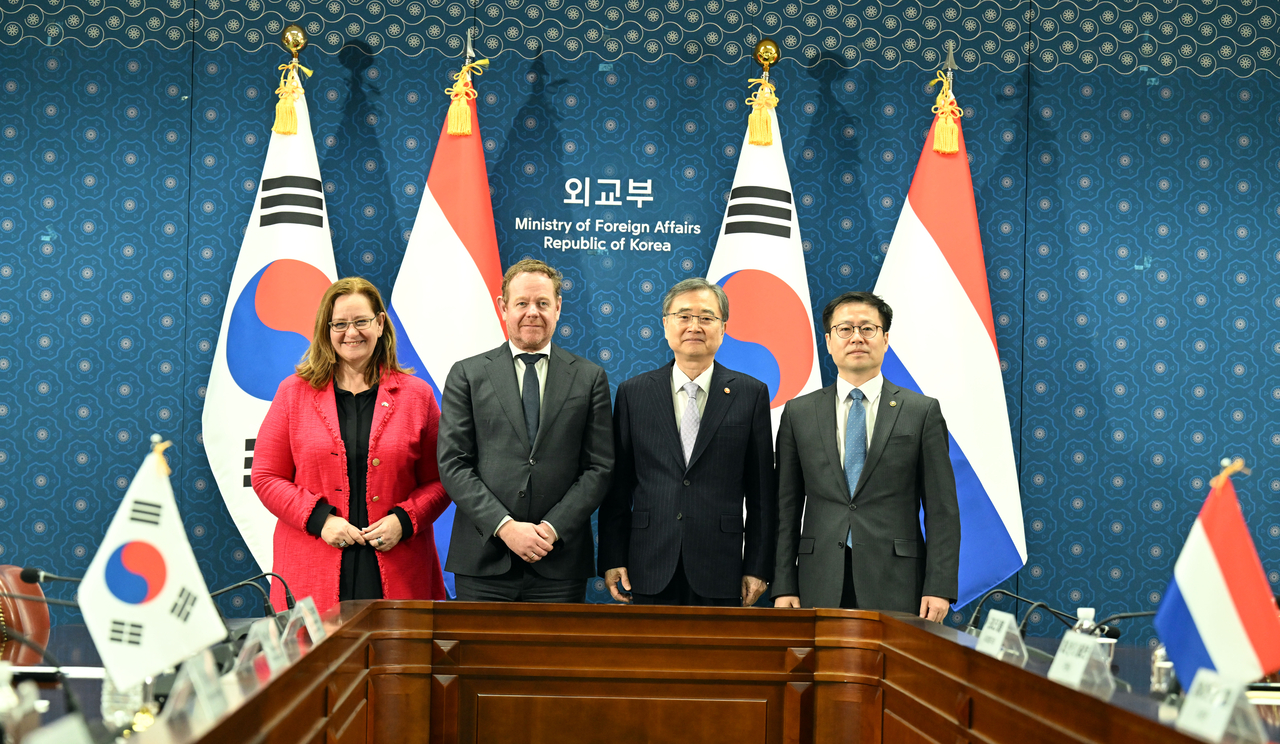
South Korea and the Netherlands agreed Wednesday to deepen cooperation on economic security, advanced technology and supply-chain resilience, amid rising geoeconomic tensions and a weakening global trade environment, a joint statement released by Seoul's Foreign Ministry said.
Foreign and trade ministers from both countries held the inaugural 2+2 foreign and industry high-level dialogue in Seoul, underscoring the need to strengthen their strategic partnership in response to disruptions in global trade and rapid technological change.
Wednesday's talks were attended by Foreign Minister Cho Hyun and Trade Minister Yeo Han-koo, with their respective Dutch counterparts, David van Weel and Aukje de Vries.
In a joint statement, the two sides said the new framework reflects a shared recognition that closer coordination is needed to safeguard sustainable growth, economic security and technological leadership within a rules-based international order.
“Against the backdrop of increasing geoeconomic tensions, a faltering international trade system, and rapid advancements in new and disruptive technologies, the ministers reaffirmed the need to further deepen bilateral cooperation,” the statement said.
The ministers highlighted the South Korea-Netherlands strategic partnership as a key mechanism for ensuring long-term growth capacity and economic security, noting the two countries’ strong trade and investment ties and expanding collaboration across emerging sectors.
Both sides pointed to progress in cooperation on trade, semiconductors, cybersecurity and critical raw materials, as well as joint efforts to promote the responsible use of artificial intelligence in the military domain. They also cited regular consultations on export controls and early warning systems as effective tools for strengthening economic security.
The ministers agreed to expand cooperation on monitoring supply chains and diversifying sources of critical materials, stressing the importance of building transparent and secure supply networks for key technologies and strategic items.
In the digital domain, the two countries pledged to work together to promote an open, secure and interoperable cyberspace while strengthening collaboration on deterring cyber threats and developing international norms and legal frameworks.
They also reaffirmed support for international initiatives on responsible artificial intelligence in military use, including the Responsible AI in the Military Domain process and related United Nations resolutions, and agreed to explore broader cooperation on safe and human-centric AI development through regular bilateral working-level dialogue.
Semiconductor cooperation emerged as a central pillar of the discussions, with both sides welcoming expanded government consultations, trade missions and joint participation in industry exhibitions. The ministers said they would seek closer linkages between the two countries’ semiconductor ecosystems, including partnerships among small and medium-sized firms and research institutions.
The two countries also committed to exploring mutual investments in advanced technology sectors, building on a recent letter of intent signed in The Hague to advance joint research and development projects in strategic fields such as semiconductors and quantum technology.
The ministers agreed to hold the next 2+2 foreign and industry high-level dialogue in two years in The Hague.
mkjung@heraldcorp.com