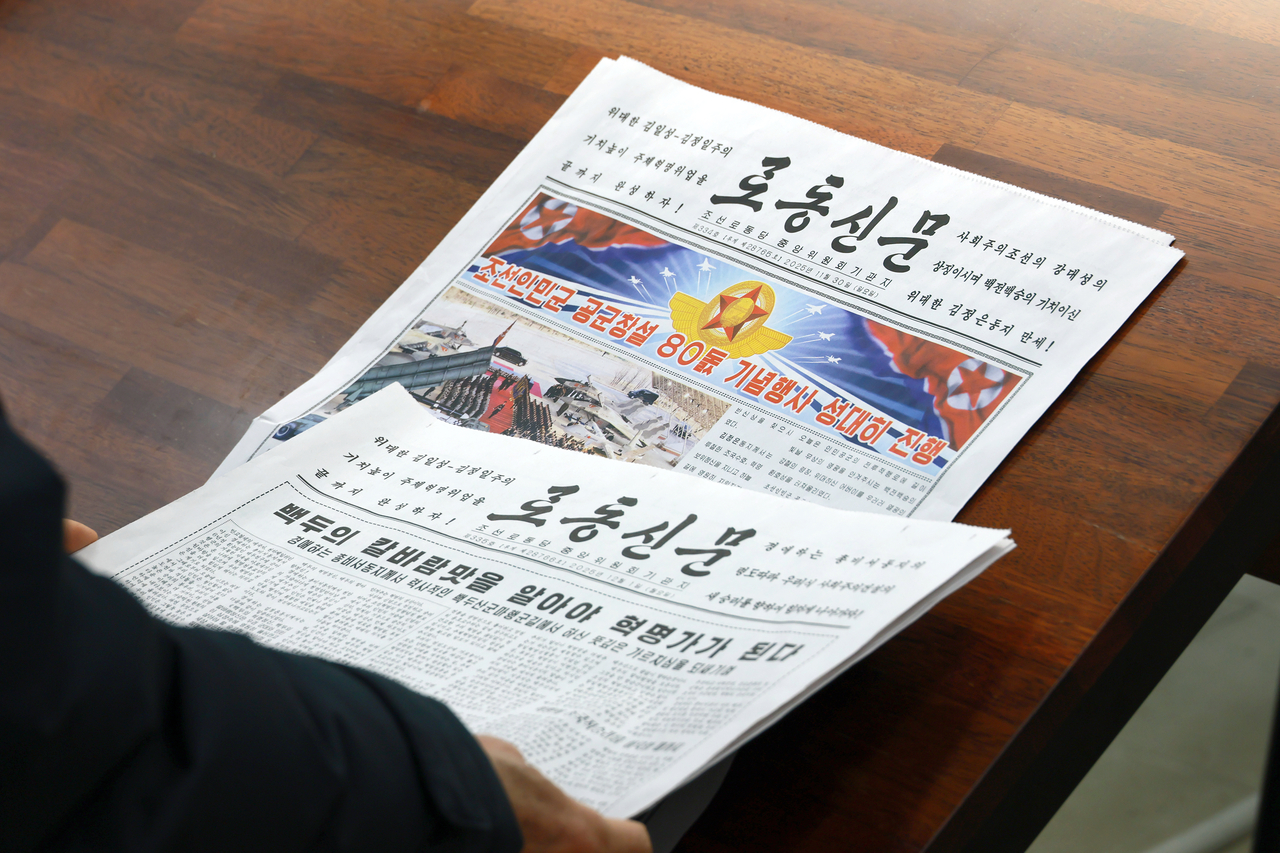
South Korea’s decision to allow broader public access to the Rodong Sinmun, North Korea’s main newspaper, has sparked debate over potential ideological influence on younger readers, prompting the Unification Ministry to say safeguards are already in place.
According to a written response submitted to Rep. Han Jeoung-ae of the ruling Democratic Party of Korea on Friday, the ministry said institutions handling North Korean materials operate their own collection and access policies based on their respective mandates, with users required to follow procedures set by each facility.
Access is generally limited by age, the ministry said. The North Korea Information Center and the National Library of Korea allow users aged 16 and older, while the National Assembly Library permits access from age 18. Younger users may still view the materials after submitting a separate application.
Currently, around 20 facilities among 181 authorized institutions provide access to the Rodong Sinmun, including the ministry’s North Korea Information Center, the National Institute for Unification Education, the National Library of Korea, the National Assembly Library, major university libraries such as Seoul National University and state-run research institutes. At these locations, members of the public can, in principle, read the original print edition without a separate application process.
The issue surfaced during a parliamentary committee session in January, where some lawmakers warned that exposure to the newspaper could contribute to ideological bias among youth. Unification Minister Chung Dong-young acknowledged the concerns as worth reviewing. Rep. Han noted that teenagers capable of reading the publication are likely already exposed to diverse media but that the issue still requires careful consideration.
The ministry’s explanation suggests that younger children — from preschoolers to middle school students — would in practice face limited access, easing some concerns. However, criticism persists that the government has yet to establish a unified national standard, as age requirements vary by institution.
The controversy comes after the government reclassified the Rodong Sinmun as general reading material rather than restricted “special material,” allowing easier access at designated facilities and major libraries.
Previously, the newspaper could be viewed only after identity verification and approval of purpose due to concerns that it contained content praising the North Korean regime. With the restrictions eased, the public can now access the print edition more freely, though online access to the newspaper’s website remains blocked.
The ministry said it plans to expand access to North Korean information, including pursuing the lifting of restrictions on roughly 60 related websites such as the Korean Central News Agency, through legal revisions.
Vice Unification Minister Kim Nam-jung said in December that the government intends to broaden public access so citizens can examine North Korean information firsthand and make their own informed judgments, rather than relying on blanket restrictions.
Under the Information and Communications Network Act, authorities can still restrict online access to materials deemed to violate the National Security Law following review by the Korea Communications Commission.
mkjung@heraldcorp.com