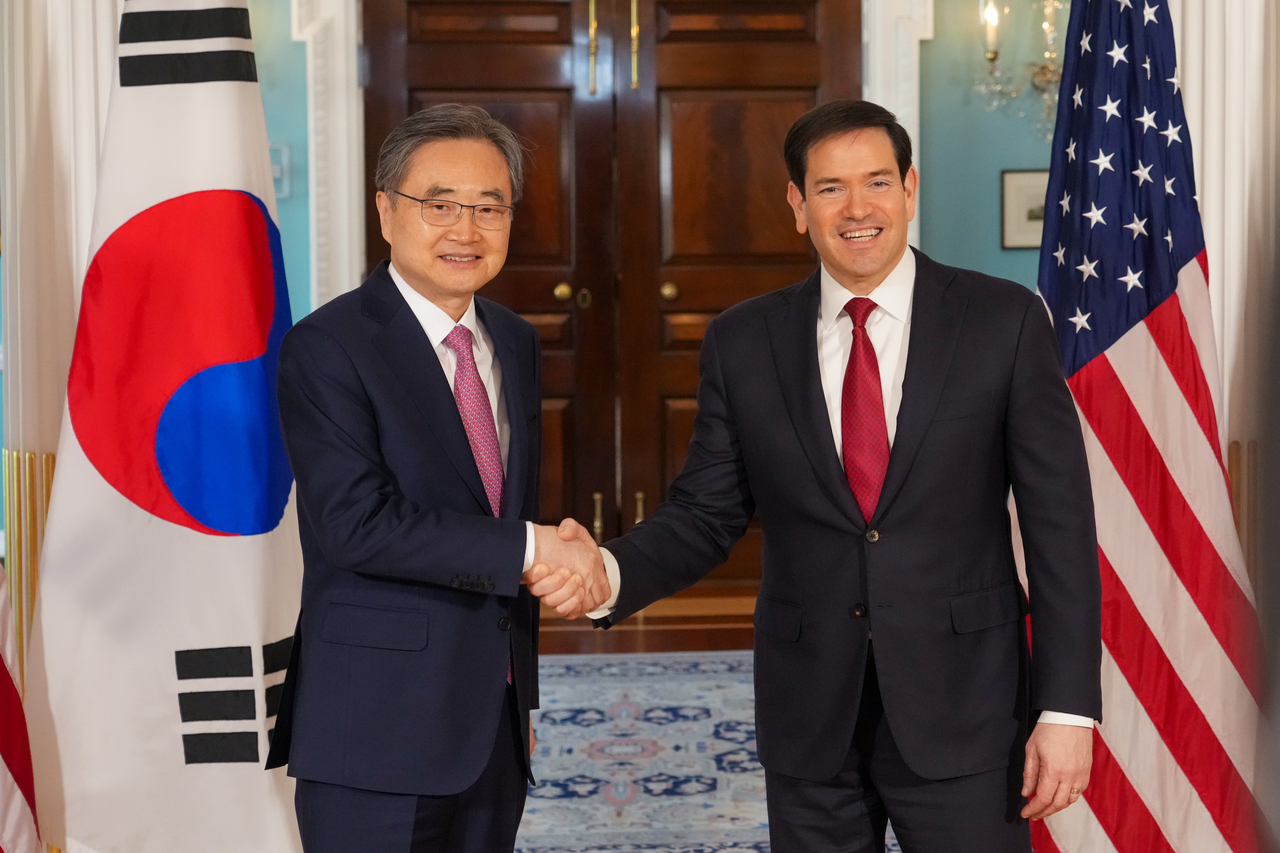
Recent high-level diplomatic talks appears to have led to little progress on trade issues, as tariffs were largely absent from the official readout of the Korea-US foreign ministers' meeting even as Washington reviews steps to formally reinstate higher duties on Korean goods.
Foreign Minister Cho Hyun met US Secretary of State Marco Rubio at the US State Department on Tuesday (local time), as Seoul stepped up diplomatic efforts to head off a potential tariff increase on Korean exports from 15 percent to 25 percent, underscoring the gap between ongoing security coordination and unresolved trade concerns.
According to South Korea's Foreign Ministry on Wednesday, Cho used the meeting to explain Seoul's domestic efforts to implement the bilateral tariff agreement and fulfill its investment commitments, proposing that diplomatic authorities continue close cooperation to ensure smooth communication and consultations between trade officials.
Despite Seoul's emphasis on trade concerns, what the two sides agreed on was focused on the faithful and timely implementation of security-related agreements, aiming to sustain positive momentum in the alliance, the ministry said.
Cho urged Rubio to take a "leading" role in ensuring that cooperation in key areas — including civilian nuclear power, nuclear-powered submarines and shipbuilding — produces tangible results.
The ministry relayed that in response Rubio said he will continue to play a necessary role and especially pledged to encourage relevant government agencies to move forward so that substantive discussions can proceed swiftly.
Cho further called for cooperation in security-linked sectors to be implemented "swiftly and substantively," asking that concrete milestones be achieved within this year, particularly in nuclear energy, nuclear-powered submarines and shipbuilding.
Meanwhile, the US State Department's official readout of the meeting does not mention tariffs at all, instead emphasizing alliance cooperation in strategic industries.
In a briefing after the talks, US State Department principal deputy spokesperson Tommy Pigott said: "Secretary Rubio and Foreign Minister Cho discussed ways to advance the US-ROK Alliance, centered on a forward-looking agenda in the spirit of President Trump and ROK President Lee Jae Myung's summits in Washington and Gyeongju."
ROK stands for South Korea's official name, Republic of Korea.
"The two leaders agreed to continue to work closely on civil nuclear power, nuclear-powered submarines, shipbuilding and increasing ROK investments to rebuild critical US industries," he added.
The meeting marked the first in-person talks between the two foreign ministers since Seoul and Washington released a joint summit fact sheet on Nov. 14, following summits between Presidents Lee and Donald Trump in August and October.
The omission of tariffs from the US readout comes as Washington reviews procedural steps toward formalizing a tariff hike, according to South Korea's chief trade negotiator Yeo Han-koo. Trade Minister Yeo told reporters during a press availability on Wednesday that the US administration is conducting interagency consultations to publish Trump's proposed tariff increase in the Federal Register.
Yeo traveled to Washington on Jan. 30 but returned without securing a breakthrough, saying continued outreach would be necessary as US officials appear not to fully understand South Korea's legislative and institutional processes.
Tariff tensions escalated after Trump warned on Jan. 26 via social media that delays in the National Assembly's handling of a special investment bill could prompt Washington to reinstate higher tariffs.
Before he embarked on the trip, Cho told a group of reporters that the situation should not be interpreted as a breach of bilateral agreements, stressing that implementation is proceeding through parliamentary procedures.
North Korea was also on the agenda during the talks between the top diplomats.
"The secretary and the foreign minister reaffirmed their commitment to the complete denuclearization of the DPRK," Pigott said, referring to North Korea's formal name, Democratic People's Republic of Korea.
"They also reinforced the critical importance of US-Japan-ROK trilateral cooperation in maintaining regional stability and a free and open Indo-Pacific."
According to Seoul, Cho asked Washington to continue sending coordinated messages encouraging Pyongyang to return to dialogue, while Rubio acknowledged South Korea's efforts to reduce regional tensions and enhance cooperation.
Cho is set to attend the inaugural Critical Minerals Ministerial on Wednesday hosted by Rubio, as Washington intensifies coordination with allies to secure and diversify critical mineral supply chains amid China's growing dominance in the sector.
Pigott said Rubio expressed appreciation for South Korea's leadership in building "secure, resilient and diversified" critical mineral supply chains.
Despite continued diplomatic engagement, uncertainty remains over whether Washington will delay or withdraw the planned tariff hike, even if South Korea's ruling Democratic Party of Korea succeeds in passing the special investment bill by late February or early March, as pledged.
mkjung@heraldcorp.com