The ruling Democratic Party of Korea's floor leader on Tuesday called for bipartisan compromise to swiftly pass a bill concerning South Korea's $350 billion investment commitment to projects in the United States.
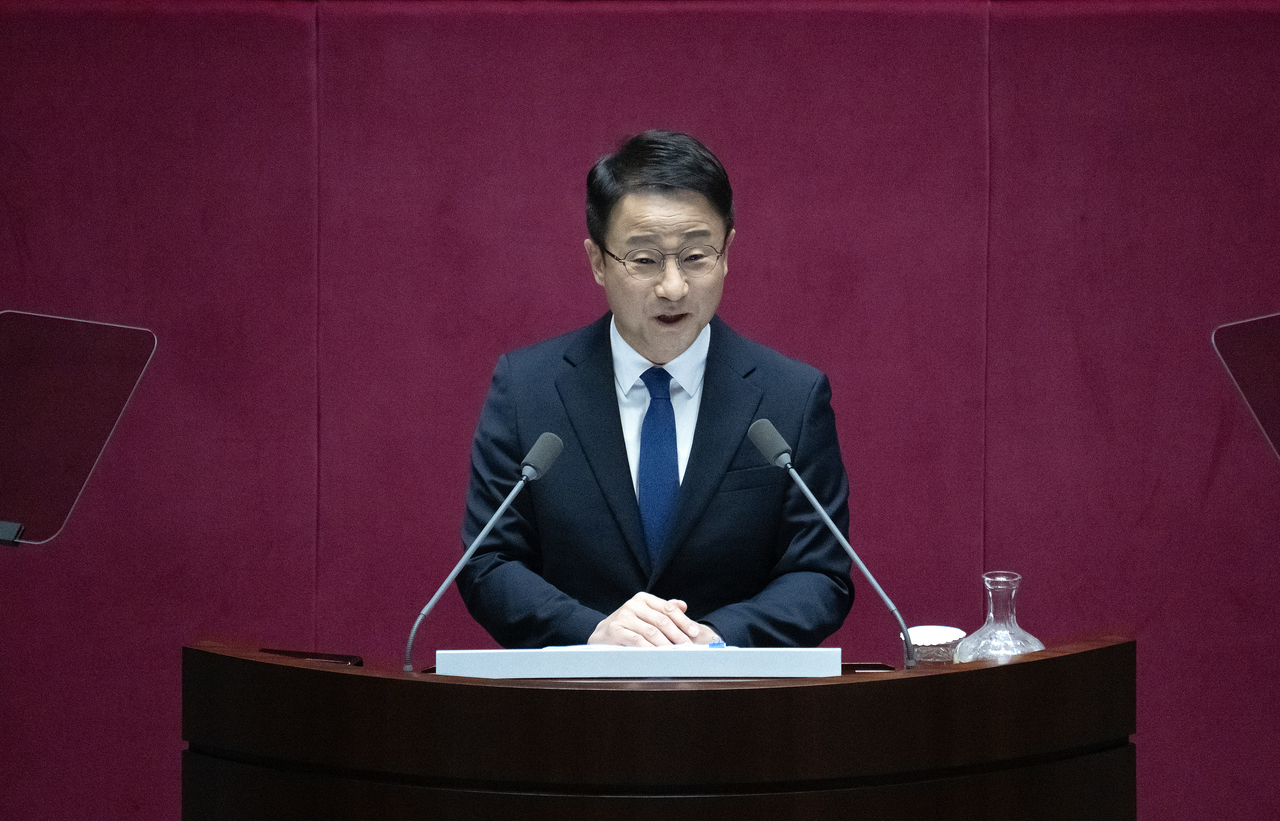
Addressing opposition lawmakers, Democratic Party Floor Leader Rep. Han Byung-do requested "close examination and swift passage" of the special bill in his speech to the National Assembly on Tuesday. The bill details the procedures and scope of South Korea's strategic investment in US projects.
The bill was proposed following last summer's trade deal with the US, in which South Korean firms would make large investments in the US, while the US lowers its "reciprocal" tariffs on South Korean imports from 25 percent to 15 percent.
However, with Korea's follow-up measures progressing at a pace apparently slower than expected by the US, President Donald Trump last week threatened to raise the rate in a social media post.
This would not only incur additional costs of over 4 trillion won ($2.8 billion) to South Korea's auto industry each year, but also pile pressure on Korean consumers and stoke job instability, Han said, adding, "We cannot waste our precious time."
Han addressed the opposition People Power Party, which had called for ratification of the joint fact sheet between Seoul and Washington in November instead of passing a special law.
"No citizen will tolerate politicians who imperil people's living standards and the national interest," he said.
The US investment bill is among a slew of pending bills in the 22nd National Assembly, which has been slower than usual to process bills, according to Han. In the first 20 months of Assembly operation, 77.5 percent of bills remain pending, compared to 71.3 percent during the same period for the 21st Assembly four years earlier.
The ruling party whip also ramped up calls for swift legislation to grant South Korea's Ministry of Unification greater control over the Demilitarized Zone, referring to pending bills proposed by the Democratic Party Reps. Lee Jae-gang and Han Jeoung-ae.
"Fundamentally, we must guarantee the peaceful use of the DMZ through our laws and systems," Han said, adding this would be in line with the ruling bloc's push for measures to restore inter-Korean ties.
Han's proposal came despite criticism from the United Nations Command, which claimed that making the bill into law was "in direct conflict with the armistice agreement."
In his first address to the National Assembly since he was elected party floor leader on Jan. 11, the three-term lawmaker outlined plans to pass bills to improve the quality of people's living standards.
Among the bills are plans to create megacities through the integration of metropolitan cities and neighboring provinces.
The ruling party, which holds a majority of seats in the parliament and is able to pass most bills on its own, has floated the bills for two megacities: the merger of Gwangju and South Jeolla Province and the integration of Daejeon with South Chungcheong Province.
Han said the party would push for the passage of the bills before the end of February to "allow the affected citizens to get the most out of the (regional) integration and see a tangible improvement in living standards."
"South Korea's great leap forward now begins in the provinces," Han said. "The Democratic Party will dedicate every effort to ... speed up legislation for regional integration."
As for the main opposition People Power Party's proposal for a merger of Daegu and North Gyeongsang Province, considered a stronghold for the party, Rep. Kim Hyun-jung of the Democratic Party said the party could consider cooperating with the opposition over a merger in the southeastern region as well.
Han added that the liberal party would spare no efforts in its drive to complete its prosecutorial reform plans and launch a new special counsel investigation into former President Yoon Suk Yeol, who created a martial law crisis in 2024, and his embattled wife Kim Keon Hee, both of whom are now behind bars.
The floor leader also called for the opposition's bipartisan support to amend South Korea's Constitution for the first time since 1987.
Han asked for the opposition parties' cooperation in changing the Constitution to uphold the spirit of the 1980 Gwangju Democratic Uprising with an eye toward holding a referendum on it alongside the June local elections.
He also vowed to push for a revision of the Referendum Act to grant voting rights to a wider range of overseas Koreans, regardless of whether they had registered their addresses in South Korea or not. The Assembly speaker has expressed support for a constitutional referendum, but has asked the legislature to revise the law first.
consnow@heraldcorp.com