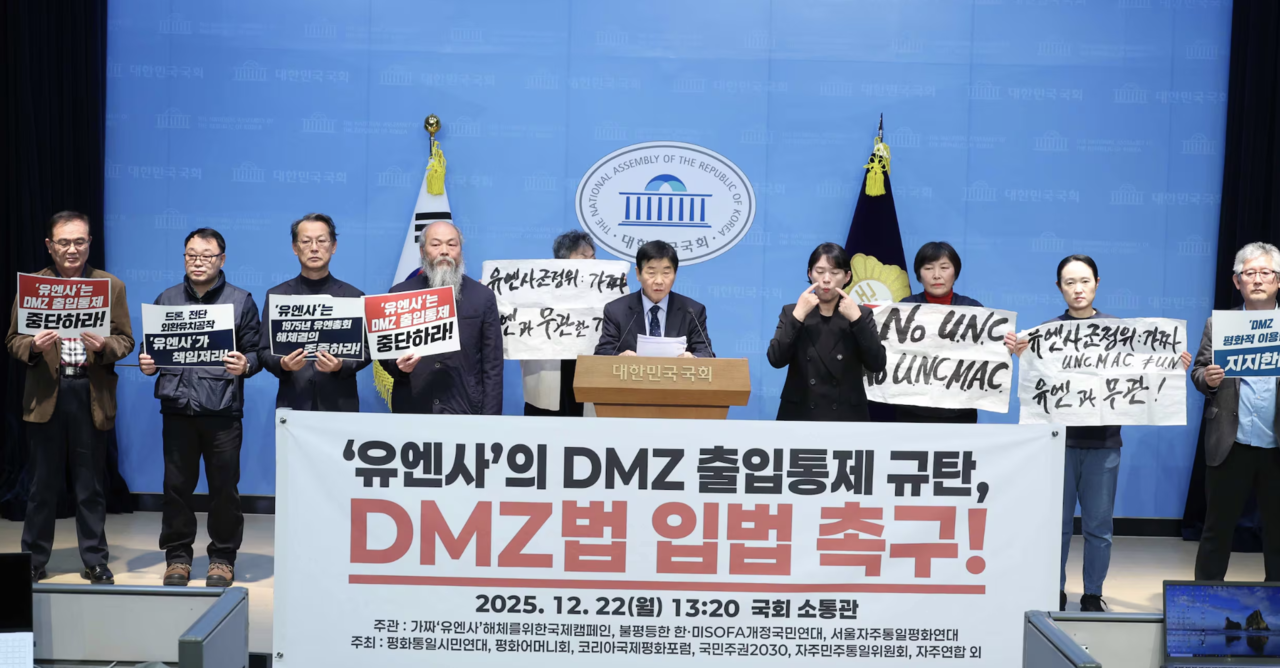
The United Nations Command, a US-general-led unit that oversees affairs within the Demilitarized Zone dividing the two Koreas, on Wednesday raised concerns over a ruling party-backed bill aimed at expanding South Korea's authority over access to the area.
The bill, introduced in August last year by ruling Democratic Party of Korea Reps. Lee Jae-gang and Han Jeoung-ae, seeks to allow the South Korean government to actively utilize the DMZ for nonmilitary, peaceful purposes, including inter-Korean exchanges, cooperation projects and ecological tourism.
Speaking to reporters at the Dragon Hill Lodge in the Yongsan Garrison in Seoul, one UNC official said South Korea retains sovereignty over the southern half of the DMZ and could, in theory, reclaim jurisdiction — but doing so would clash with the 1950-53 Korean War armistice framework.
"The South Korean government, under its sovereign authority, can take back jurisdiction over the southern half of the DMZ," the official said. "A logical, legal, reasonable interpretation of that, if the South Korean government does that, is that it is in direct conflict with the armistice agreement."
The official said allowing civilians to enter the DMZ without the UNC commander's authorization would constitute an armistice violation, warning that civilian actions could also trigger violations.
"Civilians can violate the DMZ and violate the armistice agreement just as easily as a military person can — leaflet balloons and such," the official said.
Another UNC official said the bill and the armistice framework are incompatible, describing the DMZ as a buffer zone meant to prevent renewed hostilities.
"The purpose of the DMZ is to provide a buffer zone that is governed or administered by the military commanders to ensure that nothing happens within that 4-kilometer stretch that could cause an end to the armistice and a resumption of hostility," the official said.
The official added that the UNC commander's responsibilities include civil administration in the DMZ.
"Everything that happens within the southern half of the DMZ is in compliance with the armistice and cannot restart a conflict, which is why it includes civil administration and relief," the official said.
On the pending bill, the official said it would remove the UNC commander's authority over civilian access while leaving responsibility with the commander.
"From a technical reading of the armistice agreement and reading of the bills that are pending, they are completely at odds," the official said. "It takes away authority from the UNC commander and gives it to a third party, but yet he retains the responsibility for what happened."
"That's why I say that the bills and the armistice agreement can never align," the official added.
UNC officials also addressed recurring debate over whether UNC jurisdiction should apply only to matters "of a military character," as referenced in the armistice preamble. The same official said the preamble is not substantive binding language and that the phrase was included to clarify the armistice was not a final peace settlement.
"The preamble is not substantive. That is not binding language on the parties," the official said.
Under the armistice signed on July 27, 1953, the UNC is tasked with maintaining the ceasefire regime on the Korean Peninsula and managing accidental military clashes within the DMZ. Specifically, Article I, Paragraph 9 of the agreement stipulates that no military personnel or civilians may enter the DMZ except those engaged in civil administration and relief work or those who have received specific authorization from the Military Armistice Commission.
Separately, another UNC official said the purpose of Wednesday's session was not to weigh in on South Korea's domestic legislation, but to provide context on UNC roles.
"The purpose behind today wasn't a concern over the bill, but it was an opportunity for questions to be asked of an organization that many of you might not know fully about," the official said.
Regarding the denial of a visit in November last year by a senior South Korean presidential security official to a remains recovery site at White Horse Hill, the official said the decision was made on safety grounds.
“For safety and security reasons, we requested that that not occur, and we offered up another opportunity, which the security office accepted,” the official said, adding that around the time the visit request was submitted, “we had an explosion inside of the DMZ with an injured soldier.”
The official pointed to ongoing hazards inside the DMZ, saying, “every day that the team is out there, there is unexploded ordnance that is found — mines, grenades, artillery rounds that are found every day.
The official also raised procedural concerns, saying it would have been preferable for communication to take place before the issue was disclosed to the public.
“We should be notified before the statement is submitted,” the official said.
The trail was first opened in 2019 under the Moon Jae-in administration in coordination with the UNC, but was suspended later that year over security concerns.
While parts of the program were reinstated in 2023 under the Yoon Suk Yeol government, access to sensitive DMZ sections has again been curtailed amid deteriorating relations with North Korea.
flylikekite@heraldcorp.com