Wi Soo-jung wins Yi Sang Literary Award for ‘Snow and Pebbles’
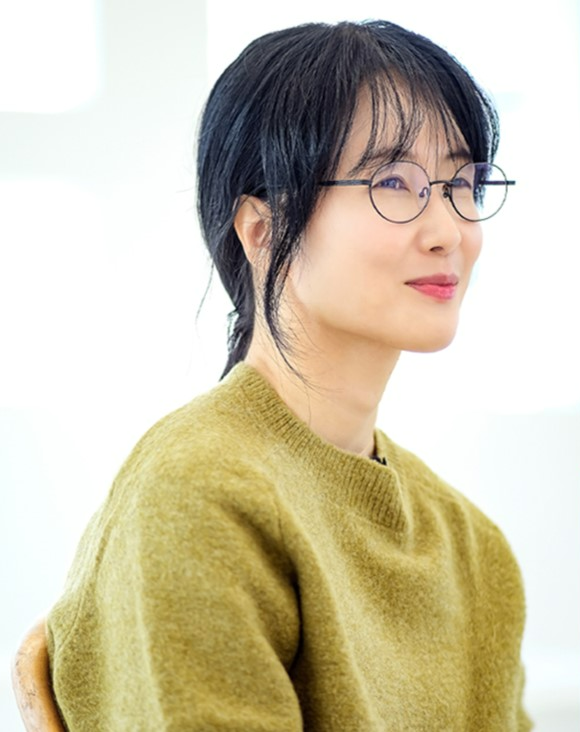
Wi Soo-jung has been named the winner of the 49th Yi Sang Literary Award, one of the country’s most prestigious prizes for short and medium-length fiction. Her winning work, “Snow and Pebbles,” was announced Tuesday by Dasan Books, the award’s organizer, at a press conference in central Seoul.
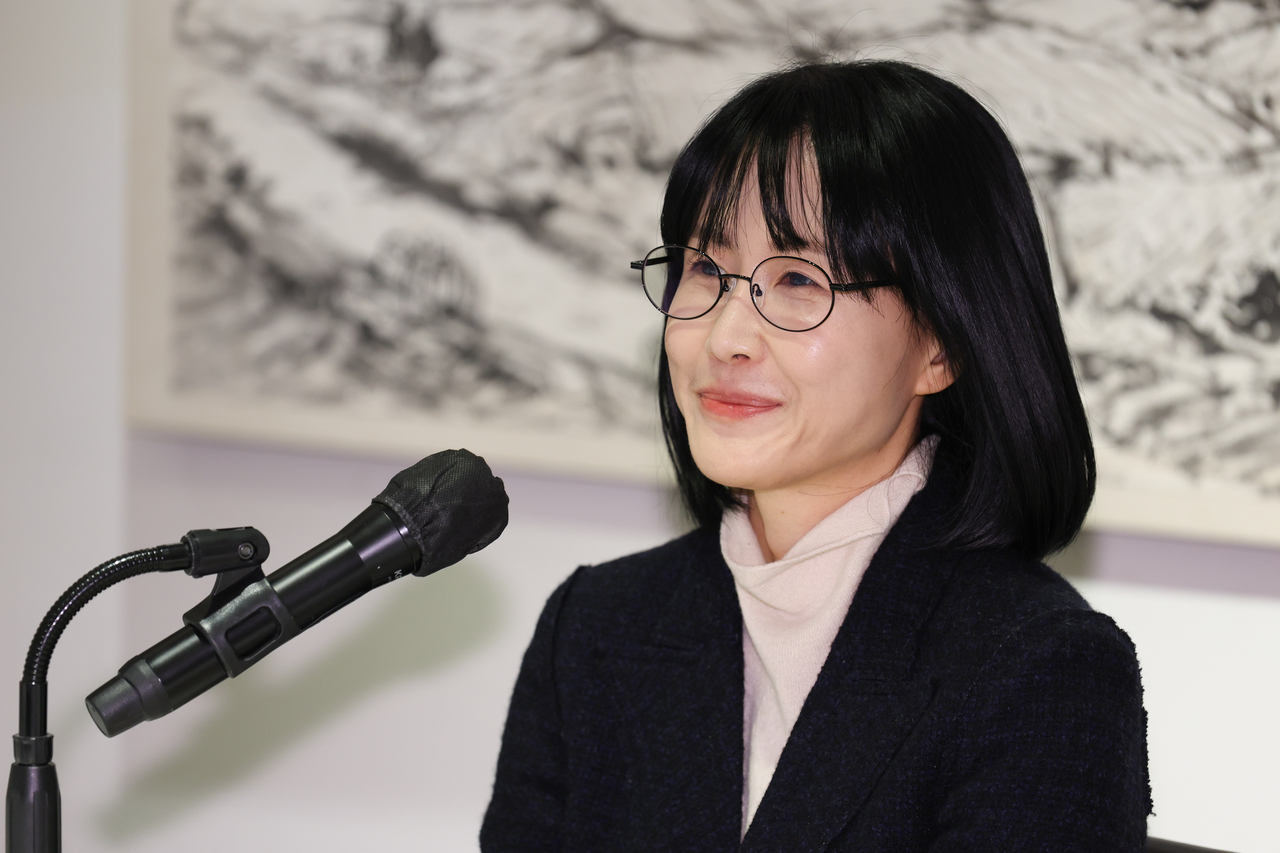
“I still consider myself early in my career as a writer, so the honor feels both overwhelming and deeply gratifying,” Wi said. The 48-year-old author, who began her literary career in 2017, added that she hoped to accept the prize as “momentum to write with greater responsibility going forward.”
“Snow and Pebbles” opens with the mysterious sound of a glass front door shattering and closes with a hand clenched around a small pebble. The story centers on three friends who first met in a university film club and remained loosely but intimately connected for nearly 20 years.
When the story begins, Su-jin, who had been living with cancer, is dead. Yu-mi and Jae-han decide to carry out her wish to bury her ashes in a cedar forest in Togakushi, Japan, a remote place reached only after a long drive from Nagoya. The two surviving friends are unsure why Su-jin had so strongly wanted to go there. They do not know why she canceled her earlier travel plans, nor why she chose death.
Life, as the story renders it, is filled with such blank spaces — unanswered questions and unknowable fears. As snow falls steadily throughout their journey, Yu-mi and Jae-han confront their grief while coming to understand their friend, invoking filmmakers including Hirokazu Koreeda, Kiyoshi Kurosawa and Bong Joon-ho, each trying, in their own way, to interpret what life might mean.
Kim Hyung-joong, a literary critic and one of the judges, praised the story as “an exceptional work that cannot be reduced to character or plot alone,” pointing instead to “the ambiguity of life, exquisitely concealed within a snow-covered landscape.”
That scenery serves both as a backdrop for mourning and as a source of threat. Wi said that “like a landscape that appears peaceful when viewed through a car’s rear window but turns terrifying from the driver’s seat, nature reveals the physical fragility of humans most starkly,” adding that she did not see mourning as “a process that is simply beautiful or purifying.”
Wi said that while she has always believed a writer has an obligation to be understood by readers, she described this particular story as one that deliberately steps away from the conventions of a neatly resolved narrative.
“Had I been thinking that way, I might have chosen a kinder, more accessible approach.” Instead, she accepted the risk of criticism in order to write honestly about how life feels to her.
“Some of the characters’ stories don’t fully conclude; others blur, fade or disappear. But that, to me, closely resembles the shape of life itself.”
Wi said that she is not drawn to what is conventionally bright or virtuous, but is more fascinated by the instincts that continually pull humans toward more dangerous and controversial things.
“As a novelist, I think my task is to bring those instincts to the surface and to ask whether what we accept as ‘obvious’ truly is," Wi said. “This work gave me courage to illuminate the darkness within us and to portray human complexity with greater boldness.”
“That may put a writer at odds with their time,” she added, “but that tension is ultimately the fate of anyone who chooses to live in literature.”
Established in 1977 in honor of the modernist writer Yi Sang (1910-1937), the Yi Sang Literary Award is widely regarded as Korea’s prestigious honor for short and medium-length fiction. Past recipients include acclaimed novelists such as Kim Seung-ok, Yi Chong-jun, Park Wan-suh, Yi Mun-yol, Eun Hee-kyung and Han Kang.
This year’s jury reviewed approximately 200 works of short and medium-length fiction published in major literary journals between January and September 2025. The grand prize carries a cash award of 50 million won ($35,000).

hwangdh@heraldcorp.com