AI makes cheating easier, but the real danger may be how easily people justify dishonesty and how quickly trust begins to unravel
Recent AI-assisted exam cheating scandals in South Korea reveal more than a growing willingness to bend the rules.
Psychologists say technology is making dishonesty easier to justify, and ethical standards struggle to keep pace with rapid advances in artificial intelligence. That gap threatens to erode trust and reshape people's perception of right and wrong.
Students across Korea will sit for the Suneung on Thursday, but a string of AI-related cheating scandals has raised concerns about whether the high-stakes examination system can keep pace with rapidly advancing technology.
From smart glasses to miniature cameras, sophisticated devices are making deception harder to detect. Recent scandals involving professional qualification exams, including the national tax accountant exam and the Law School Admission Test, have fueled concerns that no examination is immune to cheating.
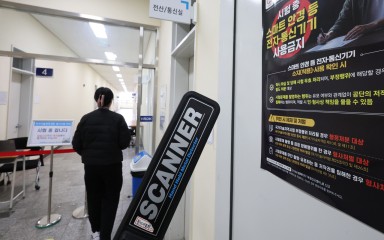
In an unprecedented crackdown, authorities are deploying thousands of additional proctors and introducing tougher security measures, including a nationwide emergency alert to mobile phones before the exam.
While technology may be changing how people cheat, the underlying psychology is rooted in longstanding social pressures, according to psychologists.
"Competition is intense, and our society places greater importance on results than on how they are achieved," said Kwak Keum-joo, professor emeritus at Seoul National University, in an interview with The Korea Herald.
"When results are emphasized so heavily, people become more willing to resort to dishonest means to obtain them."
Korea's rapid economic development helped foster a culture that prizes speed and tangible results, she said. The pressure is compounded by a deeply ingrained sense of hierarchy, in which universities, professions and companies are ranked against one another.
The country has seen high-profile academic cheating scandals before. A Yonsei University law school student stole an exam paper from a professor's office in 2013, while in 2018, a mother leaked test questions to help her twin daughters at a high school.
Kim Hack-jin, a professor at Korea University, said the pressure to succeed also taps into a fundamental human fear: losing social status and being excluded from a group.
"In a high-stakes, winner-takes-all society like Korea, where the outcome of a single exam can have a significant impact on a person's social status and future opportunities, failing an exam feels like more than an academic setback. It can be seen as a collapse of one's sense of self-worth and being left behind socially," Kim said.
"When people constantly anticipate this kind of threat, their decision-making shifts toward protecting their immediate status rather than considering long-term values. So they are more willing to break rules to secure an immediate advantage."
Does AI make cheating feel less wrong?
AI devices may further weaken the psychological barriers to cheating, both professors said.
With few cases of detection or punishment to serve as precedents, test-takers may see little reason to fear the consequences, Kwak said.
Kim said technology can also make it easier for people to rationalize dishonest behavior by creating distance between themselves and their actions.
"Using a pair of glasses that looks perfectly ordinary, for instance, may feel less like cheating than pulling out a cheat sheet or looking at someone else's answers."
Yet not everyone gives in to the same pressures. The difference, Kim noted, lies partly in whether honesty has become an internalized value or depends on external supervision.
"For some people, making an honest choice is not something that requires an effort to resist temptation. It can function as a relatively automatic default," Kim said. "Others rely more heavily on the presence of observers to keep their behavior in check. When that external scrutiny disappears, they may be more vulnerable to cheating."
The surrounding social climate also matters, according to Kim. When people believe that "everyone else is doing it," the perceived cost of breaking the rules decreases, making cheating more likely to spread.
A crisis of trust
Both professors agreed that strict punishment and effective monitoring are necessary to deter cheating.
Kwak argued that penalties must be severe enough to prevent people from dismissing cheating as a minor offense. Kim, meanwhile, pointed to criminological research suggesting that the certainty of being caught is a stronger deterrent than the severity of punishment.
"But technological advances are making detection increasingly difficult. A system that relies too heavily on external surveillance also risks fueling a race between those enforcing the rules and those seeking ways around them," Kim warned.
Both called for stronger ethics education at home and in schools.
"Technology has advanced so quickly that our ethical awareness has not kept pace. We have not had enough time to develop a shared understanding of how these technologies should be used," Kwak said.
Kim said education should help people see following rules not simply as a way to avoid punishment, but as a source of dignity and self-respect. The goal is to make honesty a natural default rather than something people must struggle to maintain when faced with temptation.
The broader challenge, Kim added, is to build a more flexible society in which one failed exam does not amount to a life setback and success is measured in more than one way. Reducing the pressure to treat a single result as a verdict on one's future could help people maintain a healthier sense of self-worth and resist the temptation to cheat.
For Kwak, the danger goes beyond the integrity of any single examination. As AI makes deception easier, it also risks deepening suspicion between people, even when no wrongdoing has occurred. "AI has already begun to turn against humans in this sense," she said.
"It is creating instability, making people distrust one another and fueling confusion and conflict. We don't have to wait for some distant scenario in which AI becomes physically dangerous. The damage is already beginning."
hwangdh@heraldcorp.com