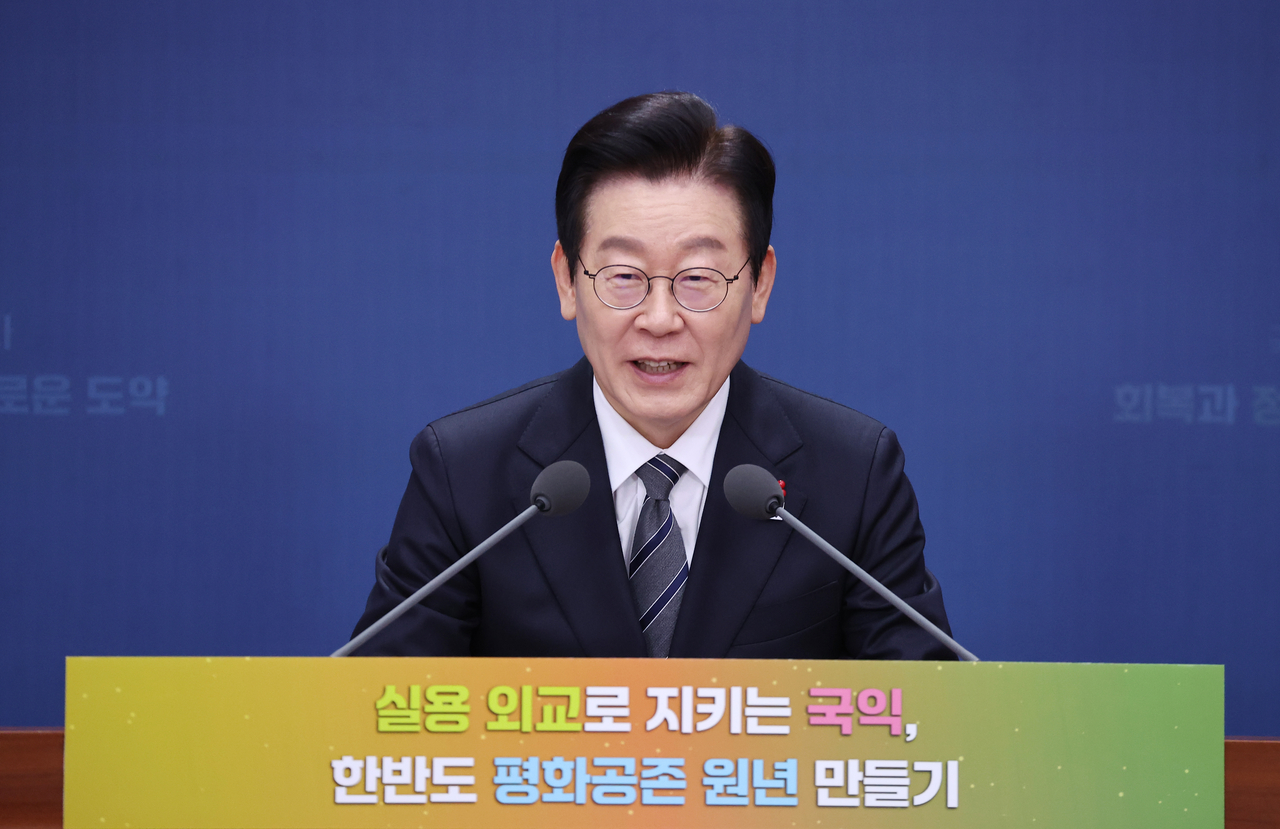
President Lee Jae Myung on Friday moved to settle tensions between the Foreign Ministry and the Ministry of Unification over leadership on North Korea policy, underscoring that responsibility for easing inter-Korean hostilities should rest with the Unification Ministry.
Speaking during a joint policy briefing by the Foreign Ministry, the Ministry of Unification and the Overseas Koreans Agency at the Seoul Government Complex, Lee called for a patient and proactive approach to reducing tensions on the Korean Peninsula.
“With patience, we should make every effort to ensure that hostility between the two Koreas can be eased in a preemptive and leading manner, so that even a small seed of trust can begin to take root,” Lee said. “That role is one the Ministry of Unification should carry out.”
Lee offered a blunt assessment of current inter-Korean relations, saying they appear to be deteriorating beyond past cycles of confrontation.
“When I look at inter-Korean relations these days, it feels as though we have truly become enemies,” he said. “In the past, it sometimes felt like we were pretending to be enemies, but now it seems we are actually becoming real ones.”
Lee argued that sustained hostility carries tangible economic costs, even absent ideological or nationalist considerations.
“Even if we set aside ideas like a national community, from a purely practical standpoint there is no need for such intense confrontation,” he said. “When hostility deepens, it translates directly into economic losses. But unnecessary hard-line, confrontational policies have pushed both sides toward genuine animosity.”
Pointing to recent developments along the inter-Korean border, Lee said North Korea’s construction of triple-layer barbed-wire fences, road demolitions and concrete barriers across the demarcation line reflects Pyongyang’s deep-seated security anxieties.
“This is the first time in decades that such measures have been taken,” he said, adding that North Korea appears to fear a potential southern incursion, prompting defensive fortifications.
Lee also criticized Pyongyang’s recent insistence on defining the two Koreas as “hostile states,” saying it leaves virtually no room for communication.
“Dialogue, cooperation and peaceful coexistence should be the path forward,” he said. “But right now, there seems to be not even a needle’s eye of space for engagement.”
Despite the difficulties, Lee stressed that Seoul must continue seeking improvement through patience.
“It is clearly not an easy task,” he said. “But it is equally clear that this is not something we can afford to give up on.”
On diplomacy more broadly, Lee said its importance grows during periods of global upheaval, noting that peace itself is a core pillar of national security and that diplomacy plays a decisive role in sustaining it.
He also highlighted the economic dimension of foreign policy, urging the Foreign Ministry and overseas missions to act as forward bases for expanding South Korea’s “economic territory” through cultural outreach and commercial engagement.
“Rather than performing duties in a formalistic way, I hope you will work proactively, bearing in mind that you are carrying the future of this country on your shoulders,” he said.
The remarks came as the Lee administration signals plans to pursue what it calls a “peaceful coexistence process” on the Korean Peninsula, including renewed inter-Korean dialogue beginning next year.
Against this backdrop, observers say recent consultations with the US are aimed at aligning Seoul’s engagement-oriented approach with Washington’s broader policy framework, which continues to emphasize sanctions enforcement and human rights concerns as leverage in any future talks with Pyongyang.
Despite the emphasis on coordination, the talks launched Tuesday proceeded without the participation of the Unification Ministry, which oversees inter-Korean affairs. The ministry said a day earlier that it would not attend and would instead consult with Washington through separate channels when necessary.
According to the Foreign Ministry, the meeting — officially titled ROK-US Consultations on Joint Fact Sheet Implementation — was held at the Seoul Government Complex, with Jeong Yeon-doo, director general for diplomatic strategy and intelligence at the Foreign Ministry, and Acting US Ambassador Kevin Kim serving as chief delegates. ROK stands for South Korea's official name Republic of Korea.
Both the Foreign Ministry and the Ministry of Unification later sought to downplay concerns over interministerial discord, stressing that policy coordination remains intact despite differences in approach.
mkjung@heraldcorp.com