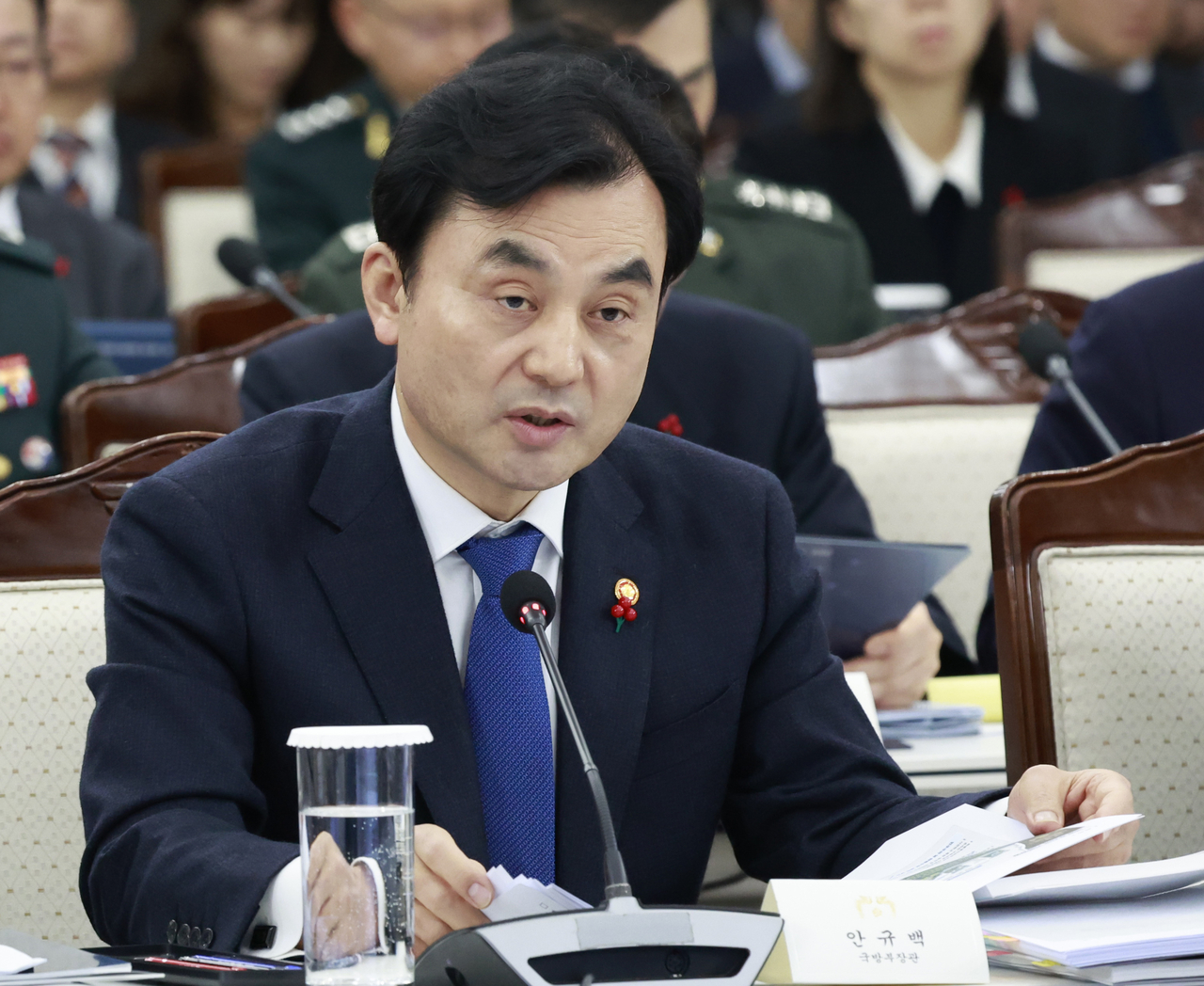
The Defense Ministry said Thursday it plans to present a basic plan for a Korean-developed nuclear-powered submarine by next year and complete key institutional groundwork, while aiming to finish verification of the second phase of wartime operational control transfer by November 2026.
The roadmap was reported by Defense Minister Ahn Gyu-back during a policy briefing for President Lee Jae Myung at the ministry’s headquarters in Yongsan-gu, Seoul, as part of preparations for the government’s 2026 defense agenda.
According to the ministry, the basic plan for the nuclear-powered submarine will outline construction methods and locations, as well as Seoul’s position on nonproliferation. The government also plans to participate in a pan-government task force and seek to conclude negotiations with the United States on nuclear fuel within two years. As the project would mark South Korea’s first use of a nuclear reactor aboard a submarine, the ministry said it will also establish safety regulations and close legal and institutional gaps.
“The nuclear-powered submarine project, which is both a key outcome of the South Korea–US summit held in October and a long-standing national aspiration, has reached a new turning point,” Ahn said. “We are now capable of building it domestically using our own technology.”
“Starting next year, we will move beyond a Defense Ministry-led effort and establish a permanent, pan-government task force to pursue the project as a national strategic initiative,” he said. “Through this, we aim to complete negotiations with the United States within two years and to press ahead with this historic mission of our armed forces with a sense of urgency.”
On wartime operational control, the ministry said next year will be a “watershed moment” for the transition and pledged to focus its capabilities on accelerating the process. OPCON refers to the authority to command combined South Korea–US forces in wartime, which would shift from the current Combined Forces Command structure to a future command led by a South Korean general following the transfer.
South Korea and the US agreed in 2006 to pursue the transfer through a three-stage evaluation process -- initial operational capability, full operational capability and full mission capability. IOC assessments were completed in 2019 and 2020, while FOC evaluation concluded in 2022. The two sides agreed at last month’s Security Consultative Meeting to pursue FOC verification next year.
The Defense Ministry said it will begin consultations with US counterparts in January, conduct joint evaluations through major combined exercises such as Freedom Shield and Ulchi Freedom Shield from March to August, and complete a roadmap to accelerate condition fulfillment by April, with the goal of finalizing FOC verification by November 2026.
The briefing also addressed military reform in the aftermath of last year’s illegal martial law declaration. Ahn said the military “deeply reflects” on its involvement in the incident and pledged to prevent the armed forces from being used again in unconstitutional actions. The ministry said it will complete reforms of military intelligence agencies’ structures and functions next year, with a special civilian-government-military advisory body set to submit reform proposals by year’s end.
In addition, the ministry reaffirmed its commitment to easing inter-Korean military tensions through the phased restoration of the Sept. 19 military agreement, while maintaining readiness. It also said it will press for the return of remaining US military base sites and support redevelopment of returned land, as well as move to resolve delays in the relocation of military airfields in Daegu, Gwangju and Suwon.
mkjung@heraldcorp.com

![[Graphic News] Nuri rocket set for fifth launch](https://wimg.heraldcorp.com/news/cms/2026/10/06/news-p.v1.20261005.74d188bdaff2417ebabf4560181741f4_T1.gif?type=h&h=800)
![[Graphic News] Nuri rocket set for fifth launch](https://wimg.heraldcorp.com/news/cms/2026/10/05/news-p.v1.20261005.74d188bdaff2417ebabf4560181741f4_T1.gif?type=h&h=800)