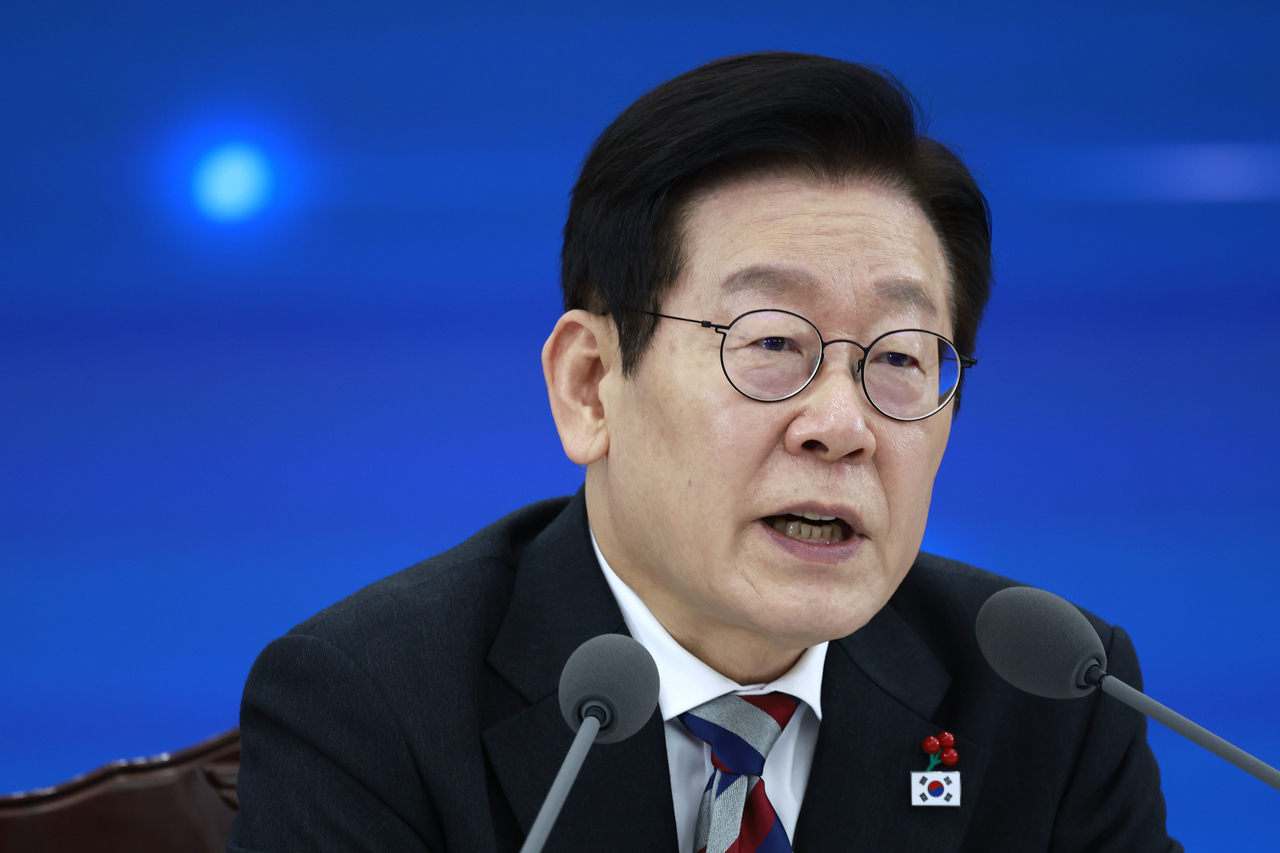
President Lee Jae Myung on Thursday instructed the Ministry of Patriots and Veterans Affairs to hold discussions with China on the excavation and repatriation of the remains of Korean independence fighters believed to be buried there, ahead of a possible bilateral summit.
Lee issued the directive during a joint policy briefing by the Ministry of Patriots and Veterans Affairs and the Defense Ministry, held at the Defense Ministry headquarters in Yongsan, Seoul.
The order came after Veterans Affairs Minister Kwon Oh-eul reported on projects related to recovering the remains of independence fighters overseas.
“The excavation and repatriation of remains require close consultation with China,” Lee said, noting that there is a possibility he may meet Chinese leaders again in the near future.
He also asked the presidential office to closely follow the matter, effectively calling for the issue to be discussed in advance of any summit-level talks between Seoul and Beijing.
Minister Kwon said the government plans to dispatch officials to China to help locate the remains of independence activist An Jung-geun. He added that, in addition to An, the ministry aims to excavate and repatriate the remains of several other independence fighters.
An, who assassinated Japan’s Resident General of Korea Ito Hirobumi in Harbin in 1909, was executed by Japanese authorities the following year. The whereabouts of his remains have never been confirmed, despite repeated efforts by South Korea to secure China’s cooperation in locating them.
Diplomatic sources said Seoul and Beijing were also reviewing the possibility of President Lee visiting China in January, though officials stressed that details were still being worked out.
During the same briefing, Lee addressed broader issues related to national security and veterans affairs, urging the military to remain focused on its core mission despite the political and social turbulence stemming from former President Yoon Suk Yeol's martial law declaration last year.
While acknowledging that South Korean society had experienced a period of confusion, Lee said the military had largely fulfilled its duty by maintaining stability and demonstrating loyalty to the nation and its people. He added that such challenges could serve as a foundation for a better future if approached with renewed resolve.
Lee stressed that preserving the national community itself was the most important condition for its survival, calling on the armed forces to reflect on the significance of their role and carry out their fundamental mission so that South Korea can continue to endure as a strong nation and as the people’s military.
On veterans policy, Lee emphasized that the state must consistently demonstrate that it does not forget extraordinary sacrifices made for the country, saying that honoring and compensating such sacrifices is essential to maintaining social cohesion in times of crisis.
Lee also reiterated the need to consider the revocation of state honors granted to Col. Park Jin-kyung, a military officer who led a bloody crackdown during the Jeju 4·3 Uprising.
Raising the issue during the briefing, Lee questioned how Park — who was killed in 1948 — could have received a military decoration related to the Korean War, which began in 1950. Park was posthumously awarded the Ulchi Order of Military Merit in 1950, and his family later applied for and received state merit status, which the Veterans Ministry approved in November last year.
Lee said the matter had drawn strong anger from the families of Jeju victims and called for efforts to find an appropriate solution. The presidential office previously instructed a review of the possible revocation of Park’s honors earlier this month.
mkjung@heraldcorp.com