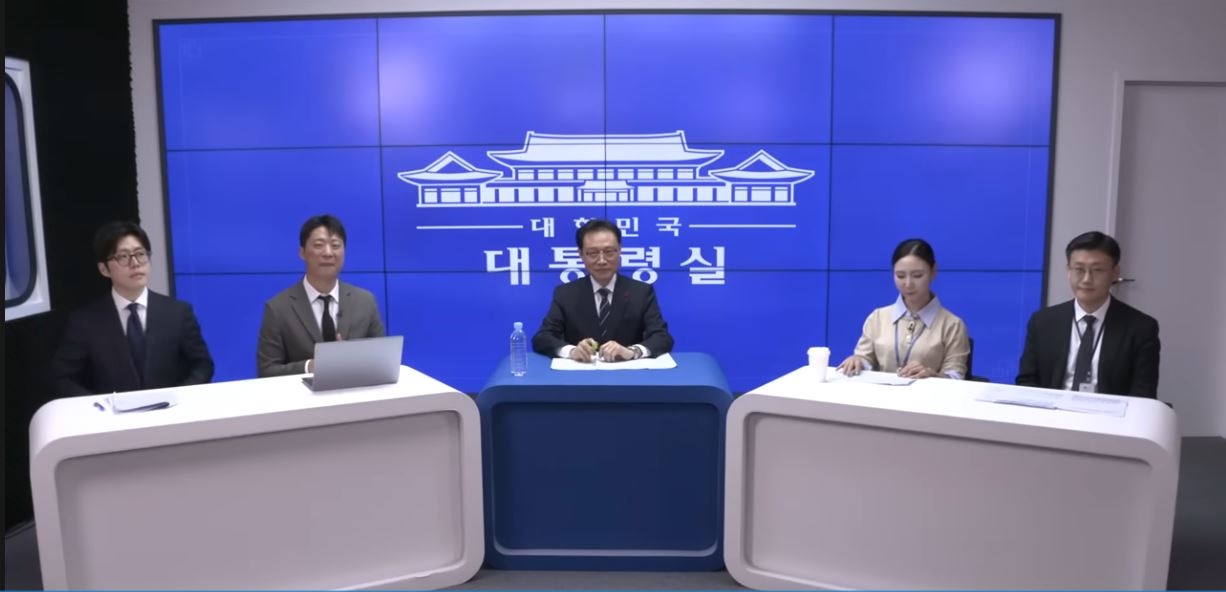
Reporters who were on the front lines of last year’s martial law declaration gathered Monday for a live discussion hosted by the presidential office, recounting in stark detail the fear, chaos and disbelief they experienced within the presidential office in Yongsan-gu and the National Assembly in Yeouido on Dec. 3, 2024.
The livestreamed session, titled “Marking One Year Since the Revolution of Light: Remembering and Recording the Day of Martial Law,” brought together correspondents from major news outlets and current affairs programs here, including The Korea Herald, News Tomato, Daily Hankook and Kim Eo-jun’s News Factory. The discussion offered one of the clearest collective testimonies yet of how close South Korea came to a constitutional breakdown.
Son Ji-hyoung of The Korea Herald said he had just finished a dinner meeting with a source when reporters received urgent alerts shortly after 9 p.m., alerting the press of an unscheduled national address by former President Yoon Suk Yeol.
“When we returned to the press briefing room of the presidential office, the doors were locked. We couldn’t enter the briefing area at all,” he said. “This was unprecedented — major announcements are exactly when the press must be allowed inside.”
At one point, reporters discovered that their entry badges had been deactivated, effectively barring them from the presidential briefing area.
“It felt surreal, something out of a history book,” Son said. “I remember thinking: If someone gets arrested tonight, it wouldn’t even be surprising.”
Park Hyun-gwang of News Factory said he was preparing for routine coverage of the budget announcement when the martial law proclamation flashed across screens.
“It felt unreal. I was terrified,” he said. “I had been covering investigations into the previous government. If martial law took effect, I wondered whether I might be detained. Under martial law, journalists also fall under the command structure.”
Yoo Ji-woong of News Tomato was inside the National Assembly when the former president announced martial law.
“I could not believe what I was hearing. How could something like this, reminiscent of Gwangju, be happening in 2024?” he said, referring to the 1980 Gwangju Democratic Uprising, when the military imposed martial law and violently suppressed civilians.
As lawmakers and citizens rushed toward the Assembly, Yoo moved outside to capture footage — just as elite troops arrived.
“It was immediately obvious that a special forces unit had been deployed and that the National Assembly was their objective,” Yoo said.
Approaching the Assembly’s main building, he was confronted by members of the 707th Special Mission Group, who seized him without warning.
“Four of them surrounded me and bent my body, taking my phone. They pinned me against the wall of the main building like I was a terrorist,” he said.
“One of them said, ‘Bring the cable ties.’ They tried to bind my hands. I knew that if I were tied, I could be taken anywhere. I resisted with everything I had. They failed to restrain me, deleted my footage of them entering the Assembly grounds, and released me — then immediately attempted to enter the main building.”
Yoo’s account aligns with later testimony that special forces units were under orders to block lawmakers from entering the Assembly chamber and remove them by force if necessary.
Park Jun-young of Daily Hankook recalled a deep sense of disorientation inside the presidential press room the night martial law was declared.
“It was strange — the press office was staffed unusually late, and security officers were suddenly stationed around the briefing room,” he said. “What shocked us was that we had no understanding of the legal basis for the declaration or how far the situation had progressed. It created absolute confusion.”
Monday’s live discussion was part of a broader effort by the presidential office to document and memorialize the events surrounding the failed martial law attempt.
mkjung@heraldcorp.com