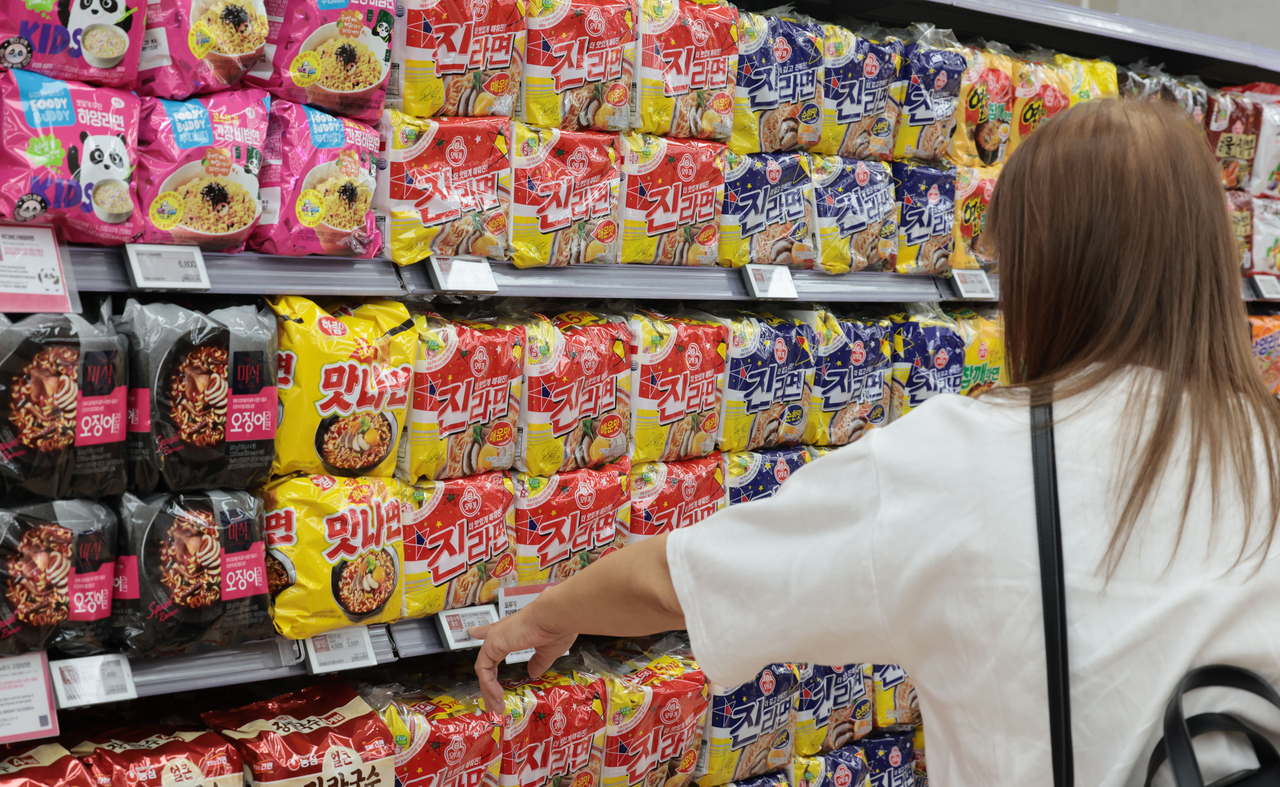
Korean food exports climbed to a record high of more than $8 billion in the first three quarters, underpinned by steady demand for instant noodles and increased shipments to the United States, data showed Tuesday.
According to data released by the Korea Customs Service, exports of Korean food products totaled $8.48 billion during the January–September period, up 8.9 percent from the same period a year earlier.
The figure marks a record high for the period, continuing a nine-year upward trajectory that began in 2016 when full-year exports reached $60.6 billion.
Processed foods accounted for the largest share of total K-Food exports at 61.3 percent, or $5.2 billion, up 6.7 percent from 2024. Instant noodles, or ramyeon, remained a key driver of the boom, making up 13.3 percent of total exports. Shipments rose 24.5 percent to $1.13 billion.
Widening overseas demand for K-Food drove gains across a range of categories. Exports of snacks rose 2 percent, while instant coffee products climbed 15.8 percent and traditional sauces gained 7.2 percent.
Seafood products, making up 27.4 percent of total K-Food exports, jumped 11.2 percent to $2.33 billion, lifted by booming sales of dried seaweed. Seaweed exports alone climbed 14 percent from a year earlier to $880 million.
Exports of livestock products recorded the fastest growth, soaring 50.3 percent to $280 million, while agricultural and forestry products also posted gains of 5.6 percent and 24.6 percent, respectively.
Korea’s top food export markets were the United States, China and Japan, which together accounted for just over half of total shipments. Exports to the US reached $1.6 billion, up 13.1 percent from a year earlier, followed by China at $1.5 billion and Japan at $1.16 billion.
Nine of the top 10 destinations were members of the Asia-Pacific Economic Cooperation, with the bloc making up 81.5 percent of total exports.
Officials anticipate global attention on Korea to further raise K-Food's profile as the country hosts the APEC Summit in Gyeongju, North Gyeongsang Province, this week, amid the expanding global influence of Korean culture. During the event, the government plans to promote Korean cuisine through 29 partner companies.
“We expect the event to generate strong publicity for K-Food,” said an official from the Korea Customs Service, adding that the agency will continue to support exporters tied to the country’s expanding K-content sector.
minmin@heraldcorp.com