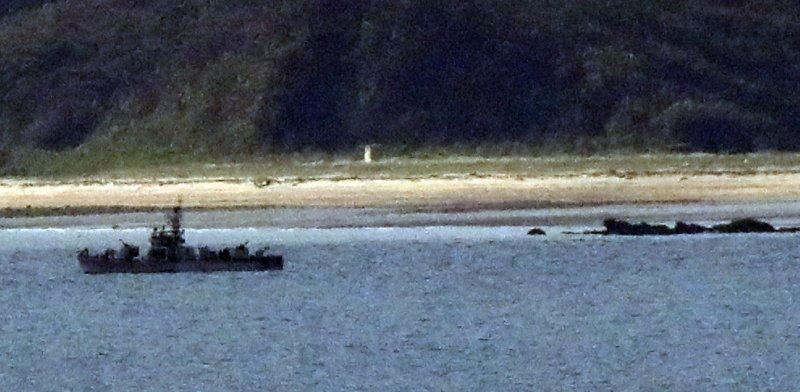
The South Korean military fired warning shots early Friday after a North Korean merchant vessel flying a Chinese national flag briefly crossed the Northern Limit Line, the de facto maritime boundary in the Yellow Sea, officials said.
According to the Joint Chiefs of Staff in Seoul, the ship sailed as far as 5 kilometers south of the NLL northwest of Baengnyeongdo at around 5 a.m. before retreating roughly an hour later. The JCS currently assesses the incursion as unintentional.
South Korean forces, which had been tracking the vessel’s movements, issued repeated warning broadcasts and eventually opened fire with 70 rounds.
The North Korean ship exited through the Maritime Control Area.
The 140-meter-long ship, identified as "Deokseong-ho," apparently attempted to evade detection by disguising itself as a Chinese vessel, a JCS official, requesting anonymity, noted.
The JCS official told reporters that shortly after the incursion, the ship changed its encoded nationality on the Automatic Identification System — an international maritime safety and tracking system — from a North Korean designation to what appeared to be that of a Chinese vessel. When South Korean patrols approached, they confirmed that the ship was flying the five-star red flag of China in place of its own ensign.
Roughly a dozen Chinese fishing boats were operating in nearby waters at the time, and the South Korean military believes the North Korean ship may have attempted to blend in with them to avoid detection.
“It is possible the vessel crossed the NLL unintentionally while altering course amid the concentration of Chinese boats,” the JCS official said, “but we will also assess the possibility of sanctions violations.”
Most foreign civilian vessels are free to transit and enjoy the right of innocent passage and free navigation in these areas — part of international waters — provided they are not engaged in illegal activity. However, any North Korean military or civilian vessel crossing south of the NLL is considered a violation under the South Korean policy.
The official also raised the possibility that the vessel may have merely attempted to avoid conflict and interaction with Chinese ships nearby. “Around a dozen Chinese fishing boats were operating near the line at the time, and the ship could have strayed across while altering its course to avoid them," the official said.
The JCS has assessed that Deokseong-ho was likely a secondhand vessel sold by China to North Korea in violation of UN Security Council sanctions. Critics say it is a reminder of the enduring links between the two countries despite international efforts to isolate Pyongyang.
The incident marked the second time since 2022 that a North Korean merchant ship has crossed the NLL, the de facto maritime border drawn at the end of the Korean War. Seoul’s military said it is still analyzing whether the latest incursion was deliberate.
At the time, the South Korean military’s 2,800-ton Cheonan frigate, which was on patrol in the area, was deployed to respond. The North Korean vessel eventually altered course westward and returned to waters under Pyongyang’s control, the military said.
No unusual troop movements were detected in North Korea following the incident.
“Our forces responded in accordance with operational procedures while maintaining full readiness to defend the NLL,” the JCS said in a statement. “We will respond firmly to any contingency.”
The Northern Limit Line, drawn by the UN Command after the 1950-53 Korean War, remains one of the most volatile maritime boundaries in the world. Pyongyang has never accepted the line, instead claiming its own “maritime military demarcation line” farther south — up to 6 kilometers below the NLL — that neither Seoul nor the international community recognizes.
The latest breach was the first since October 2022, when another North Korean merchant vessel, called the “Mupo-ho,” entered South Korean waters for about 40 minutes before being driven back by warning fire. In that case, Pyongyang accused South Korean warships of staging their own incursion.
The crossing comes at a time of heightened tension on the Korean Peninsula, as Pyongyang accelerates weapons testing and denounces joint military drills between Seoul and Washington. It also coincides with efforts by President Lee Jae Myung’s administration to revive dialogue with the North, part of a broader push to ease military confrontation and reopen channels of communication. So far, however, those overtures have been met with sharp criticism from Pyongyang, resulting in a yearslong breakdown in inter-Korean dialogue.
mkjung@heraldcorp.com