The US military’s next-generation air defense system, the Indirect Fire Protection Capability, has been deployed to US Forces Korea for the first time, a photo released through the Pentagon’s public media archive showed Thursday.
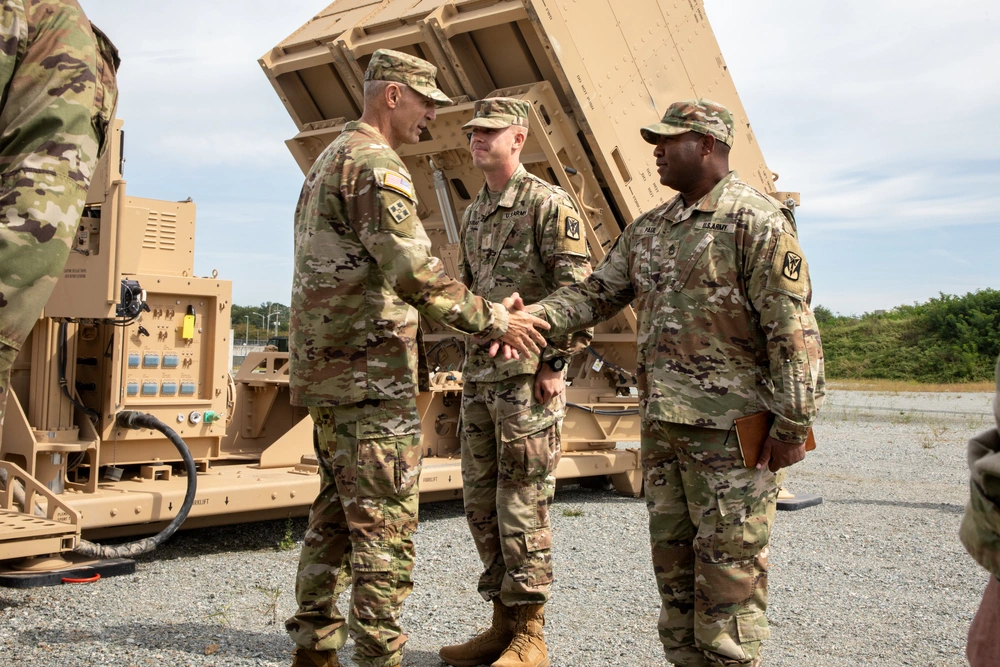
The photo shows a missile launcher identified as part of the IFPC in the background as US Army Chief of Staff Gen. Randy George shakes hands with USFK troops during his visit to Osan Air Base in Gyeonggi Province on Monday. It was uploaded to the Defense Visual Information Distribution Service on the day of his visit to the air base.
The photo caption provided by DVIDS explains that the platform in the photo is "a launcher" for an "indirect fire protection capability system at a Patriot tactical site."
This marks the first time that the weapon system, dubbed the “American Iron Dome,” has been photographed stationed at an overseas US military base. The Iron Dome is Israel’s short-range air defense system, designed to intercept and destroy incoming rockets, artillery shells, and mortars before they can hit populated areas.
The IFPC is designed to intercept a range of low-altitude threats, including drones, cruise missiles, rockets and mortars. Unlike the Patriot missile system, which focuses on higher-altitude targets, the IFPC fills a growing gap in US defenses against swarms of uncrewed aerial vehicles and surprise cruise missile attacks — capabilities that both Beijing and Pyongyang have been rapidly developing. The photo’s release comes amid the US military’s increasing emphasis on deterring threats from China.
It also comes amid a broader modernization push by US Forces Korea. In July, the Korean Air Force rotated US-made MQ-9A Reaper drones to Gwangju Air Base, and earlier this year, the US Army’s newest reconnaissance aircraft, known as Athena-R, was introduced to the peninsula. Stealth F-35 fighters have also made frequent appearances in joint exercises.
In response to The Korea Herald’s inquiry about the apparent new deployment, a USFK official, requesting anonymity, said, “We cannot fully confirm the matter due to security issues,” but added, “The latest report is aligned with the USFK’s modernization goals.”
Sharing the official’s sentiment, a USFK spokesperson responded via text message, "The US-ROK Alliance is modernizing to keep pace with a changing security environment, ensuring our combined posture credibly deters aggression from adversaries and addresses broader regional challenges.”
“United States Forces Korea, in close coordination with our Republic of Korea allies, continually adjusts its posture to maintain a robust defense against any threat — we employ a range of advanced, layered capabilities on the peninsula to uphold our ironclad commitment to the defense of the ROK and to ensure we remain ready to protect both our homelands.”
mkjung@heraldcorp.com