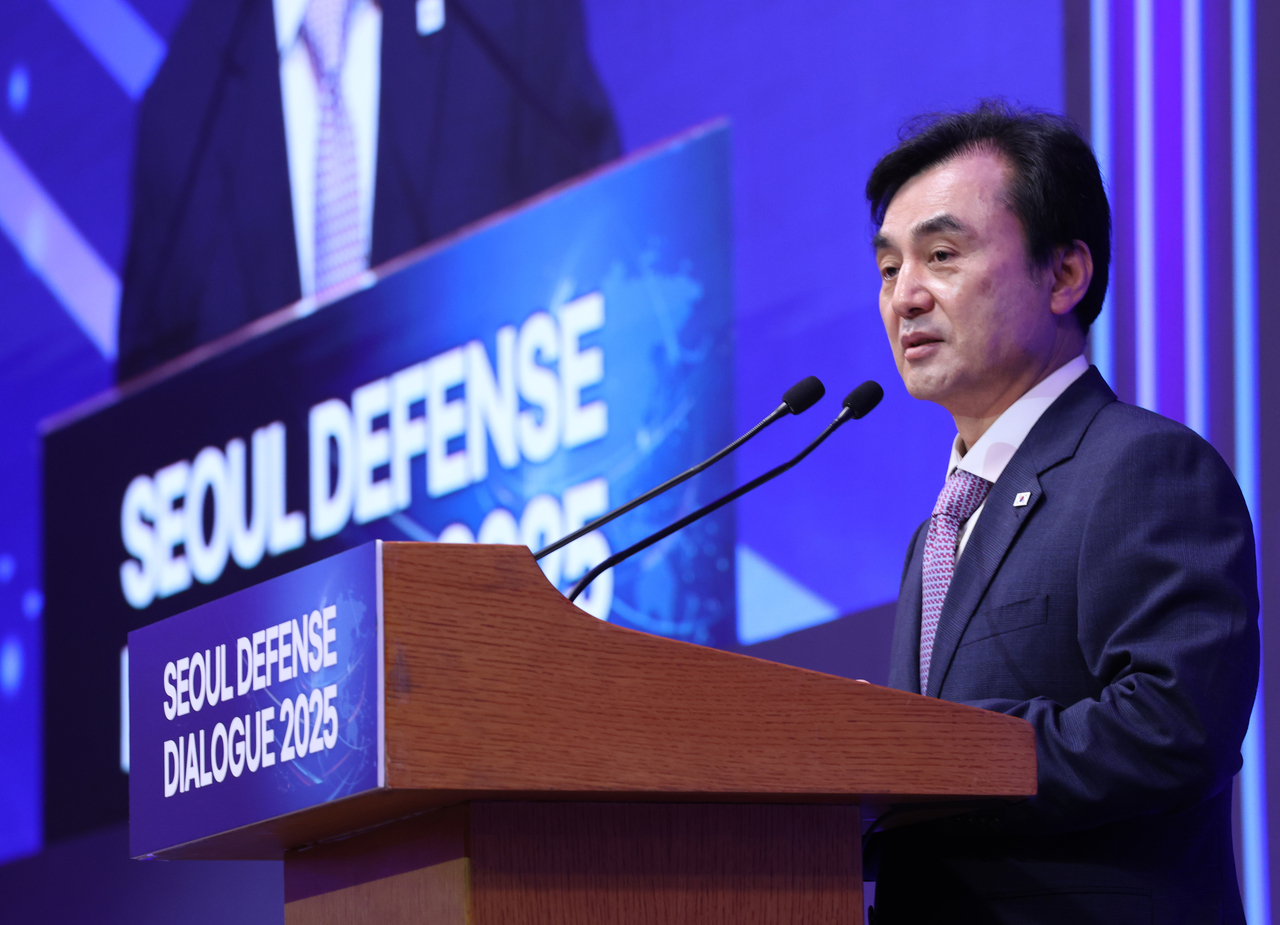
South Korea’s Defense Minister Ahn Gyu-back said Tuesday that his country will consistently pursue a “two-track approach” of strong deterrence and efforts at reviving dialogue by building cross-border trust with North Korea, as Pyongyang’s advancing nuclear and missile programs deepen regional security risks.
In his opening speech at the annual 2025 Seoul Defense Dialogue held in Seoul, Ahn warned that the accelerating development of North Korea’s arsenal represents not only a threat to stability on the Korean Peninsula and beyond, but also a serious challenge to the global nonproliferation regime.
He said South Korea would continue to fortify its defensive and response capabilities “without leaving a single gap,” while at the same time keeping the door open to talks aimed at modernizing mechanisms for reducing tensions and managing potential crises.
“Our goal is to create peace through strength and to build sustainable peace through genuine dialogue,” he said, pledging steady, practical steps to break what he called a “vicious cycle of crisis” and to open opportunities for peace.
Ahn stressed that “peace must not come by chance” and must be carefully designed, with commitments continuously reaffirmed and carried forward. South Korea seeks to reduce mutual distrust and develop practical mechanisms for managing risks through dialogue, he said.
This year’s gathering, held under the theme “Confronting Geopolitical Challenges: Building Peace Through Cooperation,” drew more than 1,000 security officials and experts from 68 countries and international organizations.
In the first dialogue session, devoted to the topic of easing geopolitical rivalries and restoring global strategic stability, senior officials from the North Atlantic Treaty Organization, the Philippines and Croatia joined in warning that North Korea’s nuclear and missile buildup has become a grave threat to international security. They called for greater solidarity in support of peace on the Korean Peninsula and beyond, while also highlighting wariness over the North’s growing military cooperation with Russia.
Adm. Giuseppe Cavo Dragone, chair of NATO’s Military Committee, cited the war in Ukraine and strengthening ties between Pyongyang and Moscow as signs of intensifying instability. He pledged to deepen cooperation with key partners in the Indo-Pacific, including South Korea.
Gilberto Teodoro, the Philippine defense secretary, pointed to mounting challenges to the rules-based international order in the Indo-Pacific and elsewhere, urging stronger engagement by international institutions to mitigate geopolitical risks.
Ivan Anusic, Croatia’s deputy prime minister and defense minister, highlighted his country’s ongoing military modernization as a NATO and EU member, while underscoring the importance of expanding cooperation with South Korea in the Indo-Pacific.
The security outlook on the Korean Peninsula has grown increasingly fraught as Pyongyang accelerates the development of its nuclear weapons and missile programs. Pyongyang’s recent displays of more sophisticated delivery systems — from solid-fuel ballistic missiles to suspected tactical nuclear warheads — have heightened concerns that its arsenal could soon overwhelm existing defenses. The North’s deepening military cooperation with Russia, including reported arms transfers for use in Ukraine, has added a new layer of complexity.
Against this backdrop, South Korean President Lee Jae Myung has sought to pair deterrence with diplomacy, pressing to fortify South Korea’s defense posture while also reopening dialogue channels with Pyongyang.
So far, the Lee administration has moved to dismantle propaganda loudspeakers along the border, ban anti-North Korea leaflet campaigns and repatriate North Korean fishers who had drifted into South Korean waters. They were all framed as gestures to reopen dialogue with Pyongyang.
The Seoul Defense Dialogue is an annual high-level multilateral security forum organized by South Korea’s Ministry of National Defense since 2012.
mkjung@heraldcorp.com