With an earlier-than-planned presidential election expected in the first half of the year -- possibly late April – the month of January is turning up the pressure on the political circle here.
Political parties and presidential aspirants are gearing up for the race, with an eye on the special investigation into the President Park Geun-hye scandal and the top court’s impeachment trial -- the results of which will determine the outlook of the election.
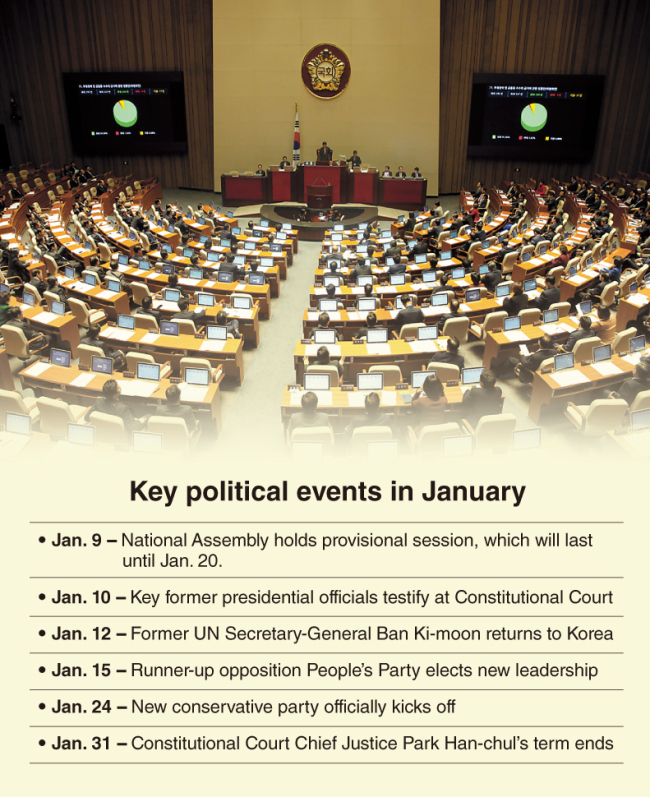
Their first hurdle is whether rival parties will reach a consensus on how to revise the Constitution during the 11-day provisional parliamentary session that starts Monday.
A special parliamentary committee is already in action, and it is generally agreed that fundamental reforms are needed for the nation’s basic law, which has remained unchanged since its last revision in 1987.
However, a key point of dispute is the timeline.
While many are calling for a swift revision before the upcoming presidential election, Moon Jae-in, the former chairman and presidential front-runner of the main opposition Democratic Party of Korea, recently signaled that he supports delaying the action to after the election.
As the constitutional revision is likely to alter the current five-year presidential term to a four-year double term, Moon’s gesture was seen by rivals as a move to maximize his presidency, if he wins the election.
There have also been calls to revise the Public Official Election Act to lower the eligible voting age from 19 to 18. The change, which could add some 620,107 liberal-leaning youths to the nation’s voting pool, is being advocated by opposition parties and the new conservative party.
But considering the lack of time and the disparity in views, political observers speculated that the provisional parliamentary session will provide barely enough time for parties to pass crucial bills related to the people’s livelihood.
Meanwhile, former UN Secretary-General and presidential hopeful Ban Ki-moon will return to his home country Thursday after serving the international organization for the past 10 years.
His upcoming return is garnering attention, as he has so far refrained from elaborating on his political plans.
Ban had formerly been considered an unrivaled figure to represent the ruling conservative Saenuri Party, especially its mainstream pro-Park faction, but with the camp now split into two, speculations are rife on his party affiliation.
Although he has made few comments on his “big picture” plan, he signaled at increasing his visibility among Korean voters. His plans tentatively include visits to Paengmok Port, which is near the site where the Sewol ferry sank in 2014, and Bongha Village, the late liberal President Roh Moo-hyun’s hometown in the southeastern part of the country.
Next up in the political calendar is the runner-up opposition People’s Party’s national convention, during which it will select a new party chief and a decision-making body. Former floor leader and interim chief Rep. Park Jie-won is considered to have an undisputed lead in the competition. The party also hopes to attract publicity and win gain some momentum through the event, before moving onto its presidential election campaign.
One of the top challenges for the People’s Party is the imminent launch of a new conservative party consisting of reformists split from Saenuri. Tentatively named the “Right Party,” the new entity will officially launch on Jan. 24.
The party, which currently has 30 former Saenuri lawmakers, is expected to attract more members after its kickoff, especially if Ban decides to join the group.
Its initial goal is to outrun the People’s Party -- which has 38 seats in the National Assembly -- to become the second-largest opposition party, behind the Democratic Party, which has 121 seats.
Meanwhile, political parties and potential presidential candidates remain tense on whether the Constitutional Court will hand approve President Park’s impeachment by January.
Though an impeachment trial usually takes two months or longer, there have been predictions that the court may rush the process so as to confirm its stance before current Chief Justice Park Han-chul retires on Jan. 31. The top justice’s retirement is expected to lead to disputes, including the problem of naming his successor during President Park’s suspension from power.
Bae Hyun-jung ()
koreaherald@heraldcorp.com











