Rising from second-in-command to acting president, Prime Minister Hwang Kyo-ahn has experienced a dramatic political upturn this year. This all in stark contrast to suspended President Park Geun-hye and a number of her key aides who are currently facing investigation over corruption allegations.
The practical state affairs leader is now also being counted as a plausible presidential hopeful for the ruling Saenuri Party -- a rumor’s made no effort to fully quash.
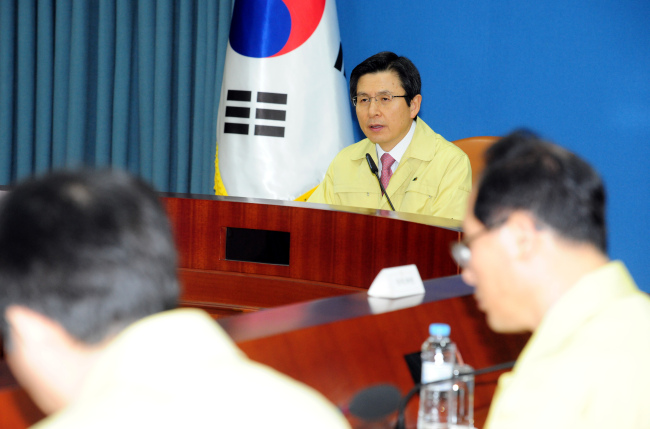
“We have to expand on the ‘one strike and you’re out’ system (concerning food) against those who misrepresent distribution dates or sell nonconforming products, so as to fundamentally prevent all unqualified sellers from setting foot back in the market,” Hwang said Friday at a ministerial Cabinet meeting on food safety measures, gesturing at taking an active stance on the issue.
He also chaired a public-private joint task force on responding to the bird flu virus sweeping through farms.
His assertive tone over his presidential role during these key meetings was also reflected in a recent talk with reporters, where he refrained from denying a potential bid in the forthcoming presidential race.
“I have already told you everything,” the prime minister said repeatedly during a luncheon with reporters Thursday, when asked in various formats whether or not he would run in the earlier-than-planned presidential election next year.
Even when asked a clear-cut question, he did not rule out running for president.
“I will do my best in serving my current post, and once it is done, I will then make efforts for the future,” he said.
Since taking office as prime minister in June 2015, Hwang has officially presided as the No. 2 chief official in the Cabinet, standing next in line to President Park Geun-hye.
Despite his position, however, Hwang has mostly been seen as an administrative assistant to the president, partly because of South Korea’s powerful president-centered governance structure and partly because of Hwang’s rigid character.
He even came close to resigning when President Park suddenly tapped former liberal presidential aide Kim Byung-joon to be prime minister, as part of her effort to pacify the political turbulence following the outbreak of the extensive corruption scandal whirling around her confidante Choi Soon-sil.
Hwang, who was given notice at the last minute reportedly via text message, immediately offered to resign, but soon withdrew his offer, as Kim’s appointment was thwarted upon opposition backlash.
It was the president‘s impeachment on Dec. 9 that brought the overshadowed prime minister to the center of the stage. Upon the legislature’s passage of the impeachment resolution and the consequent suspension of Park‘s powers, Hwang became the ninth acting president in the nation‘s history, as well as the second to temporarily replace an impeached state chief.
With a reinforced range of authority, Hwang also rose as a likely presidential choice for the ruling Saenuri Party. The conservative camp currently has few options, due to the mass defection of reformist members and the consequent estrangement of Ban Ki-moon, who was set to finish his final term as UN secretary-general on Dec. 31.
koreaherald@heraldcorp.com











