Prime Minister Hwang Kyo-ahn seems to have benefited the most from President Park Geun-hye’s impeachment, suddenly rising from outgoing premier to acting president -- and a possible conservative candidate in the next presidential election.
The opposition had hoped that Hwang would play a minimal role as acting president, acting only to prevent critical vacuum in state affairs. But his recent actions have indicated a significant degree of political ambition.
Opposition parties on Thursday urged Hwang to participate in next week’s parliamentary interpellation.
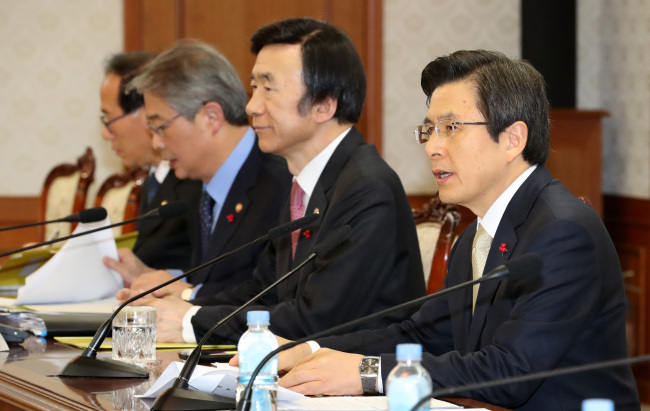
“The prime minister may be acting as the presidential authority but is not a properly elected leader of the people, and should fulfill his duty to the legislature,” said Rep. Yun Ho-jung, chief policymaker of the main opposition Democratic Party of Korea.
Senior Presidential Secretary for Political Affairs Hur Won-je had on the previous day spoken for Hwang, saying that he finds it “uncomfortable” attending the parliamentary session as acting president.
Also, Hwang had paid a visit to Assembly Speaker Chung Sye-kyun in the afternoon but made no mention of attending the interpellation.
“Hwang should regard himself as a supervisor to respond to crisis and to clean up the old evils of the Park Geun-hye administration, not as a pioneer of an upcoming new era,” said Rep. Park Jie-won of the opposition People’s Party.
“He should show himself at the parliament as prime minister and explain to lawmakers and the people the political road map lying ahead, should the Constitutional Court uphold Park’s impeachment.”
In contrast to his passive stance toward the interpellation, Hwang has been making bold moves in state affairs.
On Thursday, the acting president suggested holding individual meetings with each of the opposition parties. This was a counter proposal to the parties’ earlier suggestion for a four-party roundtable involving the three opposition party chiefs and Hwang.
The prime minister argued that one-on-one meetings would be more efficient, considering the lack of time and the urgency of matters at hand. But his move was largely taken as a gesture to seize political initiative from the opposition parties.
The Democratic Party of Korea, along with the progressive minority Justice Party, immediately hit back, blaming the acting president for politicking for his own interests.
“Under the current acting president system, key state affairs discussion should be made in an open roundtable, not in individual close-door meetings,” said Rep. Yun Kwan-seok, chief spokesperson of the Democratic Party.
“Hwang has gone overboard in pursing his political interests amid this national crisis.”
Justice Party’s spokesperson Han Chang-min argued that Hwang’s effective refusal to sit with all opposition leaders was his attempt to break down the opposition unity that was formed during the weeks running up to the legislature’s impeachment of Park.
The People’s Party’s emergency council chief Rep. Kim Dong-cheol, on the other hand, agreed to Hwang’s suggestion, saying there was a need for communication over key issues such as the avian influenza outbreak and the US key rate hike.
Despite warnings from the opposition, the prime minister alluded that he would not tone down his actions, heralding political tension over the upcoming months.
“Until recently, I followed the precedent of Goh Kun, but considering the set of unexampled situations lying ahead, I am not quite sure how to act,” he said.
“When faced by unprecedented circumstances, I believe I should focus on the nation’s interests and create new precedents.”
His remarks indicated that he would not remain the passive interim leader that Goh was when he acted for the impeached President Roh Moo-hyun in 2004, and that he would take control of state affairs.
Hwang’s ambitious attitude rekindled public calls that he, as a loyalist to the Park administration, should be ousted along with the suspended president.
The alliance of civic groups calling for Park’s ouster vowed Thursday to add Hwang’s ouster to their slogans at the Saturday rallies.
“We will firmly demand for the resignation of Hwang, who has risen as the new power to represent Park in her absence,” the group said at a press conference.
Prime Minister Hwang had earlier offered his resignation, following President Park’s appointment of Kim Byong-joon for the job. But facing controversies over Kim taking office, Hwang went back on his decision and retained his position.
By Bae Hyun-jung ()
koreaherald@heraldcorp.com











