The leaders of South Korea and Kazakhstan on Thursday urged North Korea to stop its nuclear program and all other provocative acts, as they agreed to closely work together toward the communist state's denuclearization.
In a joint declaration issued after their summit in Seoul, President Park Geun-hye and her Kazakh counterpart Nursultan Nazarbayev also expressed "serious concerns" over the woeful human rights situation in the reclusive state.
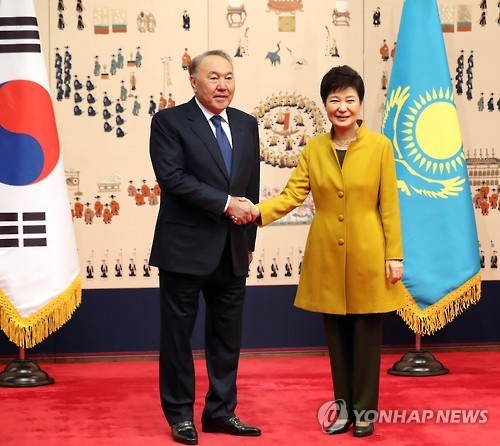
"The two sides strongly urged North Korea to abandon all activities of its nuclear program in a complete, verifiable and irreversible manner in line with U.N. Security Council resolutions, and to immediately halt provocations," the joint statement read.
The statement also noted that the two sides shared the understanding that Pyongyang's "extremely irresponsible" acts have negatively affected the international nonproliferation regime, posed a serious threat to peace and security in the region and the world, and undermined the world's efforts to secure a future without nuclear arms.
Nazarbayev, who has led his country since 1991, began his three-day state visit to South Korea on Wednesday. Over the last 25 years, the Kazakh leader has championed the cause of denuclearization in the Central Asia and throughout the world.
Aside from security issues, the two sides also agreed to expand bilateral cooperation in the economic realm.
The partners shared the view that a free trade agreement between South Korea and the Eurasian Economic Union will contribute to expanding investment, trade and economic cooperation between their countries.
In particular, Kazakhstan, this year's EAEU chair, pledged to make active efforts to open FTA negotiations between South Korea and the customs union that consists of Russia, Belarus, Kazakhstan, Armenia and Kyrgyzstan.
Seoul has been pushing to clinch a free trade deal with the union that has a combined population of 180 million with its gross domestic product reaching $1.6 trillion.
During the summit, the two sides also touched on the possibility of linking South Korea's Eurasia Initiative to Kazakhstan's Nurly Zhol plan, and agreed to build bilateral cooperation in carrying out the Central Asian country's various infrastructure development projects.
The Eurasia Initiative seeks to bring countries in the Eurasian continent closer together through increased railway and other infrastructure links. The Nurly Zhol plan is an economic stimulus package to develop roads, railways and ports in Kazakhstan.
On the occasion of the summit, the two sides signed a total of
10 memorandums of understanding over strengthening economic cooperation. The leaders oversaw the signing of two MOUs on cooperation in traffic, logistics, trade and investment.
Last year, two-way trade reached $760 million with South Korea exporting cars, synthetic resins, electronic goods and other items to Kazakhstan and importing such goods as crude oil, ferroalloys and uranium. (Yonhap)











