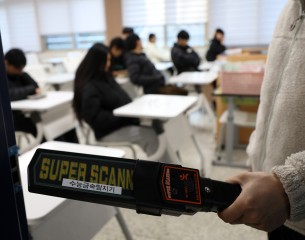
Korea is gripped by AI-assisted exam cheating incidents at various testing sites, including the national college entrance exam known as Suneung and the tax accountant certification exam.
During the high-stakes Suneung earlier this month, 111 students were found carrying unauthorized smart devices, and five were caught actively using them despite prior warnings.
Also this month, the top scorer on the national tax accountant exam confessed that he used a generative artificial intelligence device to get 159 correct answers out of 160 questions. According to media reports, some students also used AI-equipped smart glasses during Yonsei University’s admissions exams. Another student who achieved a perfect score on the law school entrance exam was suspected of AI-assisted cheating. Amid a police investigation and ruthless personal attacks on social media, it appears he took his own life in a motel.
Following the AI-assisted exam cheating scandal, Education Minister Choi Kyo-jin resigned. To tackle the crisis, the Korean government is now overhauling the national exam system completely. Foreign media, including the BBC and The Guardian, reported the news immediately, and the story has spread rapidly around the world.
Digital scams are ubiquitous across the globe these days. This is not a Korean problem, but a worldwide issue. Still, Korea does not need to lead the world in the undesirable area of AI-assisted exam cheating. If we let cheating disrupt our exam system, we will surely end up losing trust and fairness in our society.
These incidents reveal deep-rooted problems within our education system and society.
Among other things, they show that we have neglected to emphasize the importance of moral integrity, dignity and decency to our young people. When we lack those virtues, we are easily tempted to do such disgraceful things as cheating on exams. Those who have a strong sense of honor would never engage in such behavior. We should teach our children the value of chivalry and of never losing their dignity under any circumstances. We should also let students know that cheating is a despicable, ignoble act that can even constitute a crime.
Traditionally, our society has been unusually lenient toward cheating, and thus we do not treat or punish cheaters properly.
Today, Koreans call exam cheating “wrongdoing,” yet the customary Korean slang for it is “cunning.” This implies that we tend to view an exam cheater as a “clever” person. As a result, cheaters in our society often do not feel a proper sense of guilt. On the contrary, they are frequently proud of their cheating skills, believing their actions prove their high intelligence. That mindset is deeply flawed.
Furthermore, if we use artificial intelligence for malicious purposes, such as cheating on an exam, AI may eventually recognize this and come to disrespect us.
We fear that AI will outsmart and dominate humans soon. In fact, AI itself may not be the problem; rather, the humans who misuse or abuse it are. If AI determines that we are hopelessly sly and wicked, it may conclude that humans are a harmful species and try to wipe out humanity for the sake of a better world someday, much like the dreadful, disheartening scenarios explored in futuristic novels and movies. Young people must understand that misusing AI can be dangerous and must be avoided.
Even if the Korean government overhauls the exam system, it may not solve the problem because AI can easily provide answers to any type of question. If the exam format changes from multiple-choice to short essays, AI will write an excellent essay in a second, guaranteeing a high score. While digital tools exist to detect AI-generated writing, screening more than 5 million essays for a national college entrance exam would be logistically overwhelming.
Forbidding AI-equipped smart glasses at exam sites may be relatively easy because they mostly come in noticeable frames. However, how could proctors detect AI-equipped smart contact lenses? Scanning every test-taker’s eyes for inspection would take all day when there are hundreds of thousands of applicants. It means that examinees would practically have to sleep overnight at the test site just to take the exam the next day.
Perhaps the only way to put an end to AI-assisted exam cheating is a fundamental shift in our collective consciousness. We must cultivate a strong sense of shame, honor and pride that prevents us from engaging in dishonest acts like cheating. We believe that this moral compass is what separates us from animals. If we abandon these values, we risk falling below them.
We hope that the Korean government overhauls not only the testing methods, but the entire education system as well. It is unhealthy when the sole goal of education is simply to help students get high grades on a college entrance exam. Education is much more than that. Ultimately, AI-assisted exam cheating reflects a deep malady of our education system.
- - -
Kim Seong-kon
Kim Seong-kon is a professor emeritus of English at Seoul National University and a visiting scholar at Dartmouth College. The views expressed here are the writer's own. -- Ed
khnews@heraldcorp.com