US Marine Corps F-35B stealth fighters stationed in Japan were temporarily deployed to South Korea during a major US-Japan military exercise last month, fanning speculation that US bases in South Korea could be used to support operations involving China.
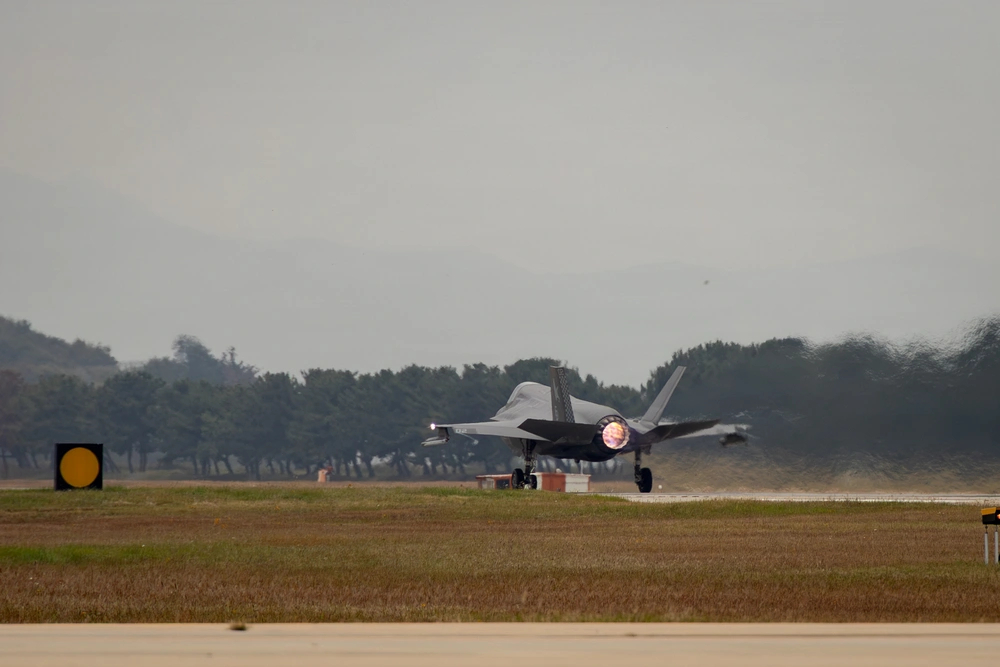
According to the US Defense Visual Information Distribution Service, F-35B Lightning II fighters assigned to Marine Fighter Attack Squadron 533, under Marine Aircraft Group 12 of the 1st Marine Aircraft Wing, conducted flight operations at Kunsan Air Base in Gunsan, North Jeolla Province, in October.
Kunsan Air Base is a collocated operating base shared by the South Korean and US air forces, hosting the South Korean Air Force's 38th Fighter Group and the US Air Force's 8th Fighter Wing.
The deployment overlapped with Keen Sword, a biennial US-Japan military exercise held Oct. 19-29, involving approximately 45,000 Japanese Self-Defense Forces personnel and 12,000 US troops.
Keen Sword is designed to strengthen interoperability and combat readiness between US and Japanese forces in responding to regional security contingencies.
The exercise has drawn increasing attention amid tensions over Taiwan and Washington's efforts to strengthen military cooperation with regional allies in response to China's growing military influence.
According to reports, this year's drills included the deployment of US Marine Corps anti-ship missile systems to Japan's Yonaguni Island, approximately 110 kilometers from Taiwan, highlighting the exercise's focus on potential regional conflicts.
Marine Fighter Attack Squadron 533, headquartered at Marine Corps Air Station Beaufort in South Carolina, was rotationally deployed to Marine Corps Air Station Iwakuni in Japan in September.
The squadron also participated in Freedom Flag, a South Korea-US combined aerial exercise held from Oct. 26 to Nov. 6, demonstrating its ability to operate across different allied training environments.
Washington has increasingly emphasized strategic flexibility, which would allow US forces stationed in allied countries to be repositioned across the region in response to broader security threats.
For Seoul, the concern is that US military installations in South Korea could potentially support operations involving China, particularly in a Taiwan-related contingency, even without the direct participation of South Korean forces.
South Korean troops did not participate in Keen Sword, with the Defense Ministry saying Japan had not invited the South Korean military to join the exercise.
US Forces Korea, meanwhile, described the deployment as part of routine military operations rather than an activity directly linked to Keen Sword.
"US units based in Japan routinely train at US installations in Korea, and US units based in Korea routinely train in Japan and around the region," USFK said.
"These rotations are part of normal US force posture in the region and are not tied to a single exercise," it added.
USFK declined to comment on specific unit missions or flight schedules.
flylikekite@heraldcorp.com