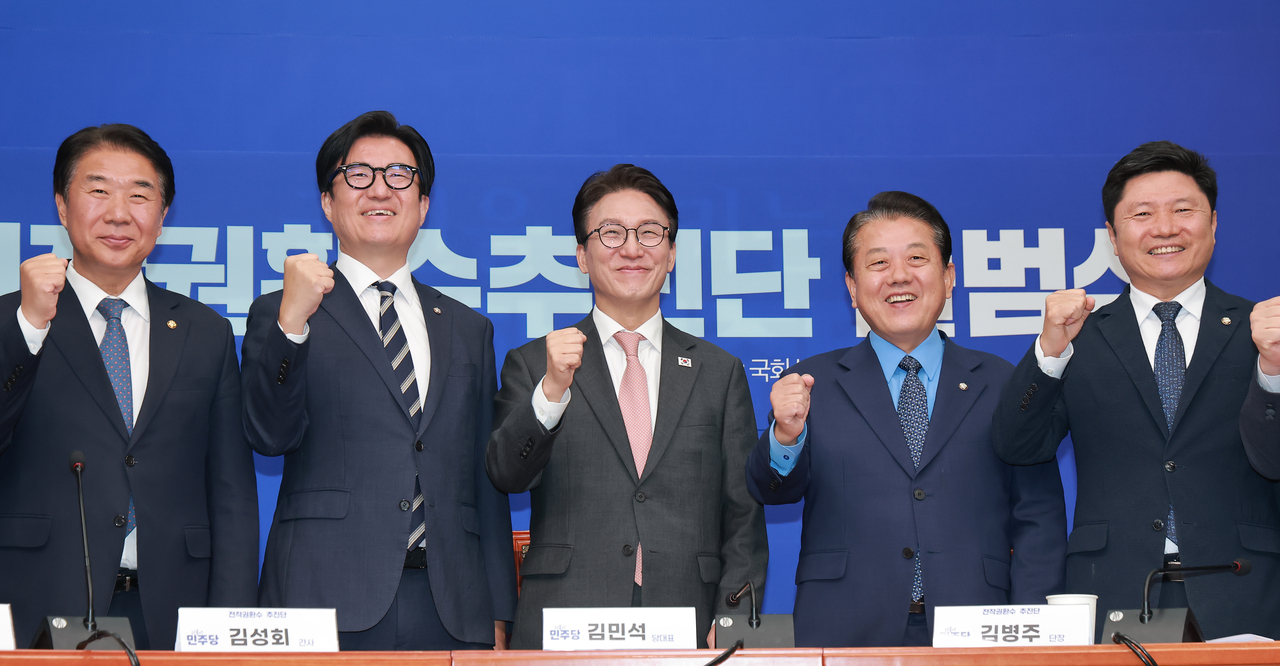
Rep. Kim Min-seok, chair of the ruling Democratic Party of Korea, said Tuesday the existing framework for transferring wartime operational control of South Korean forces from the United States should remain in place, pushing back against recent remarks by the US Forces Korea commander about changing the process.
“The broad framework for the return of wartime operational control has already been established, taking into account changes in the security environment, the strengthening of our military capabilities, and the South Korea-US alliance,” Kim said during an appearance on the party’s YouTube channel.
“As we are moving toward its return by meeting the conditions and strengthening our capabilities, there is no particular reason to change something further simply because the security environment has changed,” he said.
His remarks come as the ruling party steps up efforts to support the OPCON transfer. On Sept. 22, the party launched a task force dedicated to the return of wartime operational control, led by Rep. Kim Byung-joo, a retired four-star general who previously served as deputy commander of the South Korea-US Combined Forces Command.
The move is in line with President Lee Jae Myung’s push to regain wartime operational control, which he aims to achieve before his term ends in 2030.
Earlier Monday, Lee told reporters that South Korea should “swiftly” regain wartime operational control, saying “regaining” or “restoring” would be more appropriate terms than "transferring."
“One of the core components of sovereignty is military sovereignty,” Lee said. “To possess the minimum requirements of a sovereign state, I believe we must swiftly get it back.”
Lee also pointed to South Korea’s military strength and defense spending, saying the country has sufficient capabilities to take greater responsibility for its own defense.
South Korea handed operational control of its forces to the US-led United Nations Command during the 1950-53 Korean War. Seoul regained peacetime operational control in 1994, while wartime operational control remains with the South Korea-US Combined Forces Command, currently headed by a US four-star general.
The allies agreed in 2014 to pursue a conditions-based OPCON transition and established the Conditions-based OPCON Transition Plan, or COTP, the following year.
The framework requires South Korea to demonstrate its ability to lead a combined defense, the allies’ ability to respond to North Korea’s nuclear and missile threats, and a security environment conducive to a stable transfer.
The renewed debate comes after Gen. Xavier Brunson, commander of US Forces Korea and the Combined Forces Command, said last week that conditions surrounding the planned transfer had changed.
“Our conditions have changed, and because we have changed our plans, we have new standards which we have to uphold,” Brunson said during a seminar in Washington on Oct. 14.
Brunson did not specify what the new standards would entail, raising questions over whether Washington could seek additional requirements beyond those already agreed under the COTP.
The US Department of Defense on Monday said the OPCON transfer remains a conditions-based process agreed upon by both countries.
Some experts, however, say changes in the military environment could affect how South Korea’s capabilities are assessed even if the overall framework remains intact.
Shin Beom-chul, a senior research fellow at the Sejong Institute and a former vice defense minister, said Brunson appears to believe South Korea needs stronger capabilities in response to an increased threat from North Korea.
“The North Korean threat has intensified, so Brunson’s view is that South Korea needs to further strengthen its capabilities,” Shin said.
Yang Uk, a research fellow at the Asan Institute for Policy Studies, said Seoul may not yet have a clear understanding of Washington’s expectations.
“It appears that we do not even accurately understand the conditions the US side wants,” Yang said.
flylikekite@heraldcorp.com