In 'Bird,' actors Isabelle Huppert and Lee Hye-young use little more than their voices to evoke trauma of historical violence and silences that followed
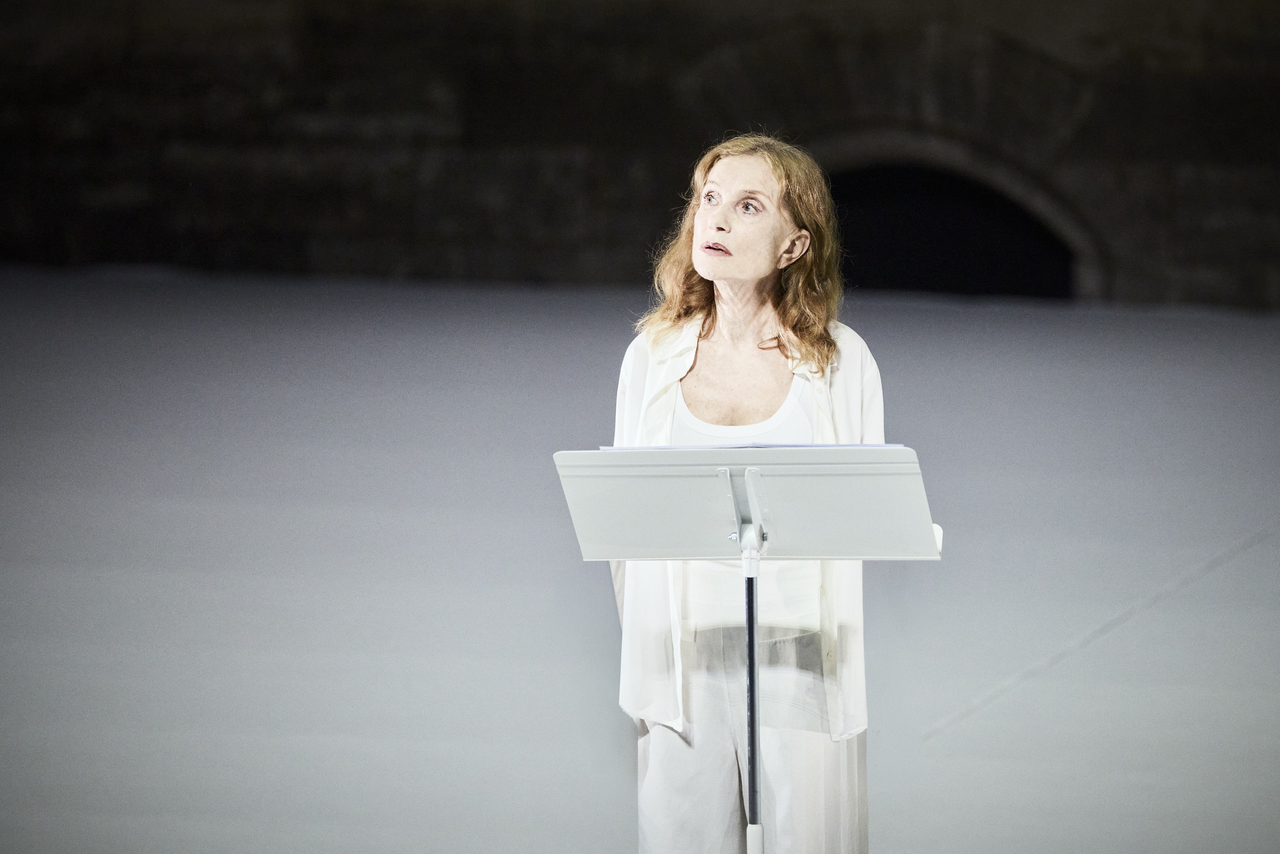
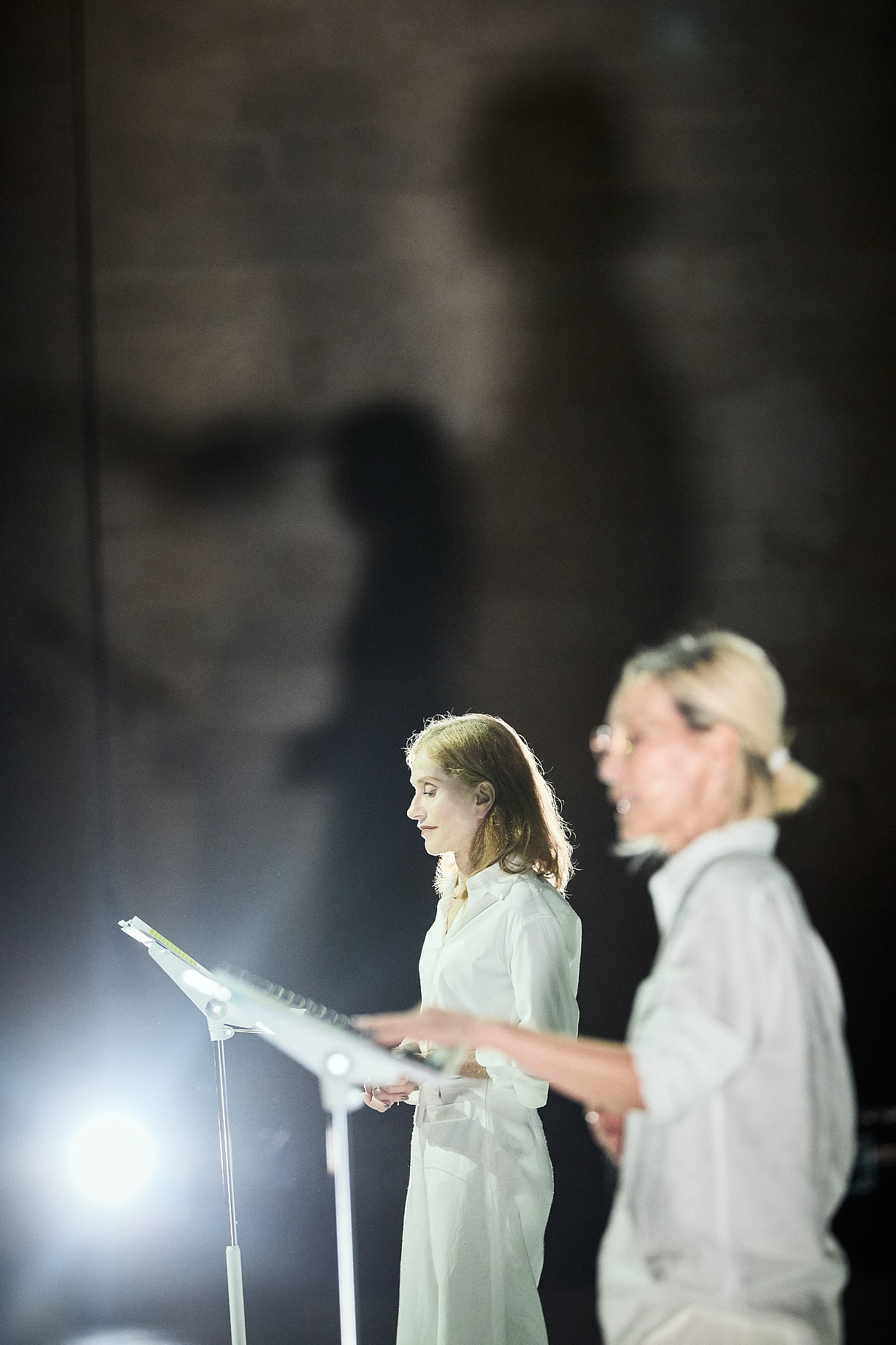
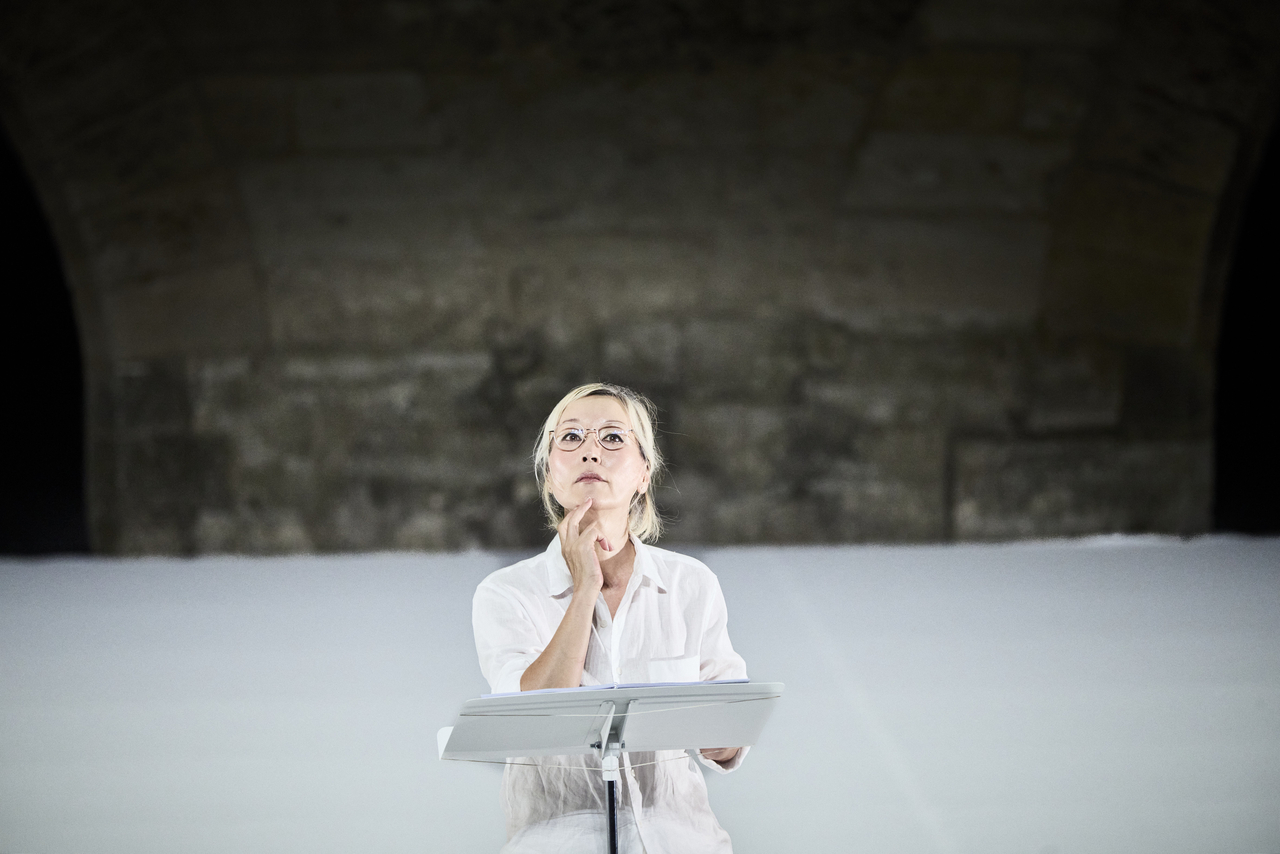
Against a white wall, two actors also dressed in white take their places onstage.
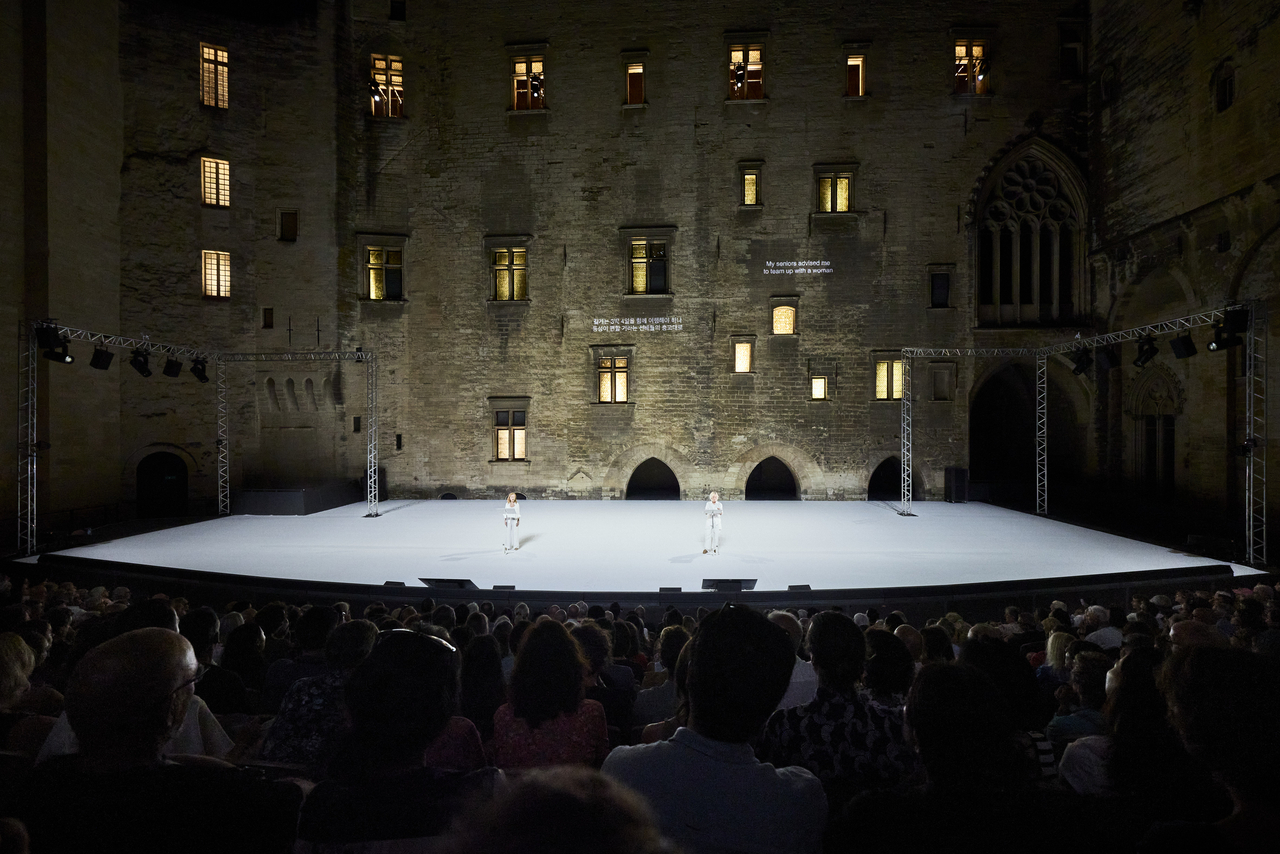
The stage is almost unnervingly bare. A vast sheet of white fabric covers the floor and walls; the music stands and water bottles are white, too. Little suggests a world beyond the stage itself. Only midway through the performance does snow descend from above, adding yet another layer of white to the scene.
In this near-empty space, Isabelle Huppert speaks in French and Lee Hye-young in Korean, their voices carrying an adaptation of Han Kang's novel "We Do Not Part." With color and spectacle stripped away, the performance rests on the rhythms of Han's prose, the weight of each pause and the quiet force of two voices recalling a historical tragedy.
Over 110 minutes, "Bird," a staged reading of the novel's opening chapter, unfolds like a book laid open on a blank page. History does not arrive all at once. It gathers slowly, in the spaces between sentences, in silences that linger just long enough to become their own kind of speech, and in words delivered with startling intensity.
The production, which premiered at the Festival d'Avignon in France in July, concluded its Korean run on Oct. 11 at Mary Hall at Sogang University in Seoul. Presented as part of the Seoul Performing Arts Festival, it had two performances, on Oct. 10 and 11.
Keeping the past alive
Speaking to reporters after the first performance on Oct. 10, Huppert said that translating Han’s prose into a theatrical reading required a particular kind of attention.
"The language of literature and the language of theater are different," Huppert said. "Han (Kang)’s sentences have a distinctive quality, and bringing them to life through a reading meant paying close attention to how they would sound when spoken aloud."
Han's writing, she added, has a power that transcends the place where it is performed.
"Han’s text is so powerful. Wherever you perform it, it never loses that power. It reaches the audience with a different kind of intensity.”
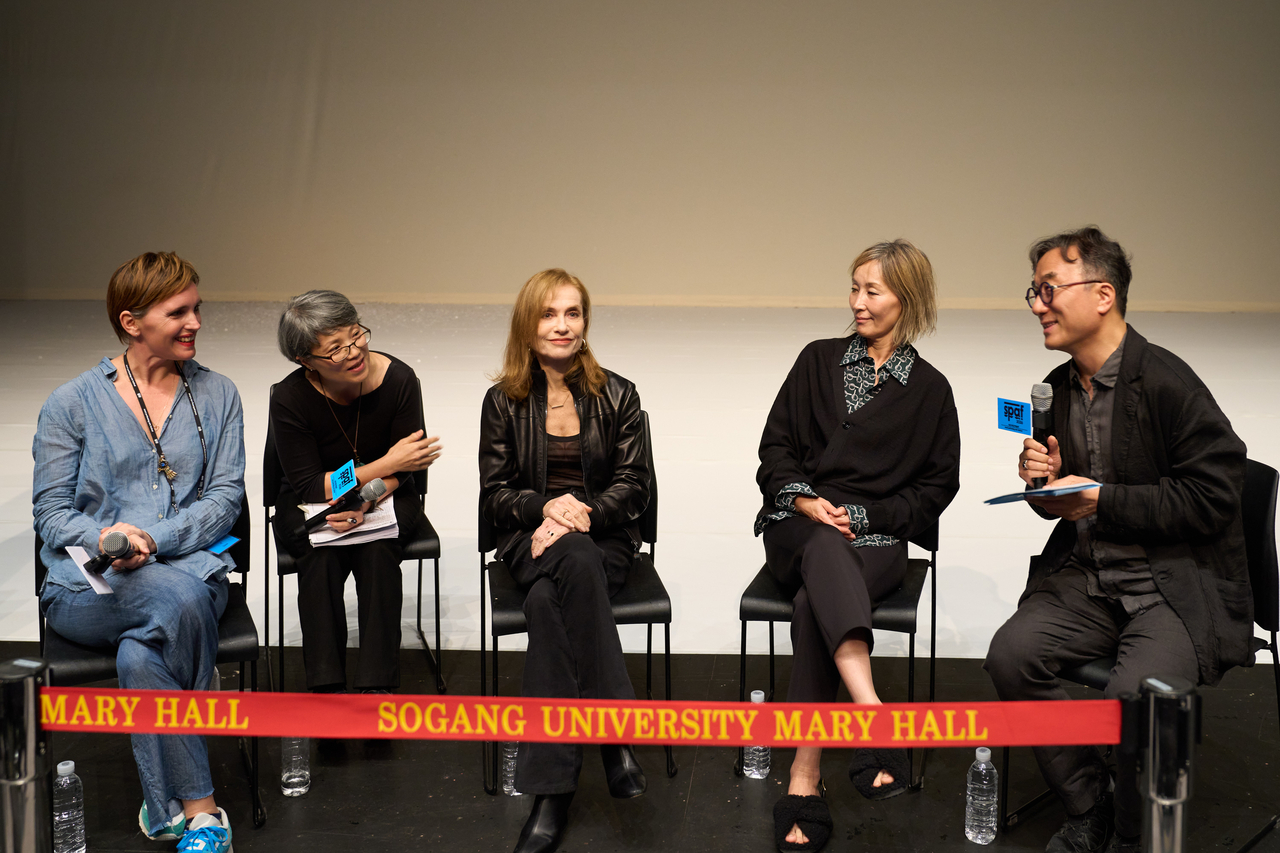
Performing in Korea, where the historical events took place, made the experience all the more meaningful, Huppert said.
"I knew nothing about this tragic chapter of Korean history before," she said of the Jeju April 3 incidents. "Through a writer's work, we can discover more dimensions of history."
A work of art, she added, may tell the story of a particular people or nation while also conveying truths that resonate far beyond its borders.
"The significance of such works lies in their ability to bring suppressed histories into view and make them accessible to audiences who might otherwise know little about them."
The production was directed by Julie Deliquet, a French theater director who has adapted works including "The Unwomanly Face of War" by Nobel laureate Svetlana Alexievich. Before turning to the story of a massacre, she wanted audiences to encounter the characters' vulnerability and their connection to one another.
"I wanted to stage that vulnerability with the simplest means possible and with humility."
That intention shaped the production's visual austerity. Rather than relying on LED screens or artificial snow as a theatrical effect, Deliquet sought to make room for the text, the performers and the silences between them.
"I thought about the silence a community had to live with for decades after experiencing something horrific. It made me wonder how literature and art can approach things that history has failed to address, or that people have not dared to speak about."
For Deliquet, that is one of art's essential roles: to bring overlooked histories into view and allow audiences to encounter the people behind them. Artists have a responsibility to keep a dialogue going.
"One of the joys and strengths of being an artist is discovering, through literature, tragedies that history has failed to address," she said. "And then, we can come face to face with vulnerability and humanity."
A new voice for the Korean stage
The Korean performances differed from the Avignon premiere in both scale and setting. In Avignon, "Bird" was staged outdoors at the Palais des Papes before an audience of about 2,000. In Seoul, it was performed indoors in a theater that seats around 500.
The more intimate setting changed the dynamic between the performers and the audience, Huppert said.
"I think being indoors made us listen to one another more closely and feel more focused than we did in Avignon," she said. "It also felt as though we were closer to the audience."
Lee, too, found the Seoul performances more intimate.
"People say that the audience completes a performance," she said. "Today, I could really feel how closely the Korean audience was following my lines, which they could understand directly. It was a different kind of good performance from the one in Avignon."
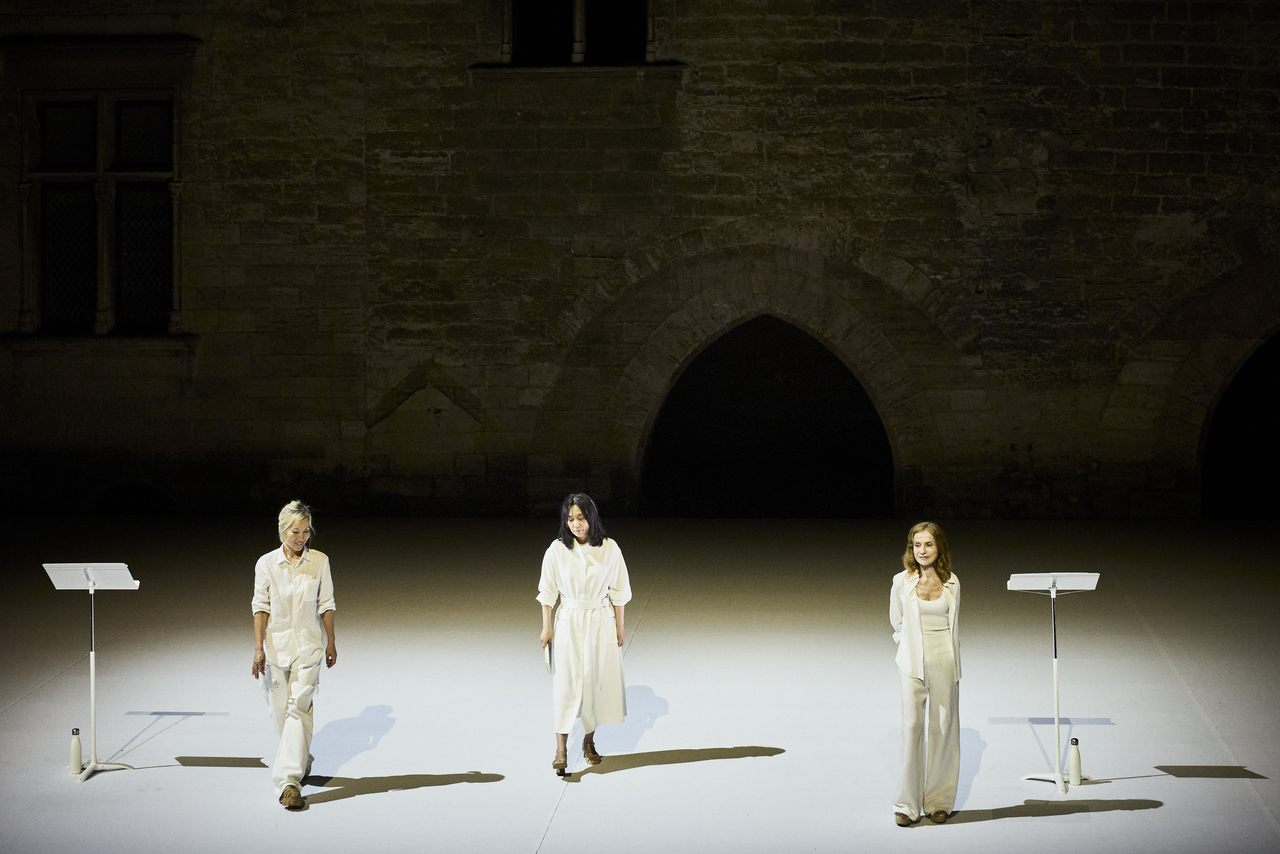
The Seoul production also introduced a new voice in its final moments.
In the closing passage, which turns to the Jeju April 3 incidents and their victims, 15-year-old Hwang Ju-hyeon joined Huppert and Lee as a third reader. She read a passage from "Flame," the novel's final chapter. At Avignon, Han herself had made a surprise appearance to read the same passage.
Deliquet said Han's appearance in France had been intended to bring the audience out of the realm of dreams and memories and back to reality. For the Seoul performances, she considered how to create a similar shift.
"I wondered how we could stop time and bring the audience back to reality," she said. "Then I thought about entrusting that role to someone from the younger generation."
Deliquet said she had heard that it took many years for the Jeju April 3 incidents to be included in Korean school textbooks. Having a young person read the closing passage, she hoped, would help introduce the history to a generation that will carry it forward.
"I hope that having a young person from the generation that will shape the future read this text will help them learn about the history."
hwangdh@heraldcorp.com